Planning For The Unknown
Testo in italiano al seguente link
How do we prepare today for a desirable future when the context of that future remains fundamentally unknown? Which key competencies must we promote and develop now in order to address the shifting short- and long-term challenges within our collective living environment?
The intellectual engagement with the future is by no means a new subject. What is new, however, is the intensity with which uncertainty, acceleration, and the overlapping of various crises now define the everyday reality of the planning professions. Within the SIA Foresight Group, which has been examining these themes since 2023, it has become increasingly clear that we are not dealing with a binary of right or wrong. The future cannot be predicted; it can only be understood, modelled, and – within the realm of the possible – influenced.
The point of departure for these reflections lies in observations drawn from practice: hypotheses nourished by experience, research, interdisciplinary exchange, and intuition. They serve as a provocation to question our own notions of «normality» and to make ambiguities visible rather than attempting to avoid them. The objective is not to find certainty, but to provide orientation – facilitated by a deeper understanding of those factors that drive systemic change. In this sense, we are rewriting the narrative of the future.
The authors speak from the front lines of practice. Their perspective does not claim a primary status of scientific evidence, but functions as an invitation to a researchoriented audience to take practitioner knowledge seriously as a complementary source of insight – especially where it concerns anticipating the unforeseen and navigating uncertainty with professional confidence.
Which future are we discussing?
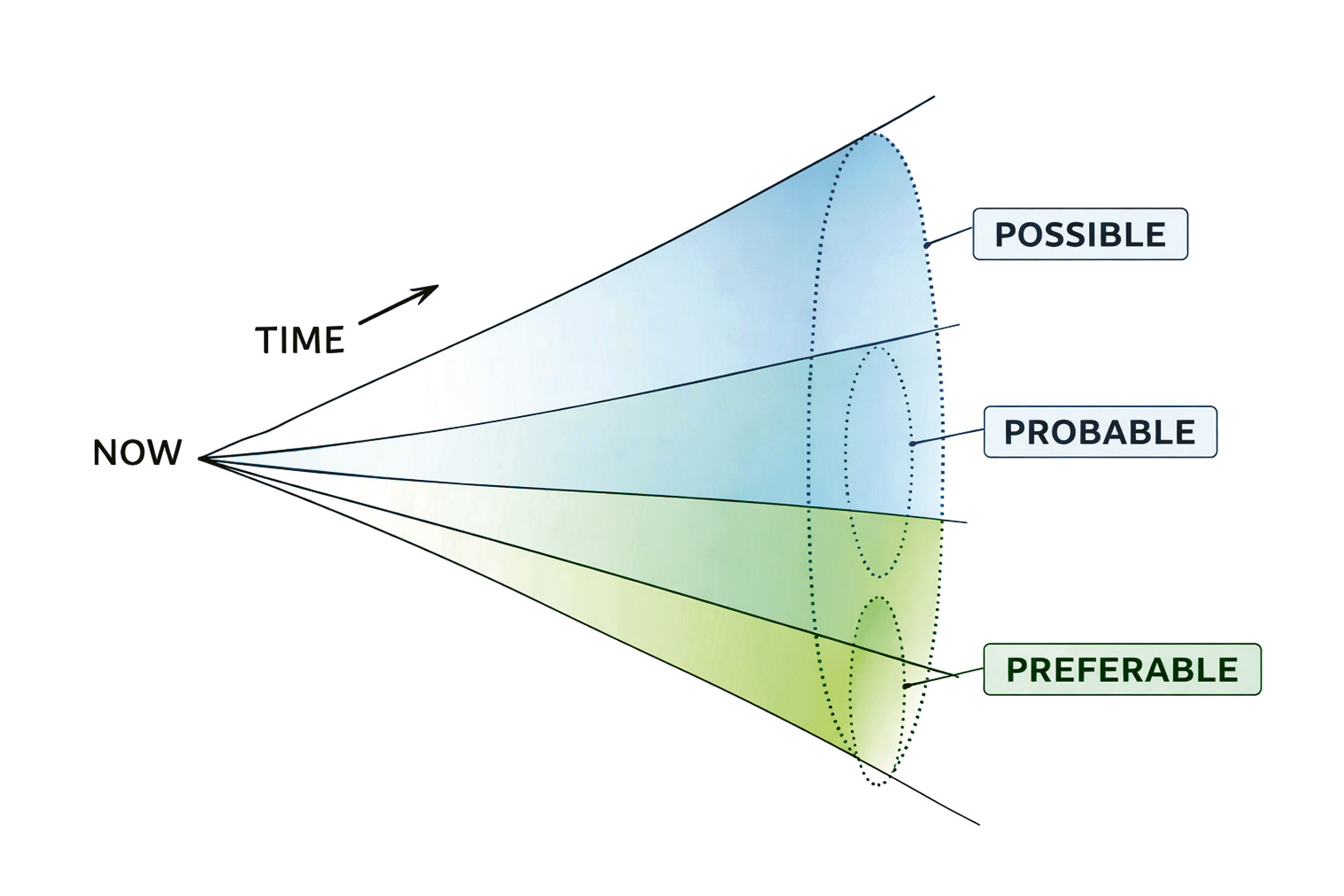
The future is frequently conceptualized through the lens of scenarios, designed to help us prepare should a specific developmental path unfold. Yet contemporary reality demonstrates that the complexity of influencing factors
is now so immense that it is becoming increasingly improbable that exactly one of these scenarios will manifest as reality. Future-readiness, therefore, is less about being prepared for an expected event and more about the capacity to handle the unknown when developments diverge from our assumptions.
In retrospect, it is consistently striking how unpredictable those events were that now define our current planning reality. A prime example is the pandemic: while it existed in many scenarios as an abstract risk, it nonetheless reshaped the planning, use, and organization of our living spaces with a depth and velocity that almost no foresight scenario had anticipated.
Understanding time – A model for orientation
Anyone preparing for the unknown is inevitably confronted with the factor of time. Sustainable, future-oriented development cannot be managed in the short term, as societal sub-systems react at markedly different speeds. Economic, political, and social processes follow their own distinct temporal logics, yet they operate in parallel. None of these systems can be considered in isolation.
Short-term (0–10 years): Economic questions dominate the discourse – skilled labor, products, services, and the necessity of adapting to shifting market conditions. Mediumterm (5–15 years): Political and institutional steering mechanisms begin to unfold their effects through regulatory frameworks, funding instruments, or tax structures. Long-term (10–50+ years): The foundations of society, education, and research undergo transformation. New competencies emerge, paradigms shift, and core values are renegotiated.
These timeframes are deliberately not sharply delineated. Decisions made today often reveal their true impact only decades later – or they permanently limit future developmental possibilities through unforeseen constraints.
Built environment as a long-term sphere of action
It is precisely within the context of our living environment that this temporal shift becomes most visible. Planning, construction, and operation exert influence over decades, often spanning multiple generations. Buildings, infrastructures, and spaces are materialized decisions. They shape patterns of use, social interactions, and ecological impacts over the long term.
The built environment is thus not merely a subject of transformation, but an active lever for social, economic, and ecological change. Errors or delays in this field cannot be simply corrected or «updated»; they solidify into a permanent physical reality. This creates a unique responsibility: the inherent inertia of these systems means that every hesitation can delay necessary developments by years. Simultaneously, insights from long-term thinking must be rapidly translated into the reactive layer – into the market and practice. Communication between these systems thus becomes a central prerequisite for future viability. In this context, transformation in construction does not primarily imply acceleration. Rather, it is about conscious anticipation: a timely adaptation of mental models, professional roles, and decision-making logics within a system that is heavily regulated, capital-intensive, and relatively inert.
Between silos and systems
Economy, politics, and society are inextricably intertwined. Simultaneously, the trend toward increasing specialization – particularly within the planning professions – has led to a situation where holistic thinking is often neglected. Many stakeholders operate exclusively within their respective silos, and interdisciplinary dialogue frequently emerges far too late in the process.
This is particularly evident in the acute shortage of «generalist» competencies. This does not refer to superficial knowledge, but to the sophisticated ability to understand, translate, and synthesize different professional logics. The much-discussed labor shortage thus reveals itself to be less a quantitative problem than a qualitative one. There is a lack of individuals capable of assuming responsibility under uncertainty, integrating new themes, and mediating contradictory requirements. Increasingly, tasks are arising that cannot be clearly assigned to existing professional profiles and which require a high degree of tolerance for ambiguity. As specialization grows, so does the linguistic distance between specialist fields. Divergent vocabularies hinder mutual comprehension, and systems begin to drift apart. In many sectors, complexity continues to rise, leading to the gradual loss of a shared language.
Uncertainty as an emotional reality
Alongside this structural complexity, an emotional dimension has emerged. Never before has so much information been available – yet uncertainty has rarely been felt as intensely as it is today. Wars, resource scarcity, the climate crisis, and the loss of biodiversity generate a pervasive sense of future anxiety. When the meaning and scale of information become opaque, the reflex is often a retreat into one’s own specialty – at the expense of dialogue and collective agency. Within the construction and planning professions, this emotional uncertainty can lead either to paralysis or to a defensive form of over-technologization. Both reactions serve to hinder effective collaboration. Recognizing these human mechanisms is an essential prerequisite for recreating spaces of trust in which genuine dialogue and cooperation can take place.
Future competencies – between technology and the human
Future-readiness requires us to challenge existing patterns and to pose new questions: Is this truly necessary? Is the system in which we act sustainable in the long term? How can our cooperation be strengthened? Relying solely on a single system or a singular solution is no longer a viable option. Technology can solve complex tasks with precision, but it must not lead to the atrophy of essential human capabilities. Transformation is all too often prematurely equated with digitalization. Digital tools are support instruments, not substitute solutions. They amplify existing structures – making them more efficient, perhaps, but not necessarily better. Resilience is not born from technical systems alone, but through learning organizations, transparent decision-making, and a culture of open discourse.
In this context, Foresight is not a forecast, but a professional stance. It is about making assumptions visible, thinking through alternatives, and making today’s decisions with a clear consciousness of their long-term consequences. Especially in our built environment, where decisions are largely irreversible, forward-thinking becomes a profound form of collective responsibility. The central competencies for the future are, therefore, deeply human: curiosity, empathy, creativity, critical thinking, and the ability to cooperate under conditions of uncertainty. Listening, translating, embracing diverse perspectives, and learning together are becoming strategic capabilities of the highest order.
The future as an action space – Forum Zukunft Bauen
The future can also be understood as a vital opportunity to change the necessary parameters today. Either the future will overwhelm us – or we decide to engage with it proactively. Perhaps it is those who have learned to live with uncertainty, to withstand ambiguity, and to take responsibility for long-term impacts who will come to understand the future not as a threat, but as an action space. The Forum Zukunft Bauen sees itself as precisely such a space: as an experimental laboratory, as a protected environment for long-term thinking, and as a collective learning process for a resilient, equitable, and regenerative building culture.