Plastic expressiveness
Balissat Kaçani, Jann Erhard
Testo in italiano a questo link
Private House, Baden bei Wien A
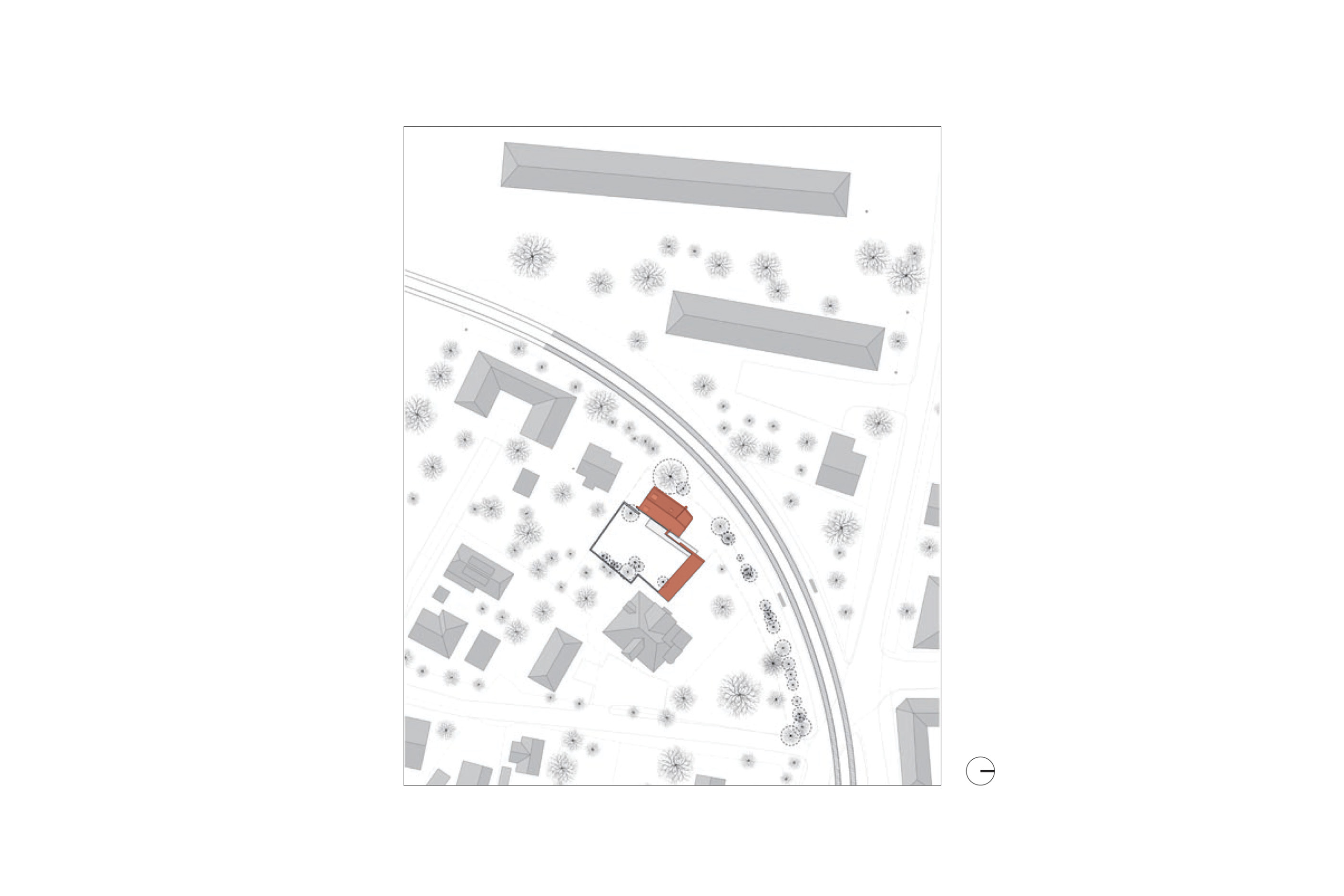
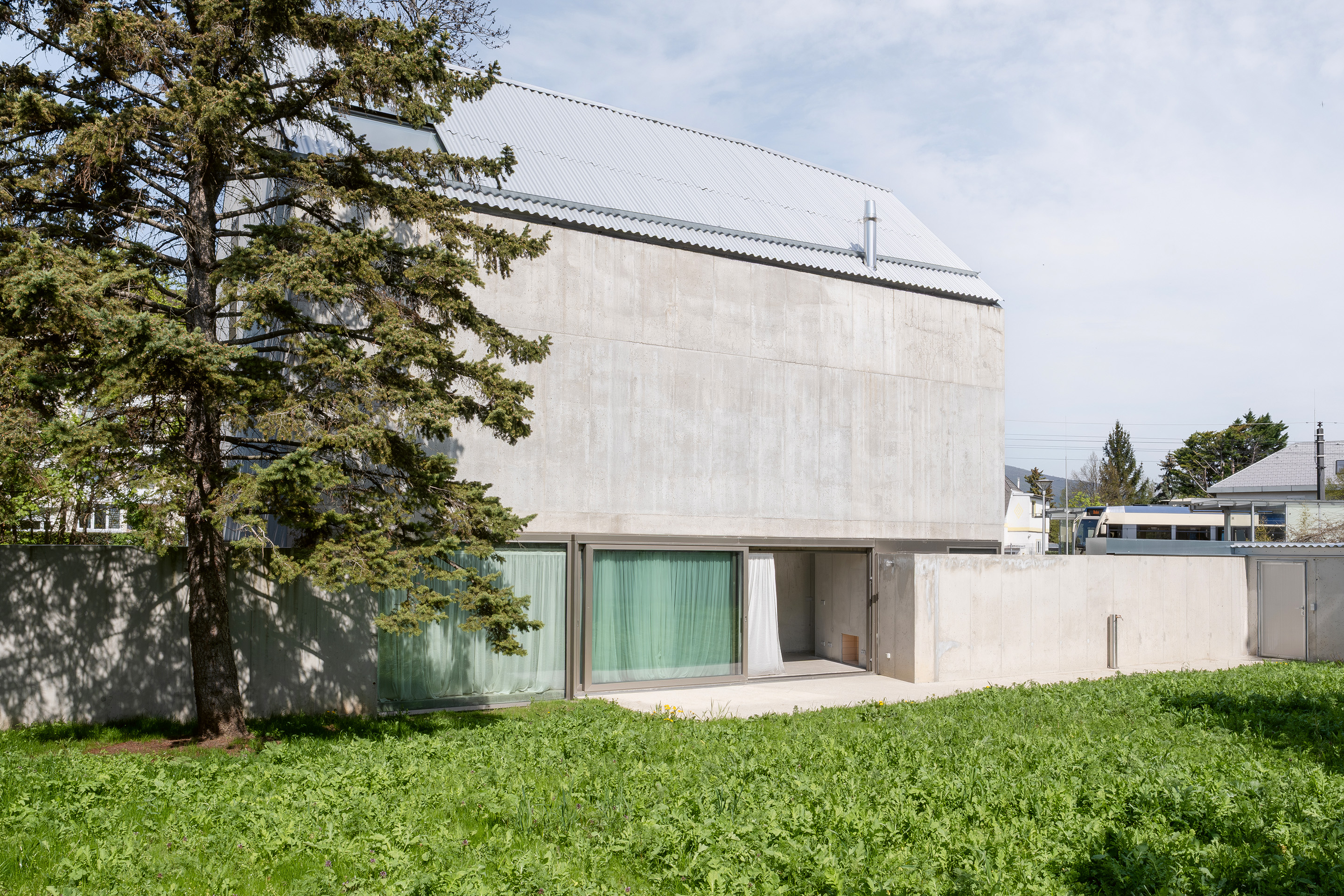
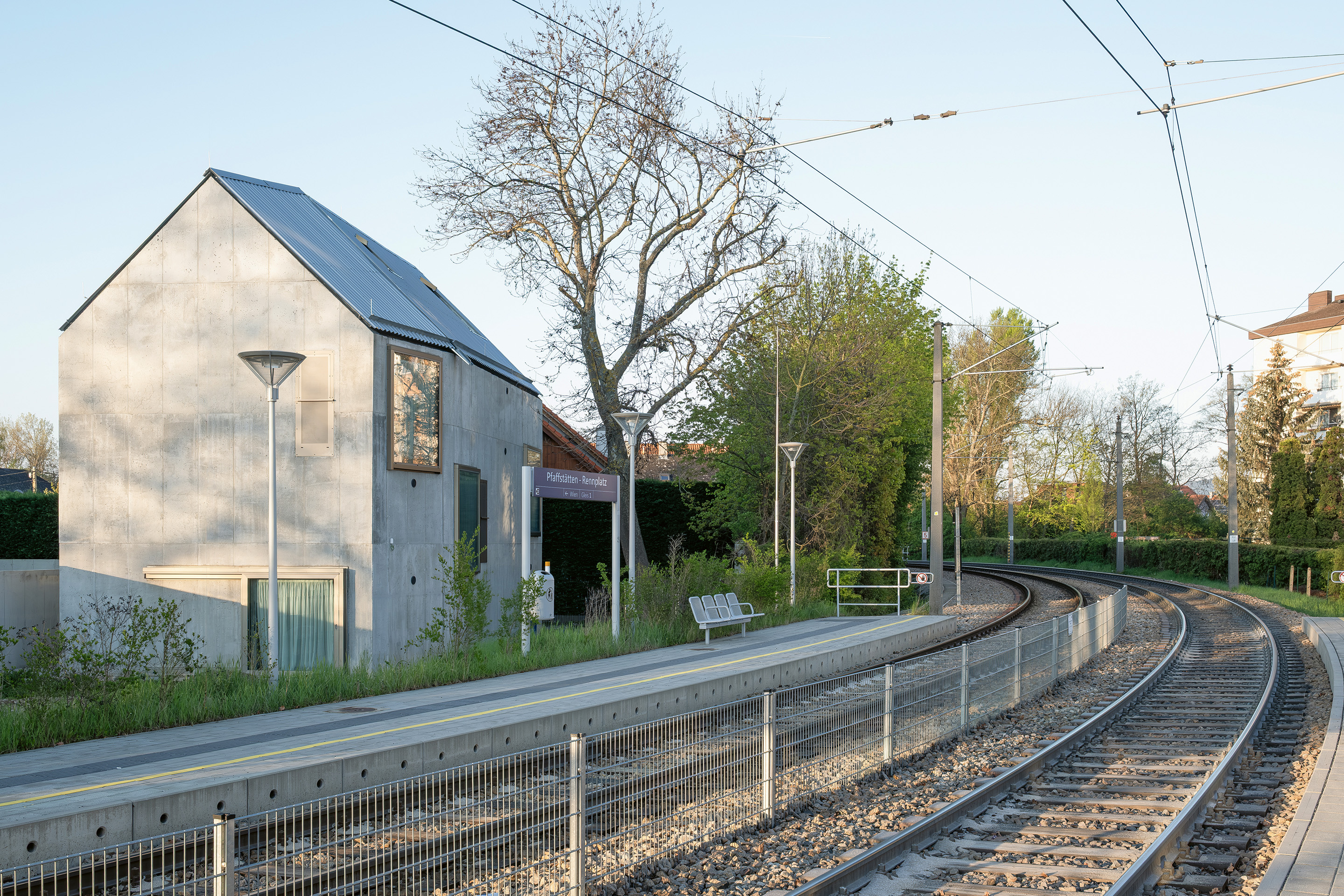
The house is located in the southern metropolitan area of Vienna, in a residential neighbourhood not far from the historical Baden racecourse, traversed by the Badner Bahn tram line. The plot itself is wedged between the curving tracks – which here turn from west to south – and a generous garden on the opposite side, separating it from a large villa.
Access to the building is provided via a private path lined with mature trees, leading from Badener Strasse to the entrance on the east side. Beyond the folded wall guiding one from this entry into the house lies a secluded garden, accessible from the living area and protected from external views by a perimeter concrete wall and tall trees.
The building’s main volume is a simple parallelepiped, whose only variation is the slight chamfer at the junction of the north and west façades. This subtle articulation is echoed in the roof, consisting of two equal-width, unprojected slopes that bend to accommodate the shift.
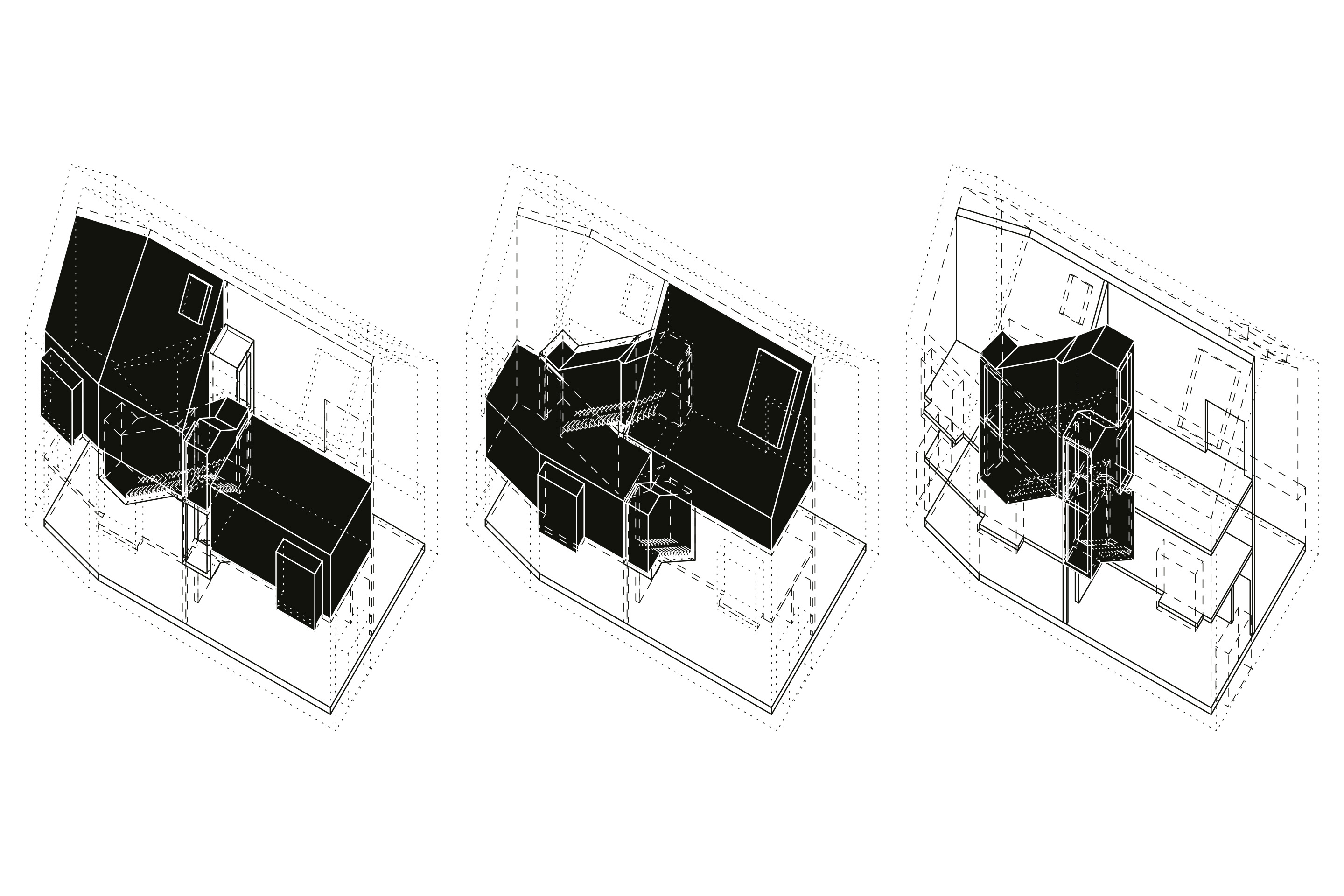
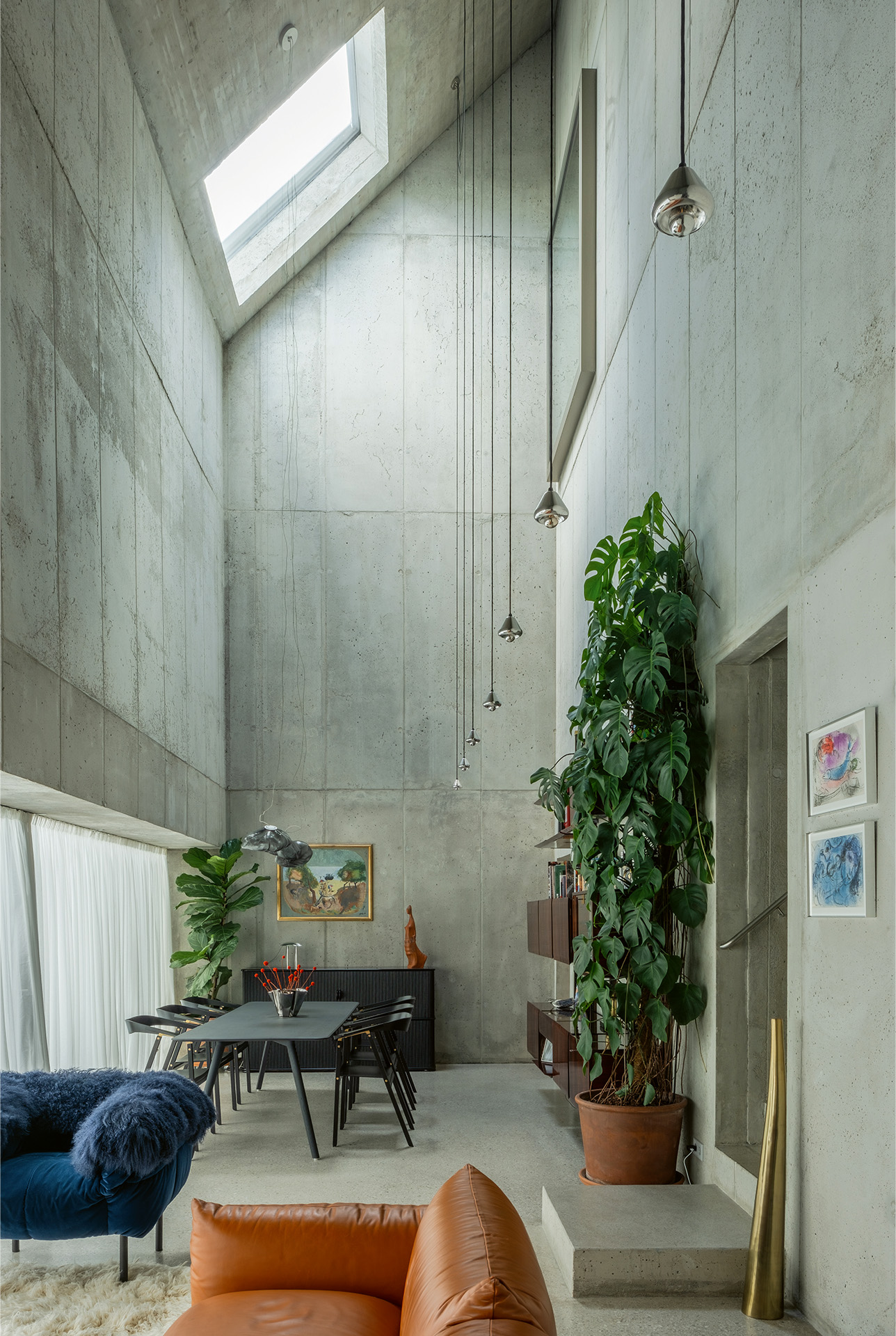
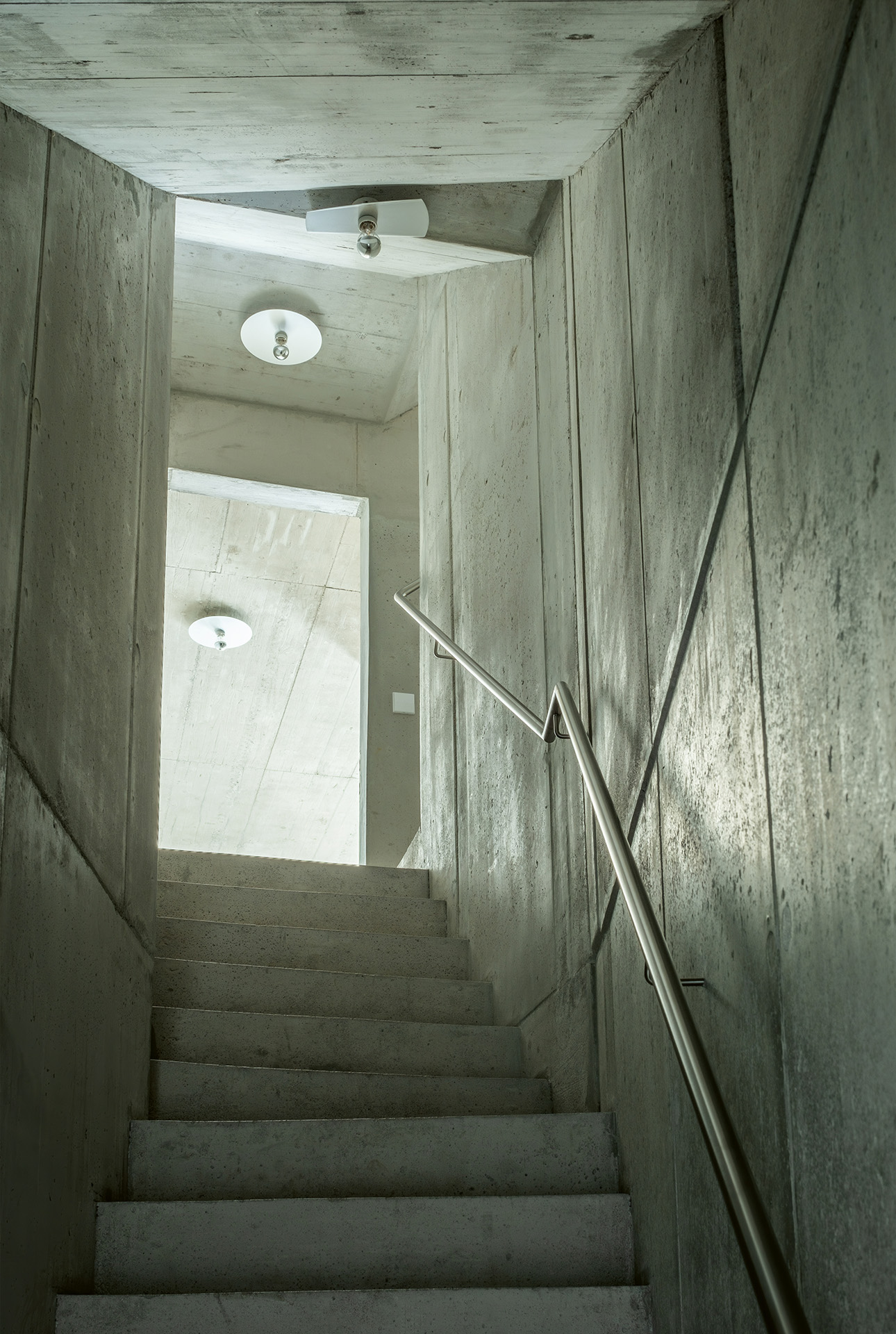
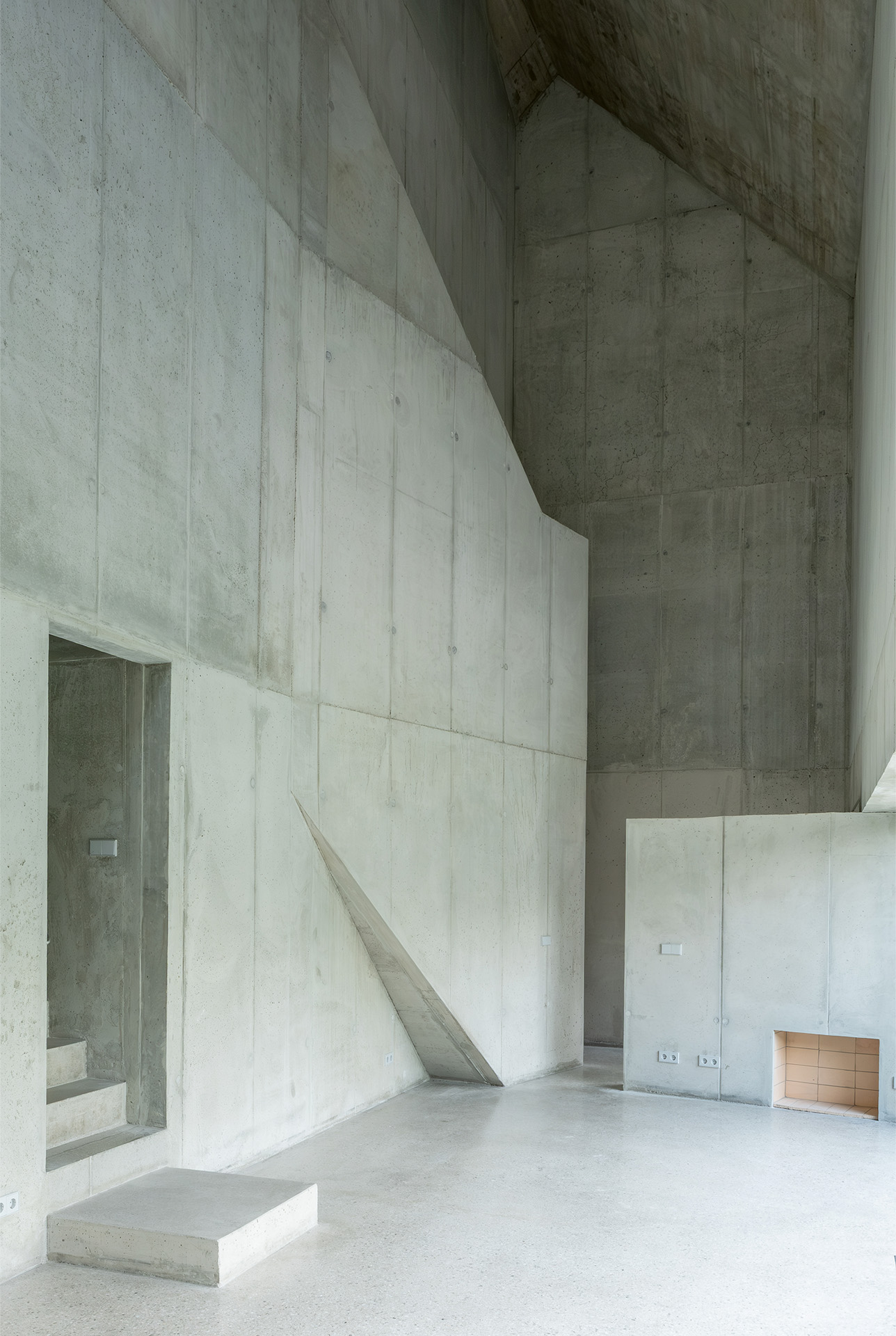
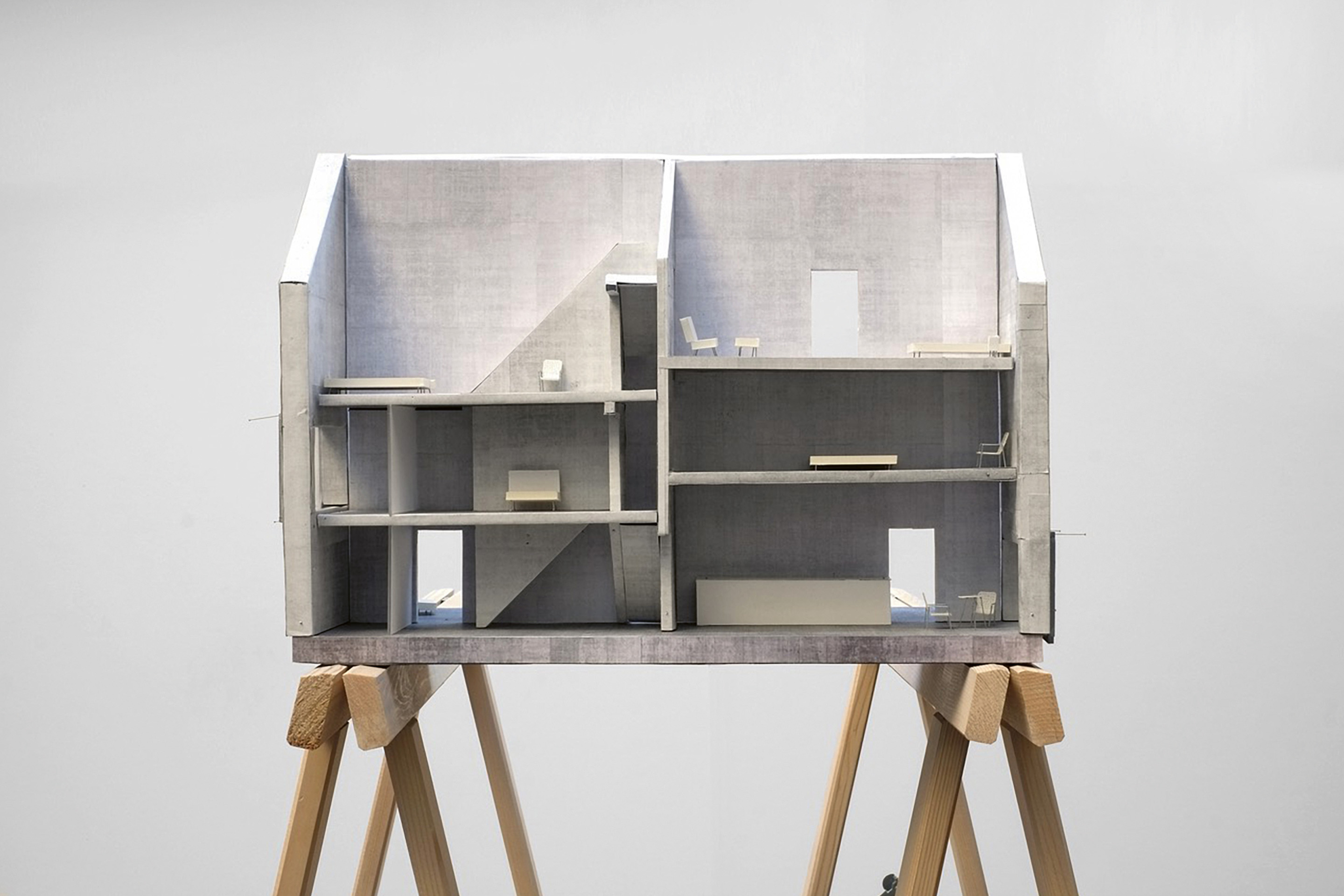
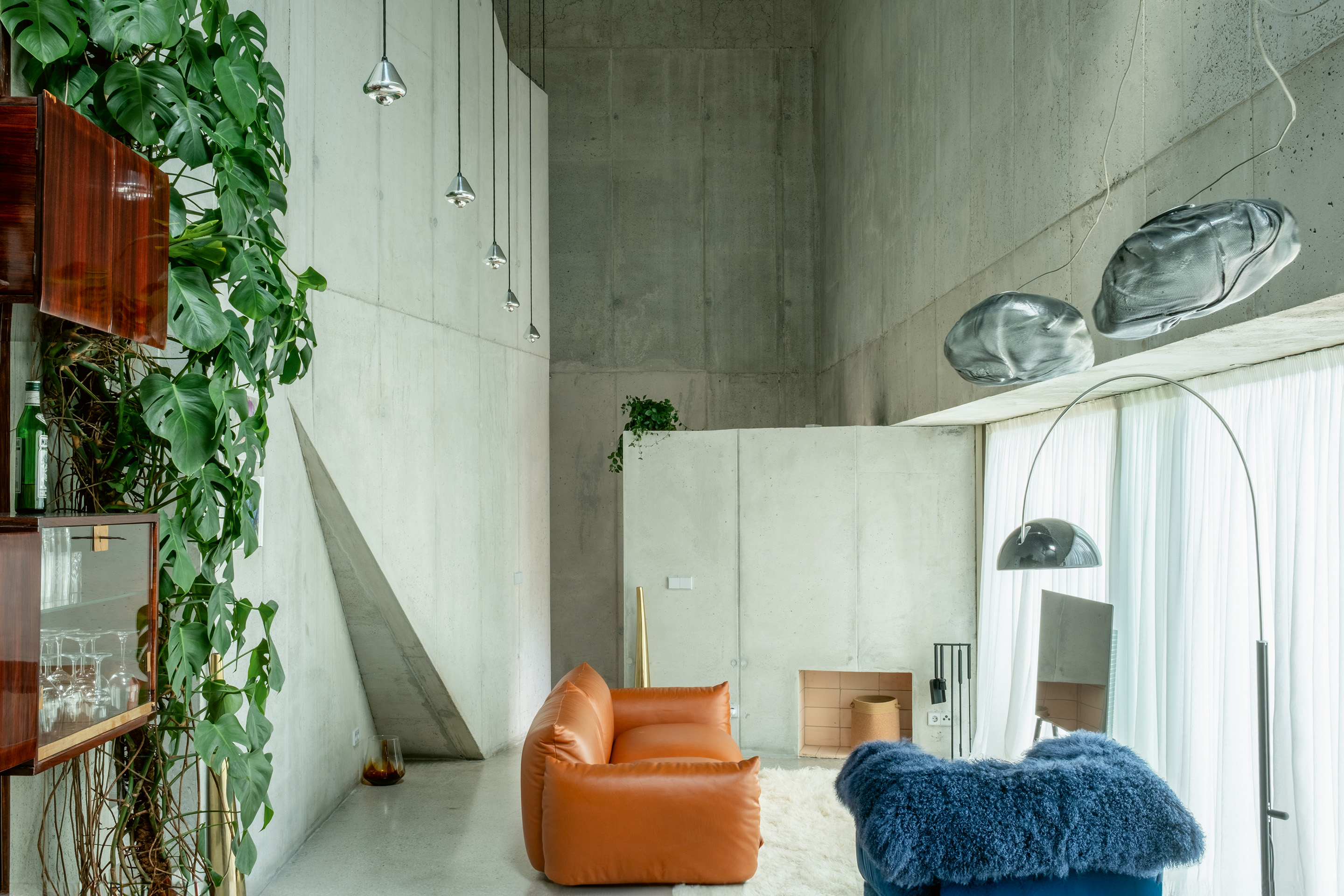
Internally, the house houses the living area on the east side – 10 metres high, 12 metres long, and just over 3 metres wide – and six rooms with services on three floors to the west, revealing a remarkably inventive and spatially expressive configuration. Superimposed on the rectangular plan, divided into two sectors of equal width and length running parallel to the long façades, is a system of interlacing staircases, forming a double helix and interrupting the primary geometry: the staircase rising from the living area, perpendicular to the long façades and centrally located, aligns coherently with the main axis, while the longitudinal staircase, starting from the entrance and slightly rotated relative to the plan, decisively disrupts the otherwise continuous central partition.
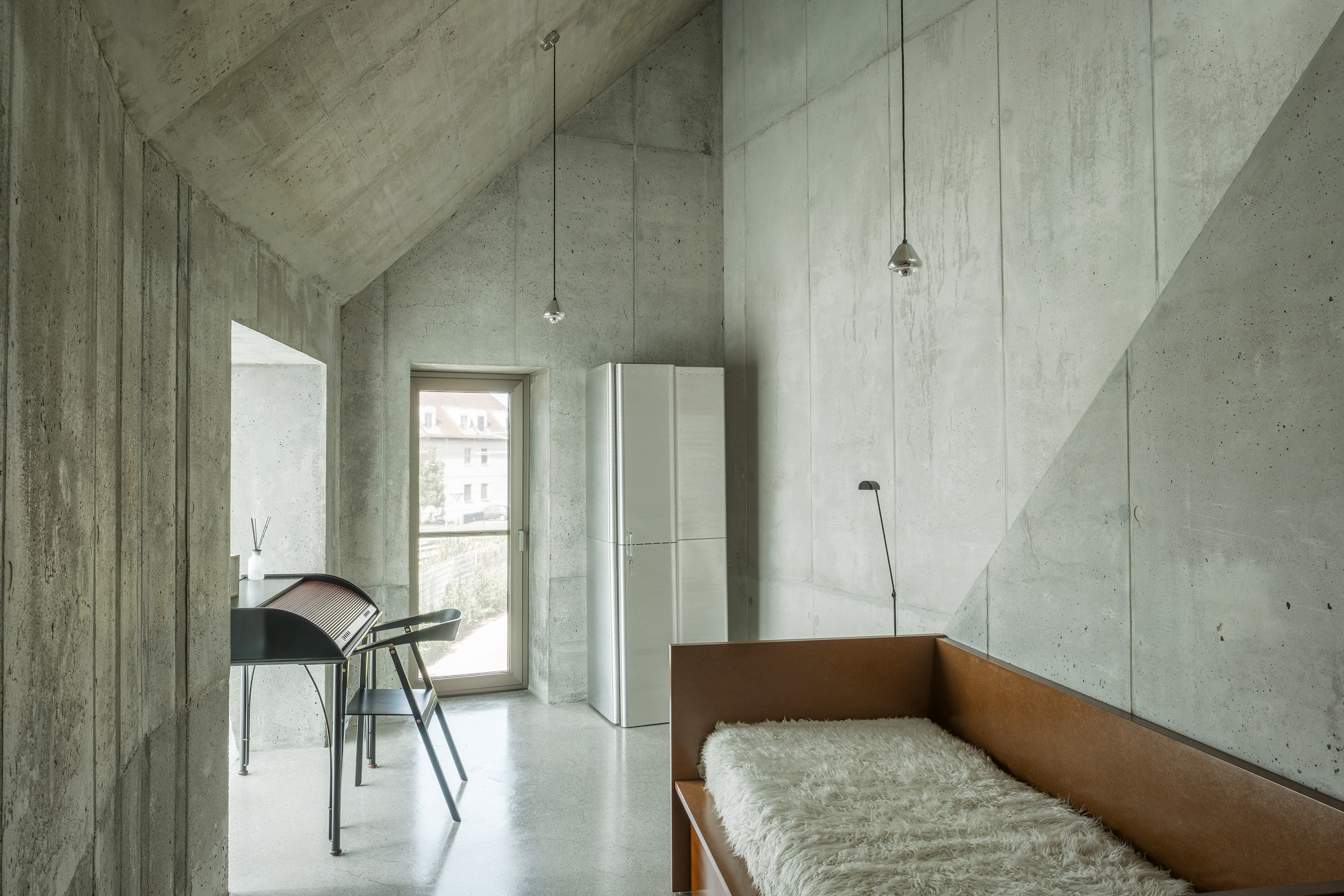
This plastic approach extends to the vertical arrangement of the rooms, with bedrooms at staggered levels, accessible via a sequence of intermediate landings along the ascent.
The treatment of the façades responds to the morphological and functional differences of the areas the house faces. To the west, where rooms look towards the tram station and the mineral surfaces of the tracks, the façade is punctuated by three large square openings, whose offset heights reveal the complexity of the section. To the east, the house opens onto the green expanse of the garden, where the double-height living area is enclosed behind a continuous wall of glazing.
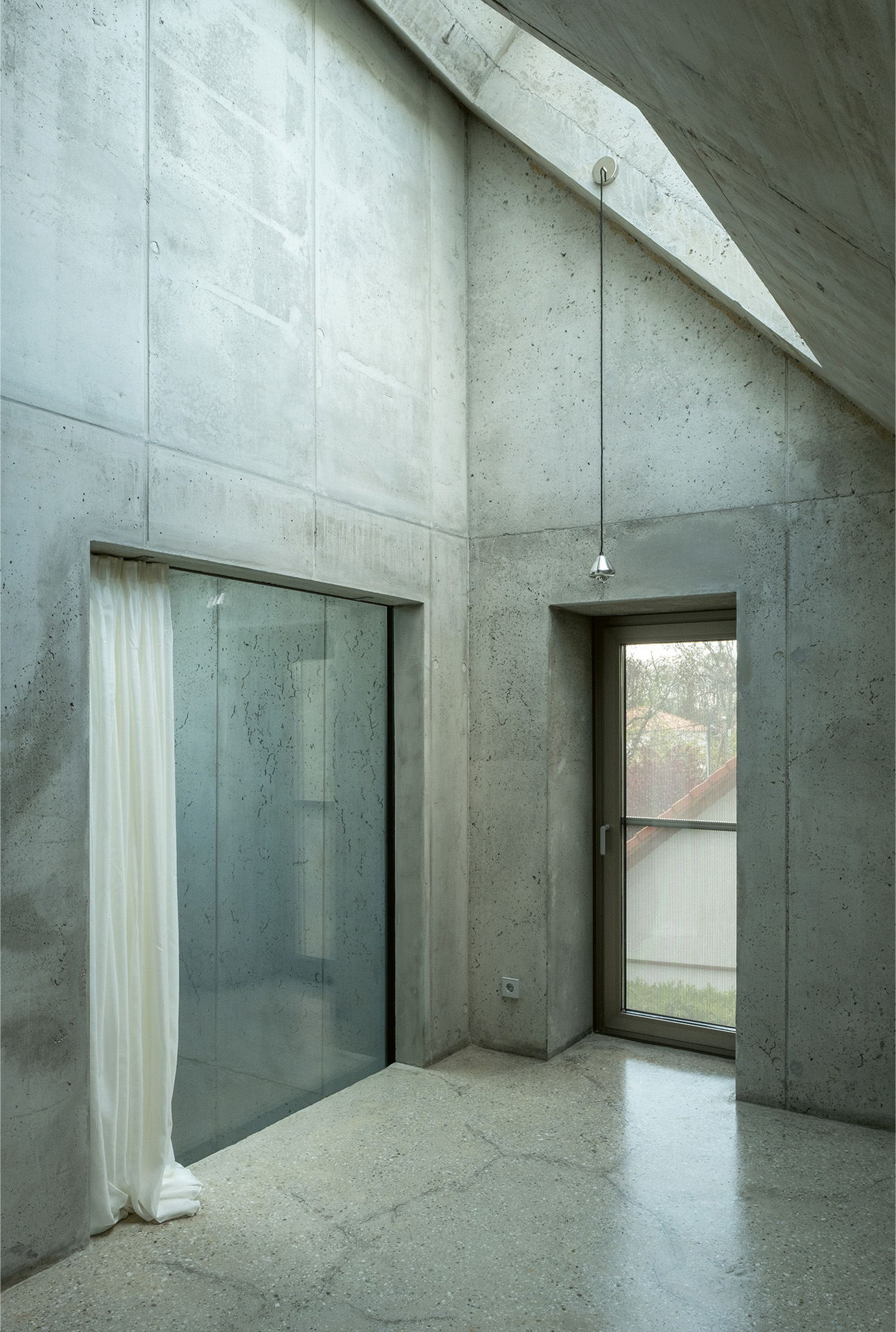
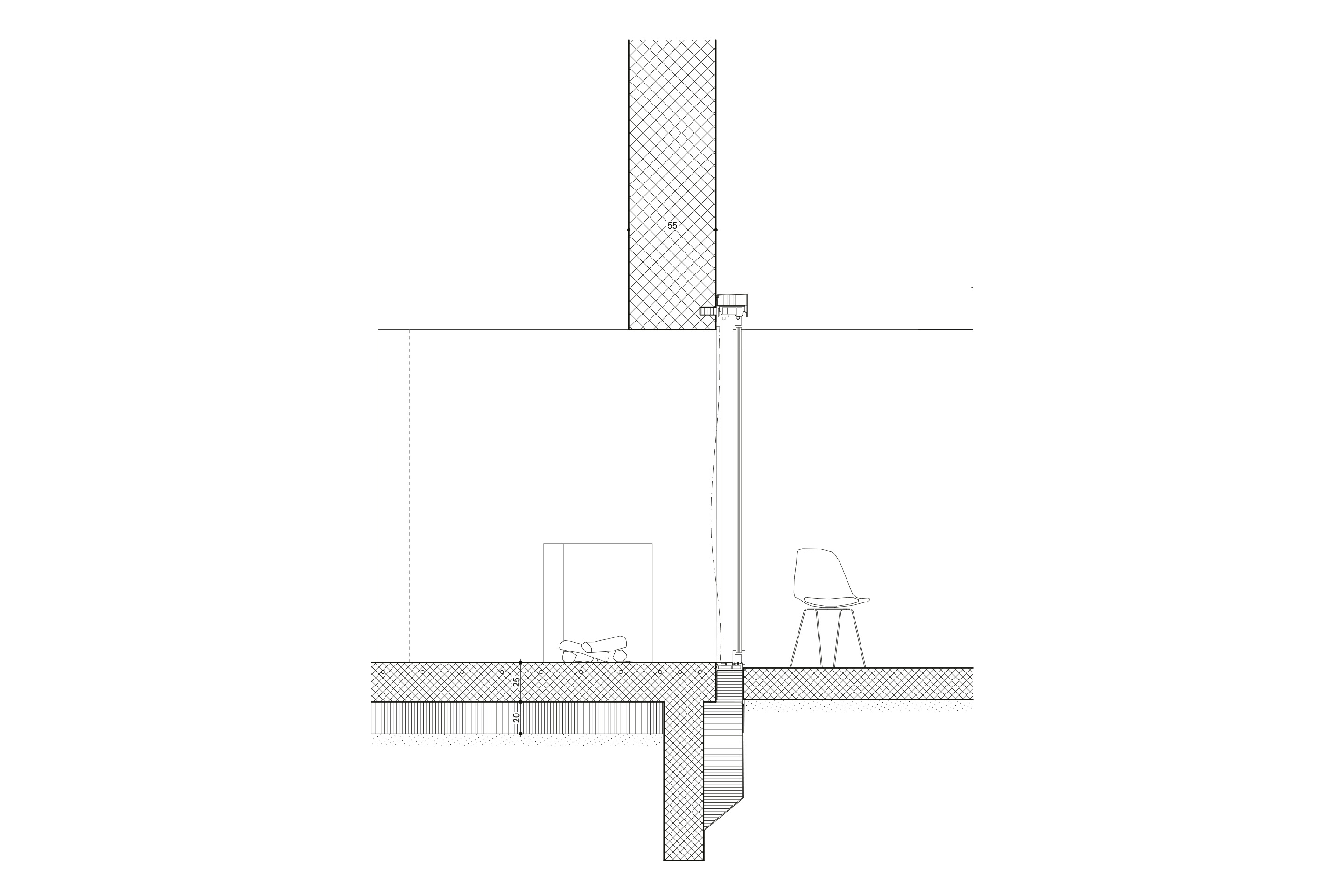
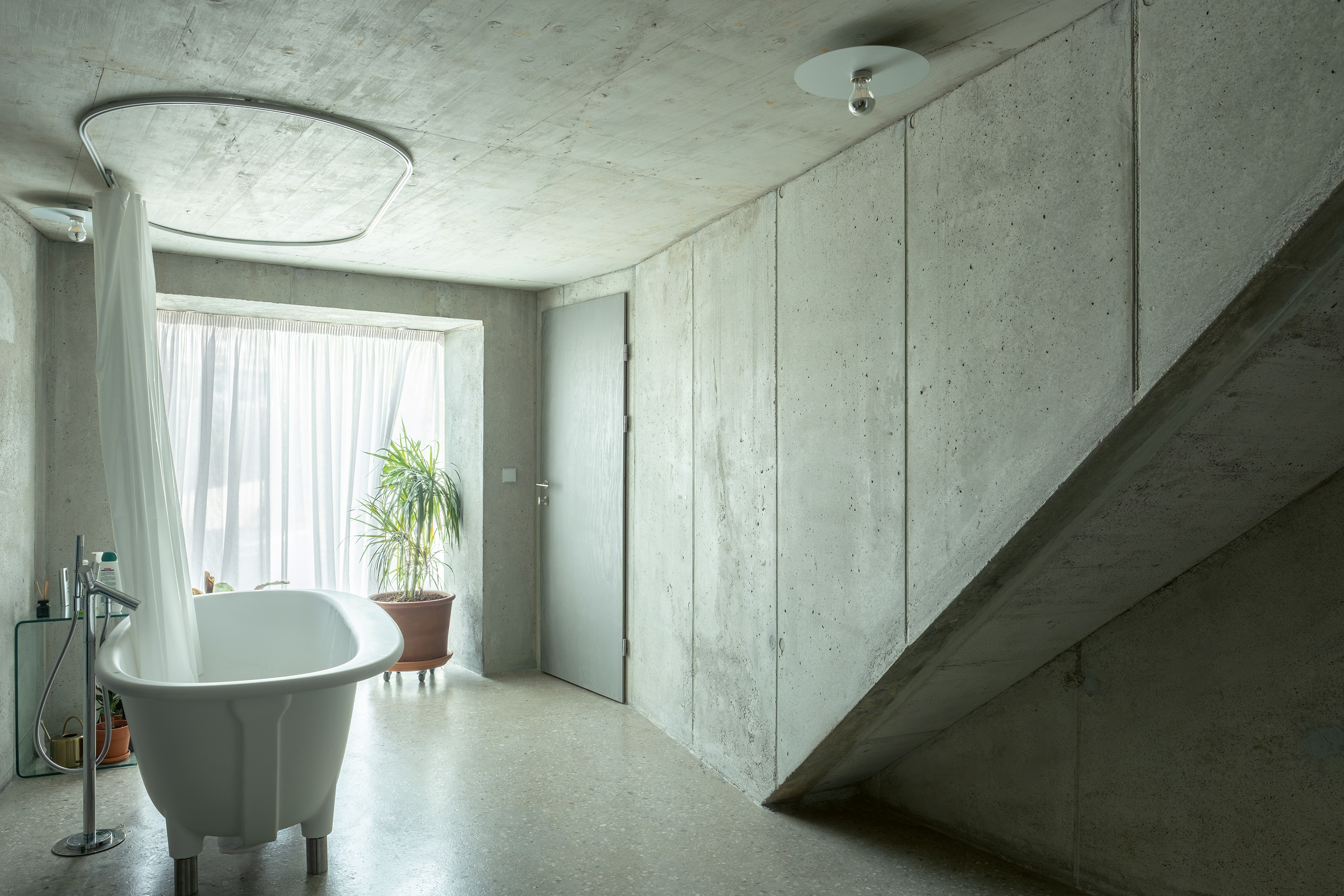
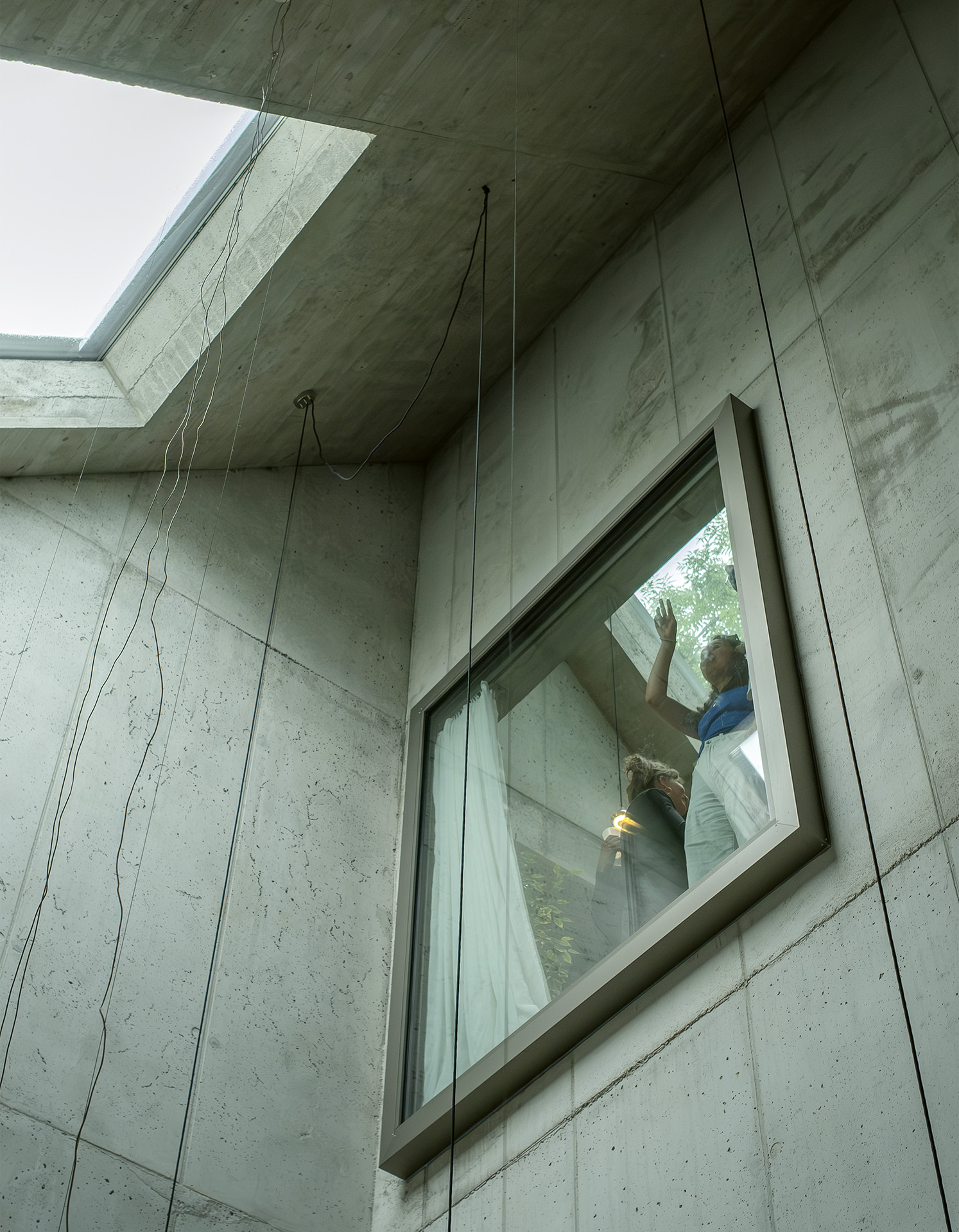
Constructively, the house is conceived as a monolithic mass: a 55-cm-thick insulated concrete wall, 15-cm internal ceilings and partitions, and embedded heating and cooling pipes within the slabs. Exposed concrete surfaces, extending from exterior to interior, unify the perception of the spaces and emphasise their sculptural quality. This effect is further enhanced by the manipulation of natural light, entering horizontally through the large west-facing openings and the full-length east glazing, while three roof skylights draw light vertically into the double-height volume of the living area, accentuating its spatial drama.
In recent years, Didier Balissat and Joni Kaçani have distinguished themselves through a diverse portfolio of projects, ranging from the adaptive reuse of an existing farm to the transformation of a printing house, demonstrating both a strong aptitude for typological experimentation and the ability to engage with sites of complex morphological and functional conditions. The project in Baden, developed with Jann Erhard, embodies through the disruption of geometric regularity, the conception of light as a hierarchical element, and the prioritisation of spatial and circulation components. At the same time, the project treats the constraints of the site as a design opportunity, shaping the building’s character through its contextual challenges.
This approach also informs the treatment of transitions between inside and outside: the movement from the expansive void of the living area to the multi-level partitioning of the sleeping quarters, the juxtaposition of the full-width glazing on one side with the windowed wall on the other, and the compression of transitional spaces contrasted with the openness of the garden are all differentiated according to this logic.
- Place Baden bei Wien (A)
- Client privati | private
- Architecture Balissat Kaçani GmbH, Baden & Jann Erhard, Zürich
- team work J. Kaçani, J. Erhard
- Landscape architecture Joni Kaçani, Baden; Jann Erhard, Zürich
- Construction management Joni Kaçani, Baden
- Civil engineering DI Andrzej Glogowski, Wien (A)
- HVAC system project S.P.R.I.N.C.L.A. GmbH, Wien (A)
- Electric systems project Elektro-X e.U. Weigelsdorf (A)
- Building physics and acoustics K2 Bauphysik GmbH, Wien (A)
- Photovoltaics AM Blitzschutz- u. Elektrotechnik GmbH, Berndorf (A)
- Lighting design designfunktion Gesellschaft für moderne Büro- und Wohngestaltung GmbH, Wien (A); Raphael Kadid Objekts, Basel
- Contractor Goran Pavic KG, Perchtoldsdorf (A)
- Photography giulia & hermes killer, Locarno
- Timeline project 2017-2019 realisation 2020-2024
- Energy planning K2 Bauphysik GmbH, Wien (A)
- Intervention and building type new construction
- Building category (Ae) single family house 150 m²
- Form factor (Ath/Ae) 1.49
- Heating and hot water 100% air-water heat pump
- Electricity Photovoltaic system 20.16 kWp
- Primary building envelope requirement 34.6 kWh/m²a
- Global Energy Index 35.4 kWh/m²a
- Special features TABS inTABS in every wall and floor/ceiling panel, decentralised ventilation with heat recovery in living rooms