Zaatari Beyond Emergency
Refugee-Led Spatial Imaginaries and the Urban Life of Protracted Displacement
This article examines Zaatari Refugee Camp as a protracted urban settlement where emergency infrastructures have become part of everyday life. Through spatial analysis, secondary data, and AI-assisted participatory workshops with Syrian refugees, it introduces the concept of refugee-led spatial future-making. It argues that residents actively imagine and shape urban futures despite remaining governed by a regime of temporariness, revealing how the camp has evolved beyond emergency through the aspirations and agency of its inhabitants.
Introduction: Zaatari Camp beyond the emergency
Zaatari Refugee Camp in Jordan is often introduced through the language of emergency: arrival, shelter, protection, service provision, and humanitarian response. Opened on 28 July 2012, it was initially established as a temporary response to the displacement of Syrians fleeing war. Yet the history of Zaatari quickly exceeded the temporal and spatial logic of emergency. Within a short period, the camp expanded from an emergency reception site into a vast inhabited territory, structured by shelters, districts, roads, schools, clinics, markets, energy networks, administrative zones, and humanitarian infrastructures. Ten years after its opening, Zaatari was still home to around 80,000 people, while more recent figures show that the camp is shrinking but not disappearing (Carlisle, 2022; UNHCR, 2025, 2026a, 2026b). This trajectory reveals a central paradox: a space designed as temporary has produced durable infrastructures, economic life, births, routines, memories, and spatial attachments.
This article begins from that paradox. It argues that Zaatari can no longer be understood only as a humanitarian container for displaced populations. Nor should it be read simply as a failed, incomplete, or abnormal city. Both interpretations are limited. The first reduces the camp to a technical apparatus of emergency management, overlooking the social, economic, and spatial worlds produced by its residents. The second measures the camp against conventional urban standards and risks overlooking the specific political conditions through which camp urbanization occurs. Zaatari is neither merely a temporary sheltering device nor simply an unfinished city. It is better understood as a protracted urban condition: a space governed through emergency, but inhabited, adapted, and imagined through everyday urban practices.
The article, therefore, positions Zaatari within debates on camps as urban-political formations. Agier’s work on humanitarian government is important here because it shows that camps are not neutral spaces of assistance, but political spaces produced through humanitarian action, border control, classification, and management (Agier, 2011). Camps gather displaced populations, but they also organize them through specific regimes of visibility, dependency, protection, and control. In this sense, Zaatari is not only a place where emergency is addressed; it is a place where emergency becomes spatially and institutionally organized.
At the same time, this article moves beyond readings of the camp as only a space of exception or containment. Ramadan’s work on the spatial politics of refugee camps and Sanyal’s work on “urbanizing refuge” are particularly useful for this shift. Ramadan argues that refugee camps must be understood as distinctive political spaces, while Sanyal challenges the idea of camps as purely biopolitical spaces and shows how refugees recover agency through the physical and political production of space (Ramadan, 2013; Sanyal, 2014). These perspectives make it possible to read Zaatari not as outside the urban question, but as part of a wider geography of displacement in which humanitarian governance, state regulation, infrastructure, informality, and resident agency intersect.
Zaatari’s transformation makes this intersection visible. What began with tents, water delivery, food distribution, and basic protection gradually became a spatial system with recognizable urban features: streets, markets, schools, clinics, service corridors, electricity networks, administrative sectors, and forms of public life. The replacement of tents with approximately 25,000 prefabricated shelters, the emergence of the “Sham Elysees” market, the recording of more than 20,000 births, and the consolidation of health, educational, and administrative infrastructures all point to a process through which emergency became territorial (Carlisle, 2022). The camp did not simply accommodate displacement; it reorganized it spatially. It converted forced mobility into settlement, humanitarian provision into infrastructure, and temporary shelter into everyday dwelling.
However, recognizing Zaatari’s urban transformation does not mean normalizing encampment or celebrating the permanence of refugee camps. This is a crucial distinction. The camp produces urban life without granting full urban rights. It generates streets, markets, homes, and public spaces under conditions of legal and political temporariness. Residents inhabit and transform the camp, but they do so within a humanitarian regime that continues to structure mobility, access, services, and future possibilities. Zaatari’s urbanity is therefore politically constrained. It is an urban condition marked by the contradiction between durable everyday life and suspended rights.
This contradiction is the starting point for the article’s main contribution. Rather than asking whether Zaatari has become a city, the article asks how refugees produce and imagine urban life within a space still governed as temporary. It argues that Zaatari is “beyond emergency” not because the emergency has ended, but because emergency infrastructures have become embedded in everyday life, and because residents actively articulate spatial futures beyond survival. This article, therefore, introduces the concept of refugee-led spatial future-making to describe the ways displaced residents imagine, visualize, and claim alternative spatial conditions within protracted camps.
The argument is developed in two steps. First, the article examines Zaatari’s transformation from an emergency camp into a protracted urban formation. Second, it analyzes AI-assisted participatory workshops conducted by the researcher with Syrian refugees in Zaatari in October 2025. These workshops produced visual scenarios of shaded women’s spaces, child-friendly parks, greener health environments, safer streets, market corridors, and everyday public spaces. The images are not treated as final design proposals or technological solutions. Rather, they are understood as visual claims through which refugees articulate priorities of dignity, care, mobility, sociality, childhood, economic life, and belonging.
This article argues that Zaatari should be understood as a protracted urban condition: a space where emergency infrastructures have become durable, where humanitarian governance organizes daily life, and where refugees actively produce and imagine spatial futures. Reading Zaatari beyond emergency, therefore, requires attention not only to the infrastructures that humanitarian actors build, but also to the everyday spatial practices and future-oriented imaginaries through which refugees continue to make life, meaning, and claims within the camp.
Theoretical Framework: From Camp Urbanism to Spatial Future-Making
This article draws on four interrelated theoretical perspectives to read Zaatari beyond the language of emergency: camp urbanism and humanitarian government, protracted temporariness and homemaking, everyday spatial agency, and participatory visual methods. These perspectives allow the camp to be understood not merely as a humanitarian apparatus or temporary sheltering device, but as a protracted urban condition shaped by governance, infrastructure, everyday practice, resident adaptation, and refugee-led spatial future-making.
Camps as Urban-Political Formations
Refugee camps have often been interpreted as exceptional spaces: temporary, segregated, and governed through humanitarian logics rather than through ordinary urban citizenship (Agamben, 1998; Agier, 2011; Ramadan, 2013). While this interpretation remains important, it is insufficient for understanding camps that persist over time and develop complex spatial, social, and infrastructural systems. Zaatari is such a case. It was established as an emergency response, yet it has gradually become a territorial formation composed of shelters, streets, markets, clinics, schools, energy networks, administrative sectors, and forms of everyday public life.
For Agier, camps are not neutral spaces of assistance; they are political spaces produced through humanitarian intervention, border control, classification, protection, and management (Agier, 2011). Camps gather displaced populations, but they also organize them through regimes of visibility, dependency, mobility control, and institutional coordination. In this sense, the camp is not only a response to displacement; it is also a spatial technology through which displacement is governed. However, to understand Zaatari only as a humanitarian apparatus would risk overlooking the urban life produced within it. Ramadan (2013) argues that refugee camps must be understood as distinctive political spaces whose spatial organization reflects broader relations of sovereignty, displacement, and power. His work is useful because it moves the analysis of camps beyond the idea of shelter and toward the political production of space. Camps are not simply where displaced people are housed; they are spaces where political relations are materialized through borders, infrastructures, circulation, services, and everyday regulation.
Sanyal’s work further extends this argument by challenging readings of camps as spaces of pure biopolitical control. In her analysis of “urbanizing refuge,” Sanyal (2014) shows that refugee spaces develop their own forms of urbanism and that refugees actively produce space physically, socially, and politically. This is particularly important for Zaatari, where residents have not only inhabited humanitarian infrastructures but also adapted shelters, produced markets, shaped streets, created domestic extensions, and transformed camp space into a lived environment. This article, therefore, approaches Zaatari as an urban-political formation. It is urban because it contains density, circulation, service networks, economic centrality, public life, and spatial differentiation. It is political because these urban processes unfold under conditions of humanitarian governance, state regulation, legal temporariness, and restricted rights. Zaatari is not outside the urban question. It is part of a broader geography of displacement in which humanitarian infrastructures, state regulation, and refugee agency produce new forms of urban life.
Protracted Temporariness and Homemaking
The second theoretical pillar concerns the contradiction between temporary status and long-term life. Refugee camps are often justified through the promise of temporariness. They are presented as provisional responses to crisis, designed to shelter displaced populations until return, resettlement, or another durable solution becomes possible (Brun, 2016; Hyndman & Giles, 2016; UNHCR, 2004). Yet in many cases, including Zaatari, temporariness becomes prolonged. The camp remains legally and politically temporary while everyday life becomes increasingly durable.
Brun and Fábos (2015) offer an important conceptual framework for understanding this condition. Their work on homemaking in protracted displacement shows that home cannot be reduced to stable property, citizenship, or permanent settlement. Displaced people make homes in conditions of uncertainty, mobility restriction, waiting, and political suspension. Homemaking, in this sense, is not only a domestic practice; it is also a social and spatial process through which people create familiarity, continuity, memory, and belonging under unstable conditions.
This perspective is particularly relevant to Zaatari. The transformation from tents to prefabricated shelters did not simply improve the technical quality of accommodation. It extended the temporal horizon of camp life and allowed residents to reorganize domestic space, create privacy, add courtyards, establish routines, and produce forms of family life. The recording of thousands of births in the camp further demonstrates that Zaatari is not merely a place of arrival, but also a place where childhood, memory, education, and generational continuity are formed.
Temporariness in Zaatari should therefore not be understood as a short period of waiting. It is a mode of governance that becomes prolonged, while residents continue to make homes, routines, memories, and futures within uncertain conditions. This produces a central tension: the camp becomes materially and socially durable, but the political status of its residents remains suspended. Zaatari’s residents inhabit a space where everyday life has become long-term, while rights, mobility, and future possibilities remain constrained.
This tension is crucial for the article’s argument. Reading Zaatari beyond emergency does not mean claiming that the camp has become a normal city. Rather, it means recognizing that emergency has acquired duration, infrastructure, social reproduction, and spatial attachment. The camp is temporary in political discourse, but durable in everyday life. This contradiction is the condition from which refugee-led spatial future-making emerges.
Everyday Spatial Agency
The third theoretical pillar concerns the production of space through everyday practice. Lefebvre’s theory of the production of space is fundamental here. Lefebvre (1991) argues that space is not a neutral container in which social life occurs; rather, space is produced through social relations, political power, representations, routines, and everyday practices. This allows us to understand Zaatari not simply as a planned humanitarian site, but as a space continuously produced by multiple actors: humanitarian agencies, state authorities, NGOs, planners, service providers, and residents themselves.
De Certeau’s work on everyday practice adds another layer to this argument. De Certeau (1984) distinguishes between strategies, often associated with institutions and systems of power, and tactics, through which ordinary people navigate, appropriate, and reinterpret imposed structures. In Zaatari, humanitarian actors and state authorities may define the camp’s official layout, service networks, sectors, and regulations. Yet residents engage these structures tactically: they modify shelters, create thresholds, animate streets, extend domestic spaces, organize commercial activities, and transform circulation routes into social and economic spaces.
Awan, Schneider, and Till’s concept of spatial agency further helps to move the discussion beyond professional architecture and planning. They argue that architecture should not be understood only as the work of architects, but as a spatial practice produced through multiple actors, relations, and forms of agency (Awan et al., 2011). This is especially relevant in refugee camps, where much of the built environment emerges through negotiation between official planning and resident-led adaptation. Refugees are not passive users of space; they are spatial actors who participate in making, modifying, and giving meaning to the built environment.
In Zaatari, this everyday spatial agency is visible in the transformation of shelters into homes, streets into markets, residual spaces into gathering areas, and informal routes into everyday public spaces. It is also evident in the AI-assisted workshop scenarios, which we will discuss later, in which refugees imagined shaded women’s spaces, child-friendly parks, dignified healthcare environments, safer streets, and improved market corridors. These images show that refugees do not only adapt to existing camp conditions; they also imagine alternative spatial futures. This article, therefore, uses the concept of refugee-led spatial future-making to describe the ways displaced residents imagine, visualize, and articulate alternative spatial conditions within protracted camps. This concept builds on camp urbanism, protracted temporariness, homemaking, and everyday spatial agency. It emphasizes that refugees are not only recipients of humanitarian space. They are spatial actors who modify shelters, animate markets, use streets, create thresholds, and imagine alternative public spaces. Their spatial imaginaries are not simply desires for improvement; they are claims to dignity, sociality, mobility, care, childhood, economic life, and belonging.
Participatory Visual Methods and AI-Assisted Spatial Imaginaries
The fourth theoretical pillar concerns the role of participatory visual methods in producing spatial knowledge. Since this article analyzes AI-assisted images generated through workshops with refugees in Zaatari, it is important to clarify that these images are not approached as autonomous technological outputs or as final design proposals. Rather, they are understood as participatory visual research materials through which residents articulated spatial priorities, unmet needs, and imagined futures.
This approach builds on traditions of community participation in design and planning. Sanoff (2000) argues that participatory design can create more responsive environments by involving users directly in the identification of problems, priorities, and spatial possibilities. In this sense, participation is not simply a consultative step added to professional planning; it is a process through which local knowledge becomes part of spatial decision-making. This is especially relevant in refugee camps, where many spatial decisions are often made by humanitarian agencies, technical experts, or state authorities, while residents’ everyday experiences remain underrepresented.
Sanders and Stappers (2008) further develop this argument through the concept of co-creation. They show that design knowledge can emerge through collaborative processes between experts and non-experts, where participants are not treated only as users or respondents but as active contributors to the imagination of possible futures. In the context of Zaatari, this is crucial. The AI-assisted workshop shifted refugees from being objects of humanitarian assessment to becoming spatial co-authors. Through the discussion and transformation of images of existing camp spaces, participants visualized shaded gathering areas, women-oriented spaces, child-friendly parks, greener health environments, safer streets, and improved market corridors.
Rose’s work on visual methodologies is also important for framing the images as research material. Visual methods allow researchers to study not only what people say about space, but also how they see, imagine, and represent spatial relations (Rose, 2016). In contexts of displacement, where verbal description may be shaped by trauma, institutional asymmetry, language barriers, or limited design literacy, images can open another form of spatial expression. The AI-generated scenarios made residents’ aspirations visible and discussable. They translated everyday concerns, shade, safety, play, comfort, sociability, mobility, and dignity into spatial forms.
At the same time, the use of AI requires careful ethical framing. AI-generated images can easily aestheticize poverty, simplify complex social and political conditions, or obscure the authorship of the communities whose experiences inform the images. Costanza-Chock’s work on design justice is useful here because it insists that design processes should center the knowledge, priorities, and agency of those most affected by structural inequality (Costanza-Chock, 2020). Applied to Zaatari, this means that the images must not be presented as technological outcomes or as expert-designed solutions. Their value lies in the participatory process through which they were discussed, generated, interpreted, and grounded in refugees’ lived experience.
Therefore, this article treats AI not as a substitute for participatory planning but as a visual mediation tool. Its role was to help residents move from verbal descriptions of need toward visual articulations of possible spatial futures. The images are important not because they provide ready-made solutions, but because they reveal how refugees conceptualize everyday urban life in the camp: as cooler, greener, safer, more social, more walkable, more playable, and more dignified. In this sense, AI-assisted spatial imaginaries become a methodological bridge between lived experience and planning knowledge.
Taken together, these four theoretical perspectives allow Zaatari to be read beyond emergency. Camp urbanism frames the camp as an urban-political formation; protracted temporariness explains the contradiction between temporary status and durable life; everyday spatial agency reveals how refugees actively produce and transform space; and participatory visual methods show how residents imagine spatial futures through visual claims. Building on this framework, the next section examines Zaatari as a protracted urban condition, tracing how emergency infrastructures have become durable and how residents’ everyday practices have transformed the camp into a lived spatial formation.
Zaatari as a Protracted Urban Condition
Zaatari Refugee Camp offers a clear case through which to examine how an emergency becomes territorialized over time. Established on 28 July 2012 as a temporary response to the displacement of Syrians fleeing war, the camp was initially organized around the urgent provision of shelter, water, food distribution, protection, and basic services. Yet its development quickly exceeded the temporal logic of emergency. Within its first year, Zaatari expanded into one of the largest Syrian refugee camps in the region, and by 2022, ten years after its opening, it was still home to around 80,000 people (Carlisle, 2022). More recent data show that the camp has entered a phase of demographic decline: UNHCR’s January 2026 factsheet described Zaatari as home to almost 51,000 Syrian refugees, while UNHCR’s Operational Data Portal listed 48,398 persons of concern as of 31 May 2026 (UNHCR, 2026a, 2026b).
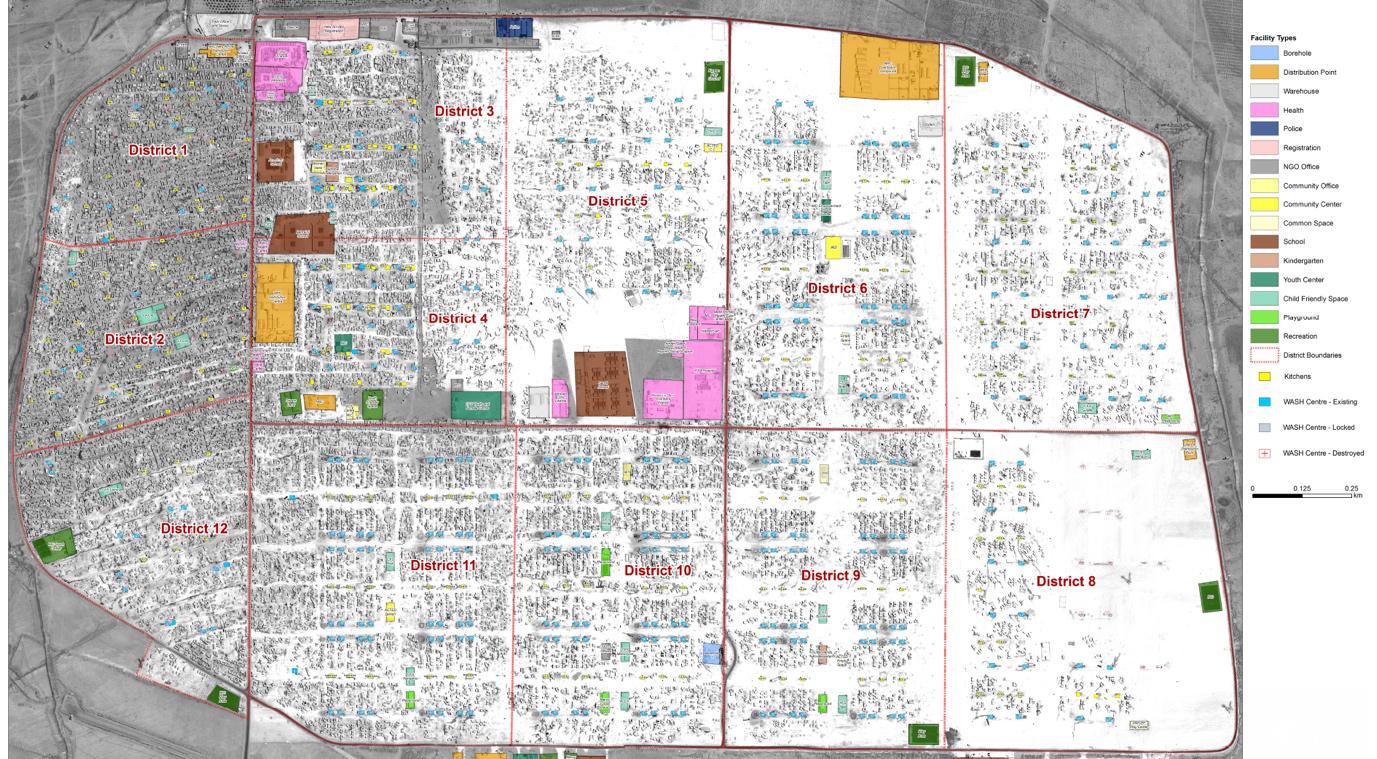
This trajectory shows that Zaatari cannot be understood as a static humanitarian site. Rather, it has moved through several phases: emergency arrival, rapid demographic expansion, infrastructural consolidation, social and economic urbanization, and partial demographic decline. Each phase has produced different spatial and political questions. In the first phase, the central question was how to respond quickly to mass displacement. In the second, how to manage density, circulation, shelter allocation, and service provision. In the third, how to maintain infrastructure, social life, and everyday routines in a space still officially framed as temporary. In the current phase, the question becomes what happens to emergency infrastructures when the population decreases but the spatial apparatus remains. As Figure 1shows the early territorial organization of Zaatari through districts, facilities, circulation networks, and humanitarian service infrastructures.
Zaatari’s transformation confirms that the emergency does not disappear when it becomes organized. Rather, the emergency becomes territorial. It produces roads, districts, shelters, clinics, schools, administrative zones, markets, energy systems, and forms of public life. This process can be read through the lens of camp urbanism: the camp is not outside the urban question, but part of a broader geography of displacement in which humanitarian infrastructures, state regulation, and refugee agency produce new forms of urban life (Agier, 2011; Ramadan, 2013; Sanyal, 2014). Zaatari is therefore not the opposite of the city. It is a politically constrained form of urbanization.
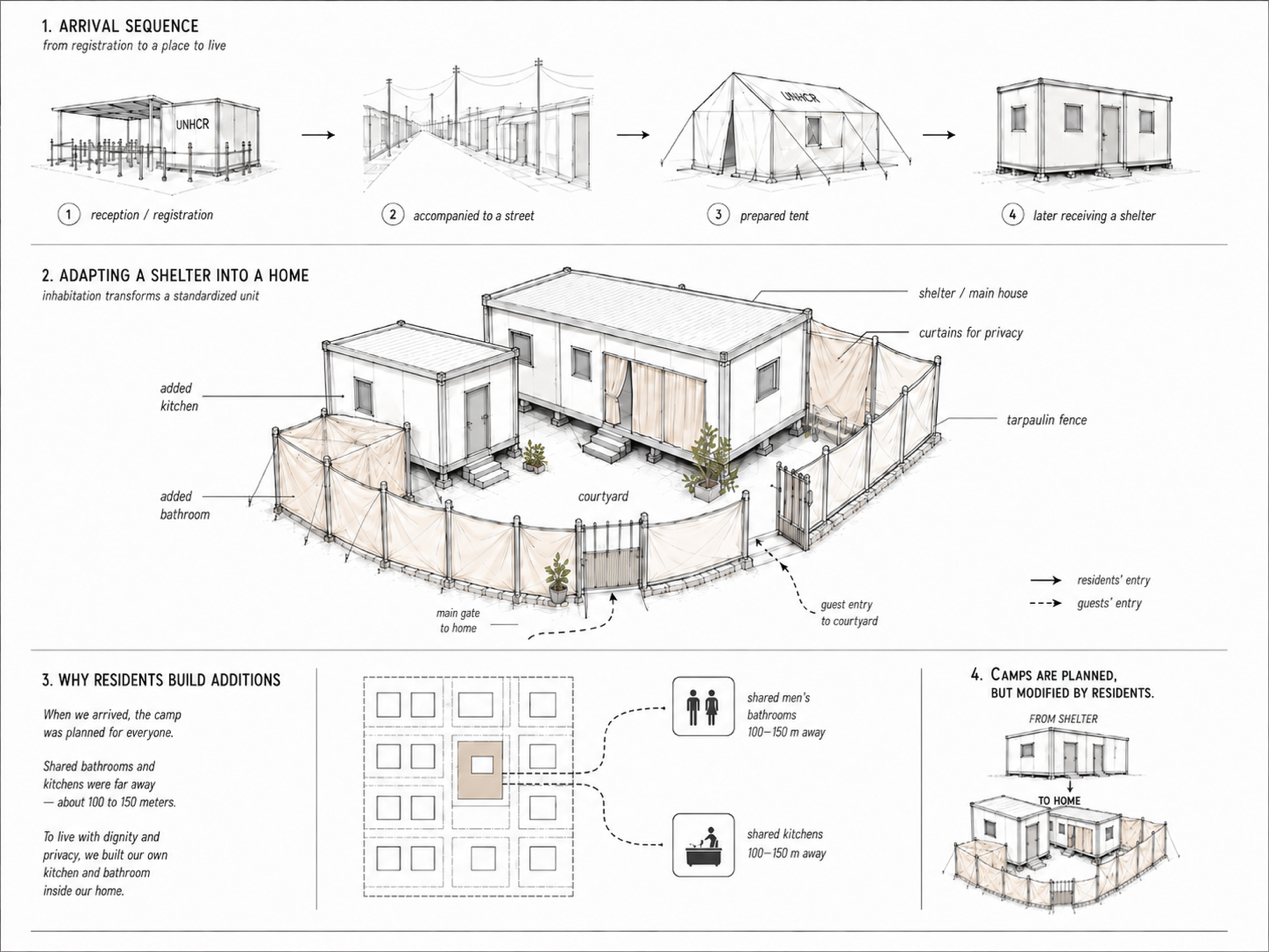
One of the clearest signs of this transformation is the shift from tents to prefabricated shelters. In the early phase of the camp, tents functioned as the primary architectural response to displacement. Over time, they were replaced by approximately 25,000 prefabricated shelters (Carlisle, 2022). This transition should not be understood only as a technical improvement. It marks a change in the camp’s temporal and spatial conditions. The shelter becomes more durable, and with that durability, residents begin to reorganize domestic life: creating privacy, attaching extensions, forming courtyards, arranging thresholds, and producing everyday routines. Please see Figure 2 figure illustrates the transition from arrival and shelter allocation to resident-led domestic adaptations.
This transformation is important because it reveals the contradiction of protracted temporariness. The camp remains politically temporary, but its shelters, routines, and social relations become long-term. As Brun and Fábos (2015) argue, homemaking in protracted displacement takes place under uncertain and often suspended conditions. Home is not necessarily tied to permanence, property, or citizenship; it can also be produced through routines, attachments, memories, and social relations in spaces of waiting. In Zaatari, the prefabricated shelter becomes a site where this contradiction is materialized: it stabilizes everyday life without resolving displacement.
The demographic life of the camp further strengthens this point. By 2022, more than 20,000 births had been recorded in Zaatari (Carlisle, 2022). This figure challenges any interpretation of the camp as merely a temporary container of displaced populations. Births produce generational continuity. They indicate that Zaatari is not only a place of arrival, but also a place where childhood, family life, education, memory, and future expectations are formed. The camp therefore becomes a space of social reproduction, even while its residents remain governed through a political condition of temporariness.
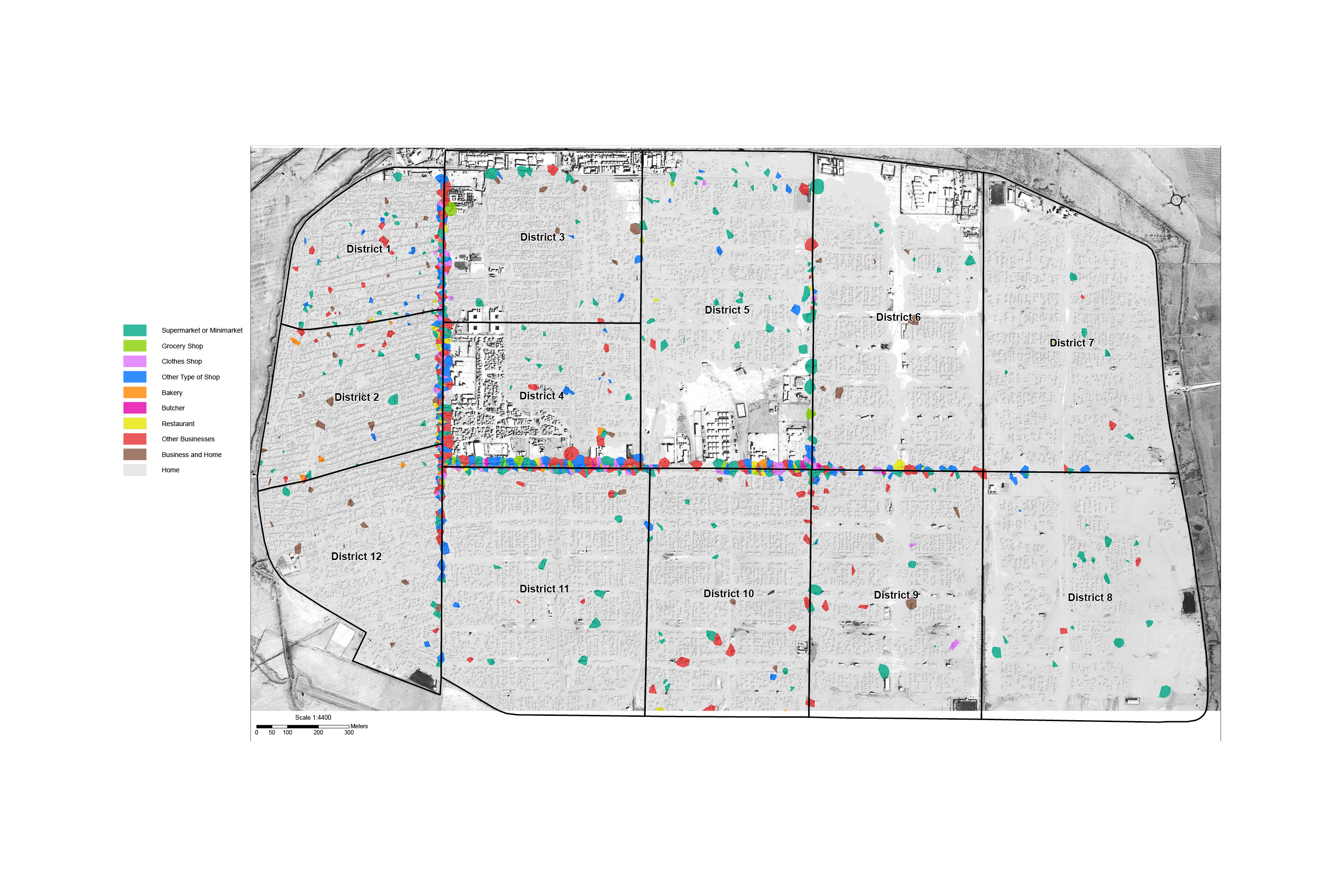
Economic life also reveals the urbanization of the camp. The emergence of the “Sham Elysees” market, with around 2,500 shops extending along almost three kilometers through the center of Zaatari, shows how residents have produced economic centrality within a humanitarian landscape (Carlisle, 2022). The market is not simply an informal addition to humanitarian provision. It is a spatial and social infrastructure through which residents create livelihoods, exchange goods, maintain cultural practices, and connect with suppliers and towns beyond the camp. Humanitarian systems may distribute assistance, but residents produce economies. As shown in Figure 3 the emergence of refugee-owned shops and commercial activity within the camp.
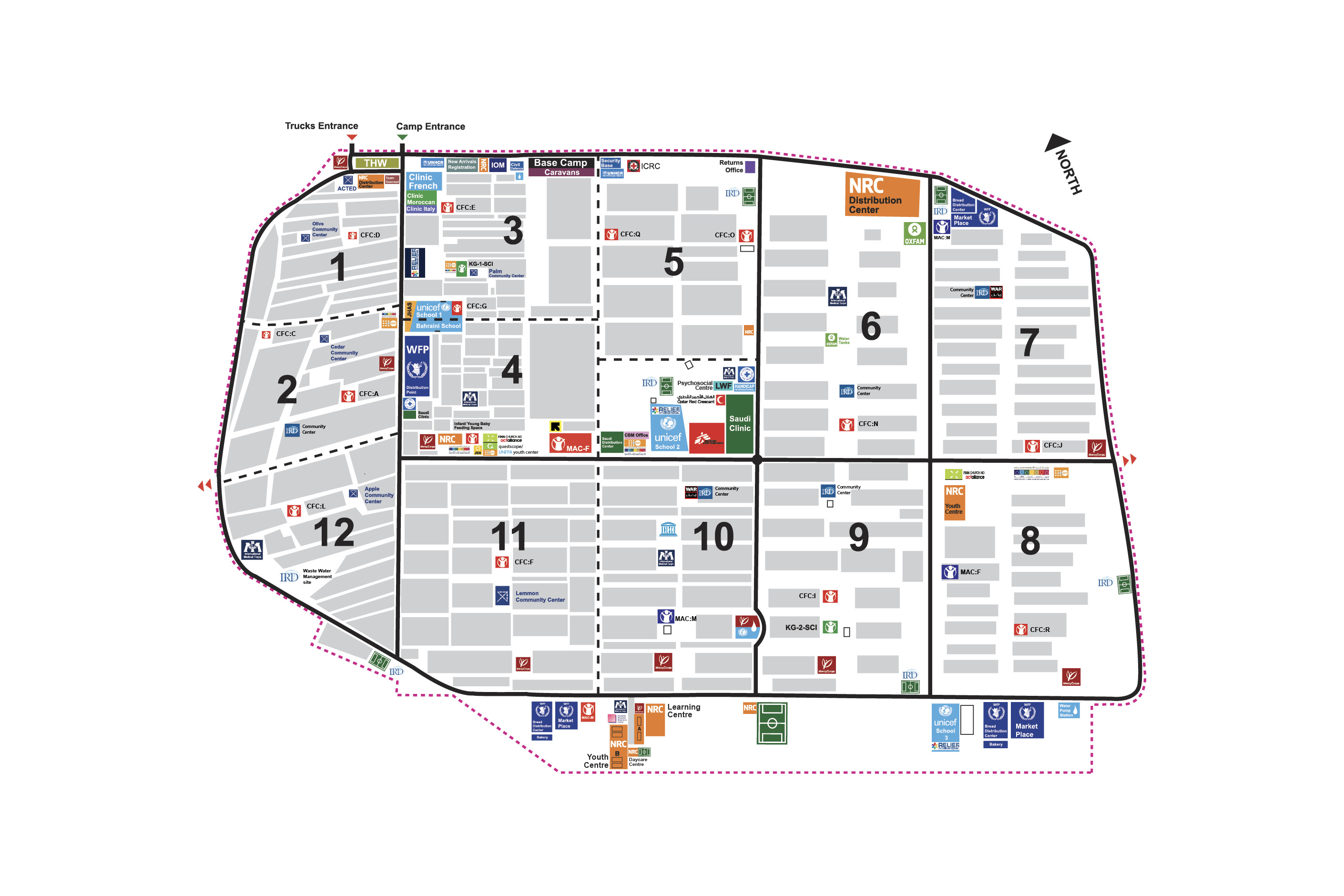
The marketization of Zaatari illustrates what Sanyal (2014) describes as the active production of refugee space. Refugees are not only housed within humanitarian infrastructures; they reshape those infrastructures socially, economically, and politically. In Zaatari, streets become commercial corridors, shelters become shops, and everyday circulation becomes a form of public life. This does not mean that the camp becomes a city in the conventional sense. Rather, it shows how urban practices emerge within and against the constraints of humanitarian governance. Health care and service provision further demonstrate how emergency infrastructures become institutionalized. By 2022, Zaatari included eight medical facilities providing approximately 25,000 consultations per month (Carlisle, 2022). These figures indicate that health care in the camp is no longer only an immediate response to crisis. It has become a routinized institutional system embedded in the spatial organization of the camp. Clinics, referral mechanisms, ambulances, maternal care, and service networks create a geography of care. At the same time, this infrastructure remains tied to humanitarian mandates, donor funding, and administrative regulation. Figure 4 illustrates the spatial distribution of humanitarian facilities and operational infrastructures, showing how emergency response became organized through a multi-actor institutional geography.
The governance of Zaatari confirms its complexity as an urban-political formation. The camp has been managed through the coordination of UNHCR, Jordanian authorities, international organizations, NGOs, service providers, and refugee communities. Such governance is not simply administrative. It is spatial. It organizes access to shelter, services, movement, documentation, work opportunities, education, health care, and public space. Agier’s concept of humanitarian government is useful here because it shows that camps are produced not only through assistance, but also through classification, coordination, dependency, and control (Agier, 2011). In Zaatari, emergency became durable because it became managed, mapped, serviced, and institutionalized.
The recent decline in population adds another layer to this interpretation. Zaatari is shrinking, but it is not disappearing. A decrease in the number of registered residents does not erase the spatial and institutional order produced over more than a decade. Roads, shelters, service networks, markets, schools, clinics, administrative memories, and social relations remain. The camp’s reduction in size may alter its density and functions, but it does not undo the territorial formation that emergency governance has produced. This is why Zaatari must be analyzed not only as an emergency site, but as a protracted urban condition.
The significance of Zaatari lies precisely in this contradiction. It produces urban life without full urban rights. It generates infrastructures without secure permanence, markets without political incorporation, dwellings without full belonging, and public life under conditions of restricted mobility. Its streets, shelters, schools, clinics, markets, and administrative systems are recognizable to urban planning and architecture, yet they are embedded in a legal and political regime that continues to frame residents as temporary. Zaatari is therefore not simply an urbanized camp. It is a politically constrained urban formation produced through the prolonged organization of emergency.
Methodology: AI-Assisted Visual Elicitation and Participatory Spatial Knowledge
This article draws on an AI-assisted participatory workshop conducted by the author with Syrian refugees in Zaatari Camp in October 2025. The workshop was designed as a form of visual elicitation and participatory spatial knowledge production, rather than as a conventional design exercise. Its aim was not to produce final architectural proposals, but to understand how refugees perceive existing camp spaces, identify everyday spatial needs, and imagine alternative futures for the camp through visual scenarios. The methodological approach builds on participatory traditions in design and planning, which argue that users and residents should not be treated merely as passive recipients of expert knowledge, but as active contributors to the definition of spatial problems and possibilities (Sanoff, 2000). It also draws on co-creation theory, where non-designers participate in generating ideas, meanings, and future possibilities alongside researchers or facilitators (Sanders & Stappers, 2008). In this sense, the workshop did not approach refugees only as interviewees or respondents. Rather, it positioned them as spatial co-authors capable of interpreting existing spaces and articulating possible transformations.
The workshop used existing photographs of Zaatari Camp as the starting point for discussion and visual transformation. These photographs included vacant plots, underused open areas, ordinary streets, health-related service areas, commercial corridors, and residual spaces within the camp. Participants discussed these spaces in relation to everyday experience: shade, safety, mobility, waiting, children’s play, women’s sociability, health, market life, comfort, and public gathering. These discussions then informed AI-assisted image generation through the UrbanistAI tool. The generated images translated participants’ spatial priorities into visual scenarios, including shaded women-oriented communal spaces, greener health environments, child-friendly parks, safer streets, and improved market corridors.
The role of AI in this process was therefore limited and mediated. AI was not used as an autonomous designer, nor were the images treated as objective or technically resolved planning outputs. Rather, AI functioned as a visual mediation tool that helped participants move from verbal description toward spatial representation. This is methodologically important because visual methods can make visible dimensions of spatial experience that may be difficult to express through words alone, particularly in contexts shaped by displacement, institutional asymmetry, language differences, or limited access to professional design tools (Rose, 2016). The images allowed participants to discuss not only what was missing in the camp, but also what kind of spatial life they considered desirable, dignified, and meaningful.
The generated images are therefore interpreted in this article as co-produced visual scenarios. They are not presented as final design solutions, architectural renderings, or technical masterplans. Their value lies in the participatory process through which they were produced and interpreted. They reveal how refugees understand camp spaces not only in terms of deficiency, but also in terms of possibility. Across the scenarios, participants repeatedly emphasized modest but significant spatial qualities: shade, greenery, seating, walkability, safety, play, sociality, gender-sensitive gathering, and small-scale economic opportunity. These recurring elements show that the desired transformation of the camp was not centered on spectacular architecture, but on everyday spatial conditions that support public life, care, mobility, and dignity.
This methodological framing is also ethically necessary. AI-generated images can risk aestheticizing poverty, simplifying complex political conditions, or obscuring the authorship of the communities whose experiences and aspirations inform the images. For this reason, the images are explicitly framed as refugee-led, workshop-mediated, and researcher-facilitated. This method relied on Costanza-Chock’s concept of design justice, which emphasizes that design processes should center the knowledge, agency, and priorities of those most affected by structural inequality (Costanza-Chock, 2020). Applied to Zaatari, this means that the images situated visual claims grounded in refugees’ lived experience.
The analysis of the workshop materials followed a thematic reading of the visual scenarios and the discussions that informed them. The scenarios were grouped according to the spatial themes that emerged most strongly: community and women-oriented spaces, health-related environments, parks and play areas, streets, and market corridors. Within each theme, attention was given to the spatial qualities repeatedly requested or visualized by participants, including shade, vegetation, seating, safety, pedestrian comfort, social encounter, children’s play, and economic activity. This analytical process allowed the images to be read not as isolated visual outputs, but as evidence of broader refugee-led spatial imaginaries. The methodological contribution of the workshop lies in its shift from needs assessment to spatial future-making. Rather than asking participants only to describe problems, the workshop enabled them to visualize alternative environments and make their spatial priorities discussable. The AI-assisted scenarios became a bridge between everyday experience and planning knowledge, showing how residents imagine the camp not only as it is, but as it could become.
Findings: Refugee-Led Spatial Future-Making
The AI-assisted workshop generated a series of visual scenarios through which refugees in Zaatari articulated how everyday camp spaces could be transformed. Across the scenarios, participants repeatedly emphasized a consistent spatial vocabulary: shade, greenery, seating, walkability, safety, play, sociality, women’s gathering spaces, dignified health environments, and small-scale economic opportunities. These recurring elements are analytically significant. They show that refugees did not imagine the future of the camp through spectacular architectural interventions, but through modest and everyday spatial conditions that could support dignity, comfort, mobility, care, social encounter, and public life.
The findings are organized around four themes: gendered spaces of sociability and care; health environments beyond service delivery; childhood, play, and social reproduction; and streets and markets as public realm. Together, these themes support the article’s concept of refugee-led spatial future-making: the process through which displaced residents imagine, visualize, and articulate alternative spatial conditions within protracted camps.
Gendered Spaces of Sociability and Care
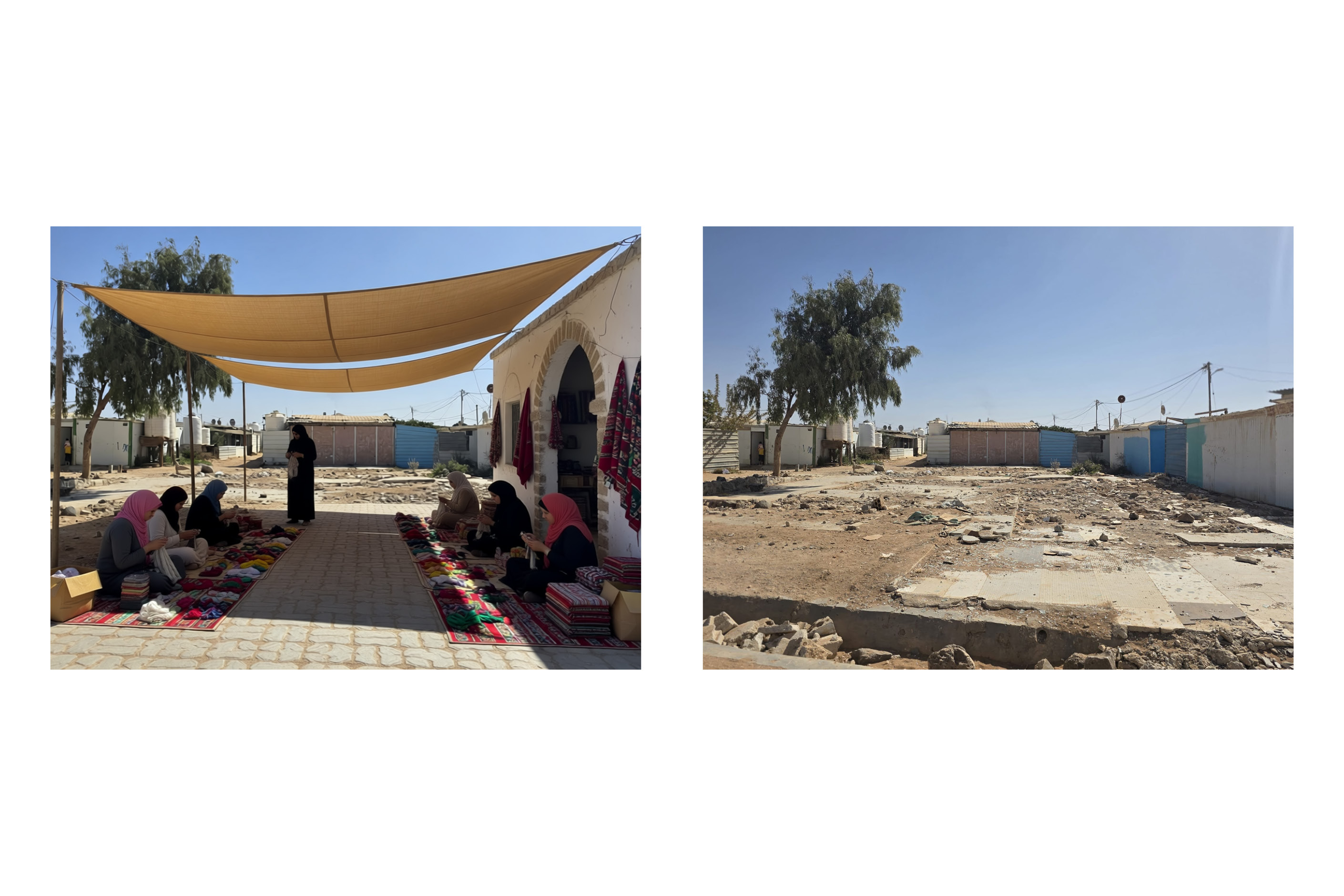
One of the strongest findings concerns women-oriented communal spaces. In several scenarios, participants reimagined vacant or residual plots as shaded, semi-protected spaces for women’s gathering, social exchange, childcare, rest, and small-scale productive activities. These spaces were not imagined as monumental public facilities, but as modest everyday environments made through shade structures, carpets, seating, plants, and partially enclosed arrangements.
This finding is important because it shows that public life in the camp is not only about open access or physical availability. For women, public presence is also shaped by comfort, privacy, safety, shade, visibility, and social acceptability. The workshop images suggest that women’s participation in public life requires spaces that mediate between domestic life and the openness of camp streets. In this sense, the imagined communal spaces extend homemaking beyond the shelter and into the neighborhood. They show how belonging can be produced not only through housing, but also through shared spaces of care, conversation, work, and mutual support.
This resonates with Brun and Fábos’s (2015) argument that homemaking in protracted displacement is not confined to the domestic interior. Home is produced through wider social and spatial relations, including routines and everyday practices. In Zaatari, women-oriented communal spaces show how residents imagine forms of public life that are socially embedded and gender-sensitive. They also confirm Awan et al.’s (2011) understanding of spatial agency: refugees are not passive users of humanitarian space, but active interpreters and producers of spatial possibilities. As illustrated in
Health Environments Beyond Service Delivery
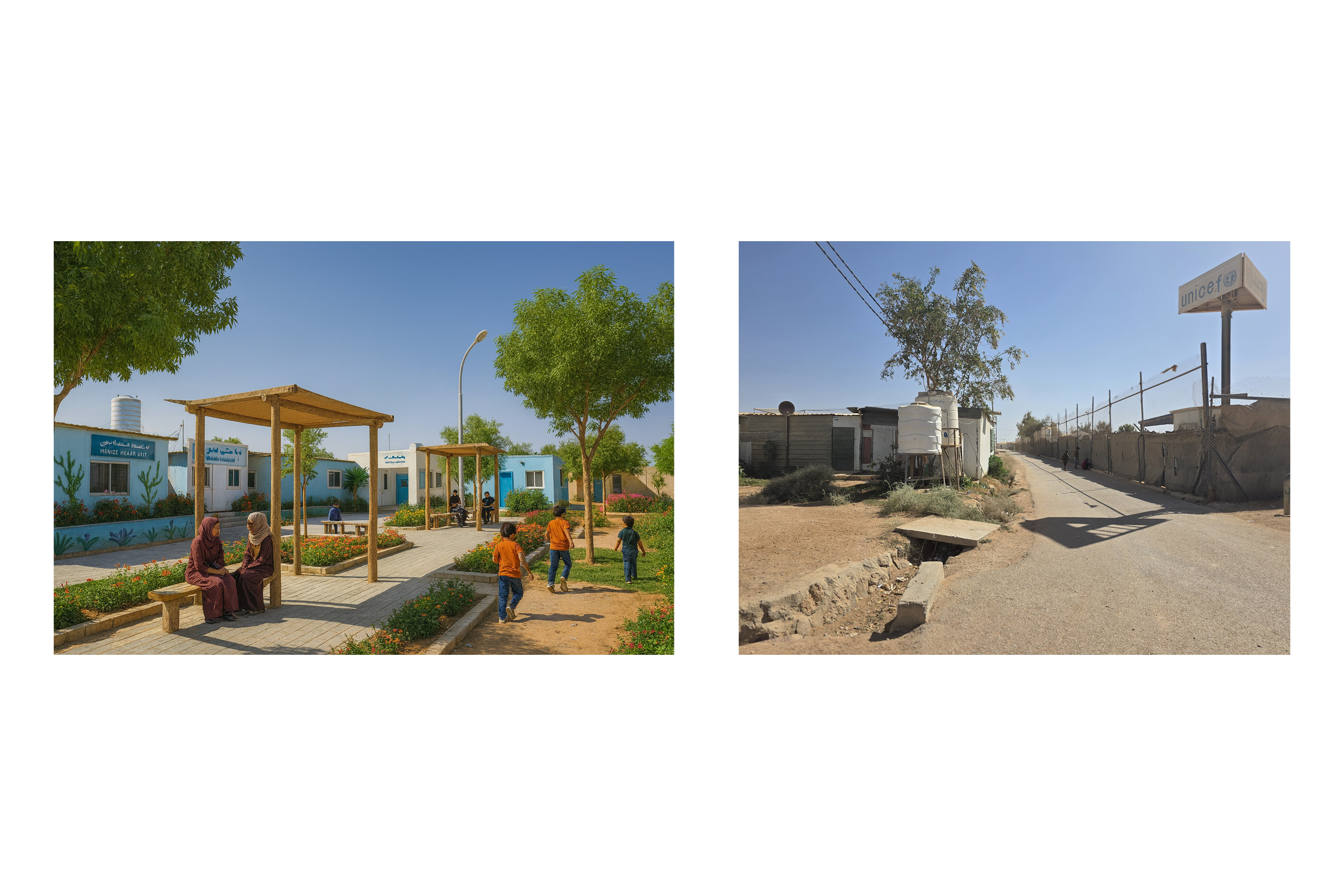
A second group of scenarios focused on health-related environments. Participants reimagined service corridors and clinic surroundings as greener, softer, and more welcoming spaces, with shaded walkways, trees, planted edges, seating areas, and clearer transitions between buildings and public space. These images show that refugees do not understand health infrastructure only through the availability of clinics or medical services. They also associate health with the spatial experience of waiting, moving, accompanying others, resting, orienting oneself, and remaining in dignified conditions.
This shifts the meaning of health infrastructure from service delivery toward spatial dignity. In humanitarian planning, health facilities are often evaluated through access, capacity, medical equipment, and service coverage. These dimensions remain essential. However, the workshop scenarios reveal another layer: the everyday environment around health services also matters. Shade, seating, calm, greenery, and accessible paths shape how people experience care before and after entering the clinic. Health is therefore not only institutional; it is also spatial and atmospheric.
The significance of these scenarios lies in the fact that they make visible a form of knowledge often absent from technical planning documents. Residents identified not only where services are located, but how those spaces feel and function in everyday life. Following Rose’s (2016) understanding of visual methods, these images can be read as visual research materials that reveal how people see and evaluate spatial conditions. They show that refugees’ claims for better health environments are also claims for comfort, waiting, social support, accessibility, and dignity. As illustrated in Figure 6, the left image shows an existing health-related service area characterized by exposed circulation, hard edges, limited shade, and a mainly functional relationship between buildings, fences, and pathways. The right image reimagines the same setting as a more welcoming health environment through shaded walkways, trees, planted edges, seating areas, and softer transitions between buildings and public space
Childhood, Play, and Social Reproduction
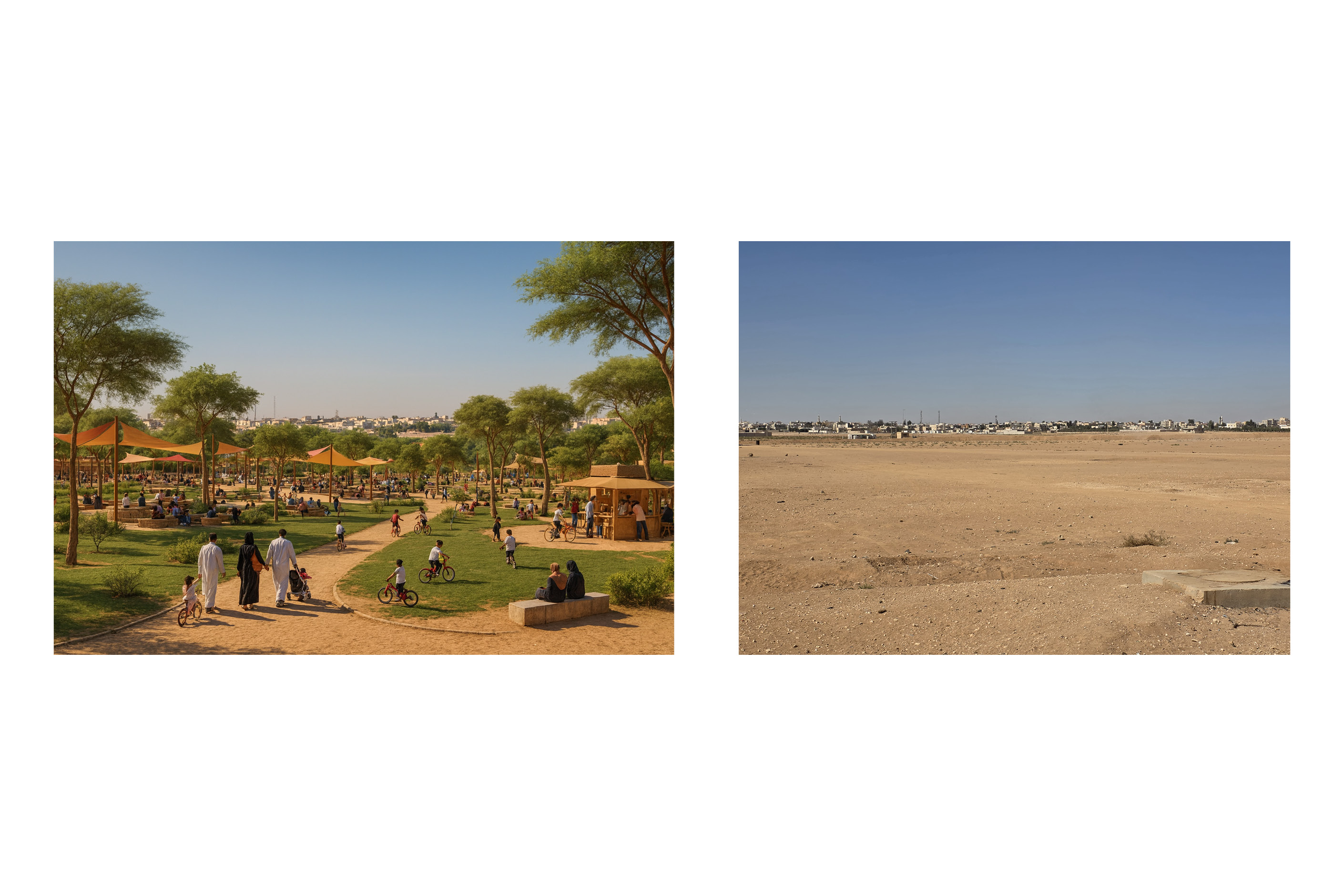
A third set of scenarios focused on parks, playgrounds, and child-friendly open spaces. Participants transformed vacant land, residual spaces, and underused plots into shaded community parks, play areas, sports spaces, seating areas, and family-oriented gathering places. These images are particularly important in Zaatari because the camp has become a place of generational continuity. By 2022, more than 20,000 births had been recorded in the camp (Carlisle, 2022). Many children have therefore known Zaatari not as a temporary interruption, but as their everyday world.
For this reason, play areas cannot be treated as secondary amenities. In a protracted camp, spaces for play become infrastructures of childhood, family life, and social reproduction. They allow children to move, interact, imagine, and develop routines beyond the minimal logic of shelter and service provision. They also support families, especially women and caregivers, by creating spaces where supervision, rest, encounter, and social interaction can take place.
This finding connects directly to the article’s broader argument about protracted temporariness. If displacement continues for years, then everyday life cannot be reduced to survival. The spatial needs of children, families, and adolescents become central to the production of camp life. The imagined parks and playgrounds, therefore, represent more than recreational space. They are visual claims to normalcy, safety, intergenerational encounter, and future-making. In Lefebvre’s (1991) terms, they show how space is socially produced through everyday needs, practices, and aspirations, rather than only through institutional planning. As in Figure 7 & 8, the left image shows an existing open plot characterized by exposed ground, limited vegetation, and the absence of shaded or programmed public space. The right image reinterprets the vacant land known to the refugees as Sater turabi-Earth berm, where refugees meet in the evening to seek a cool breeze, serving as a shaded community park for children, families, and everyday social life. Through trees, soft pathways, shaded seating, play areas, small kiosks, and gathering spaces, the scenario shows how residual camp land can support play, mobility, encounter, care, and collective well-being.
Streets and Markets as Public Realm
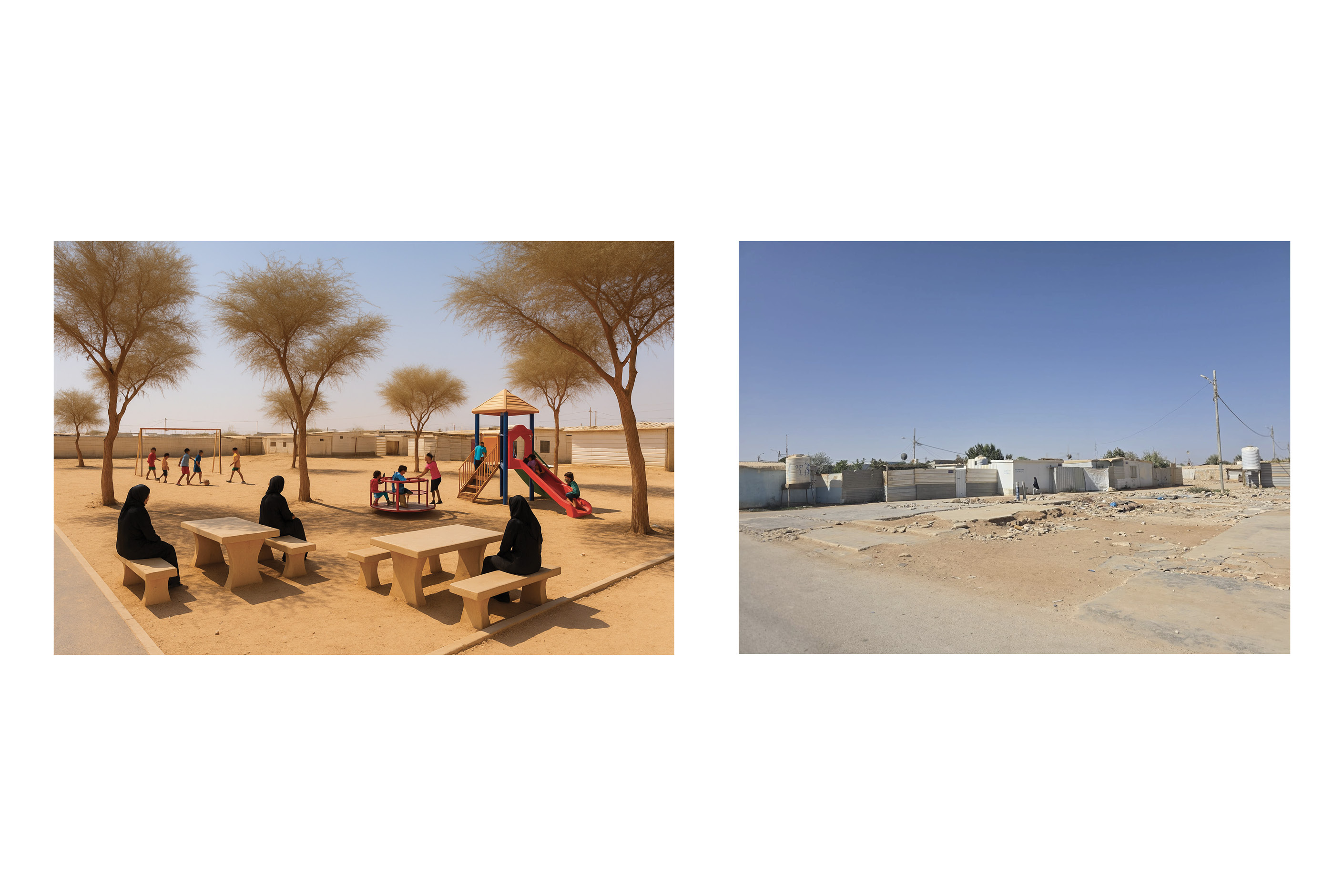
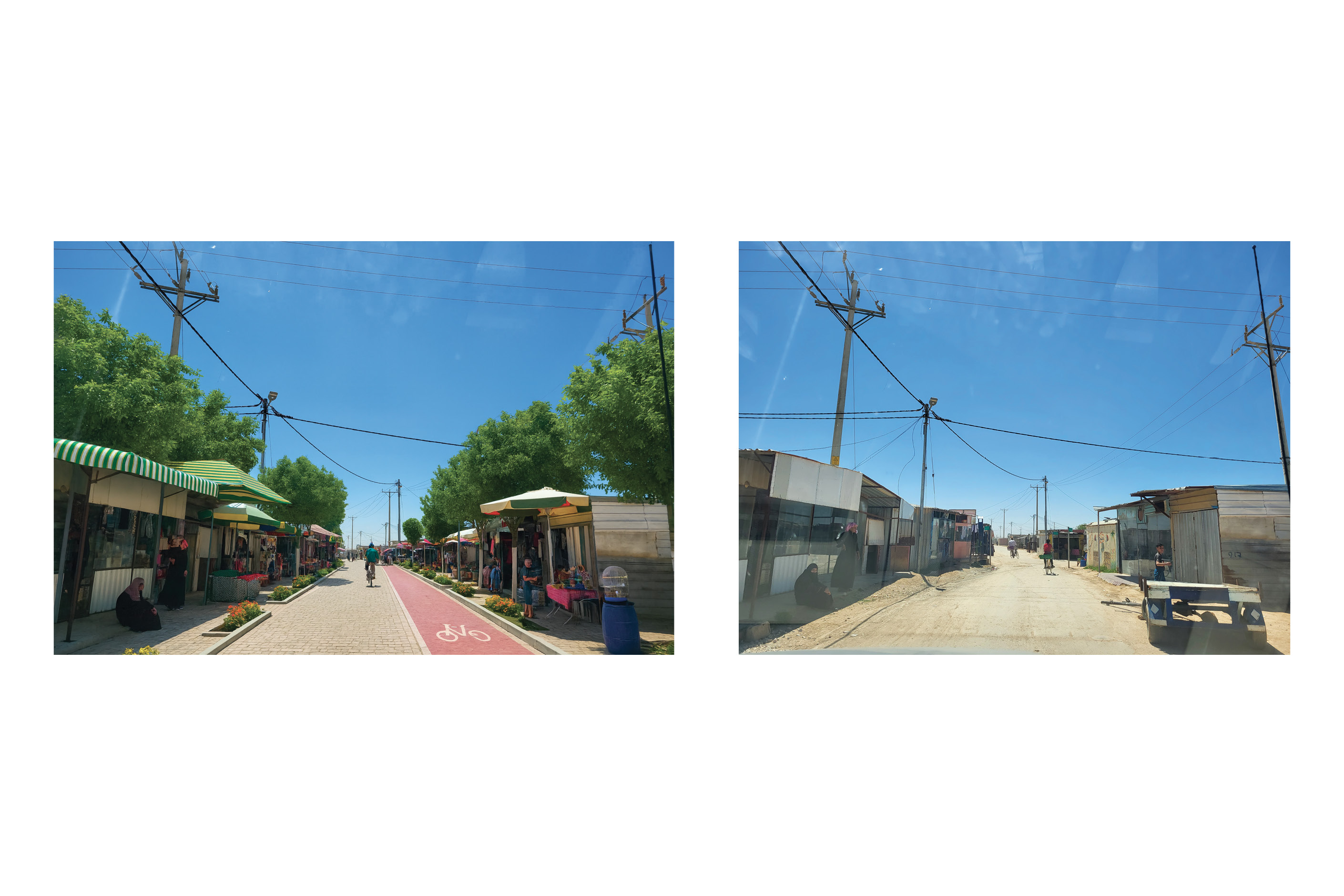
The fourth finding concerns streets and markets. Participants reimagined ordinary camp streets and commercial corridors as shaded, walkable, greener, safer, and more socially active public spaces. Some scenarios emphasized pedestrian comfort, traffic calming, children’s movement, and playful markings. Others focused on market corridors, adding shade, shopfront improvements, planted edges, bicycle lanes, seating, and kiosks. These scenarios show that refugees do not understand streets only as circulation routes. Streets are also spaces of encounter, trade, waiting, play, movement, and identity. This is particularly important in Zaatari, where the emergence of the “Sham Elysees” market has already shown how residents transform linear circulation spaces into zones of economic and social centrality. The AI-assisted images extend this logic by imagining streets not merely as functional corridors, but as a public realm.
This finding aligns with Sanyal’s (2014) argument that refugees actively produce space physically and politically. In Zaatari, the street is not only planned from above; it is inhabited, appropriated, animated, and reimagined from below. De Certeau’s (1984) concept of everyday tactics is also useful here. Refugees work within the constraints of the camp’s official layout, but they reinterpret streets through everyday practices: walking, selling, playing, sitting, meeting, and modifying thresholds. The workshop scenarios make these practices visible as spatial claims.
The market and street images also show that camp urbanism is produced through everyday uses as much as through formal planning. Roads become public spaces. Shops become social interfaces. Market corridors become places of exchange and identity. Residential streets become play spaces and routes of social encounter. These transformations do not erase the political constraints of encampment, but they reveal how refugees produce urban life within them. In Figure 9, the left image shows an existing street characterized by exposed ground, informal shopfronts, limited shade, overhead infrastructure, and a primarily functional role as a movement corridor. The right image reimagines the street as a shaded, walkable, and economically active public realm. Through trees, paved pedestrian surfaces, shaded shopfronts, small kiosks, planted edges, seating, and a bicycle lane, the scenario shows how refugee-led spatial imaginaries can support safer mobility, everyday encounters, small-scale economies, and urban dignity within the camp.
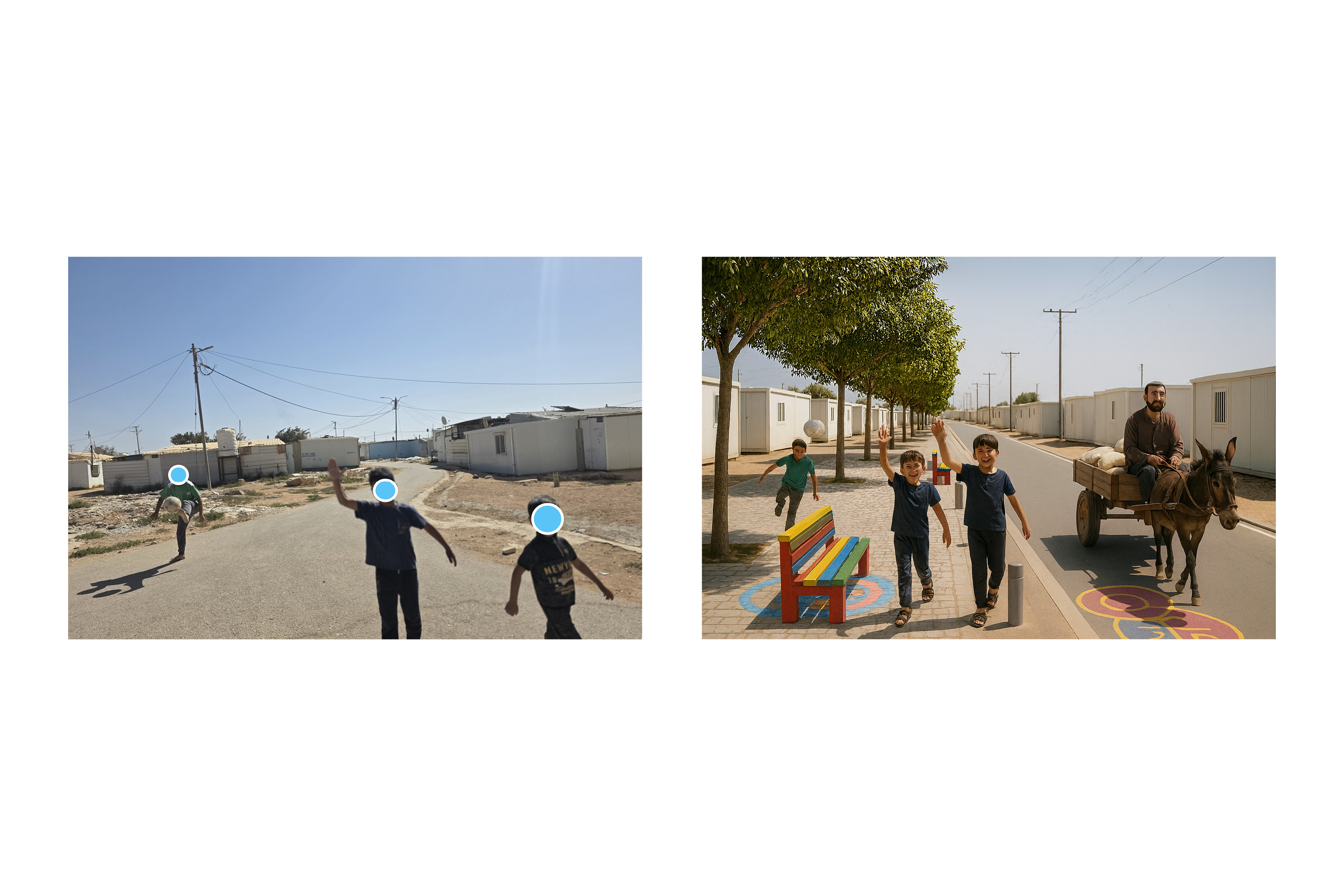
The second scenario in Figure 10 depicts an existing residential street where children use the road as an informal play space despite limited shade, exposed ground, fragmented edges, and the absence of dedicated pedestrian or recreational infrastructure. The refugee-led spatial imaginary reinterprets the street as a safer, shaded, and child-friendly public realm through trees, paved pedestrian areas, seating, playful ground markings, and clearer separation between movement and social use.
Taken together, these four findings show that refugee-led spatial future-making in Zaatari is grounded in everyday urban priorities. Participants did not imagine the camp’s future primarily through large-scale infrastructure or formal architectural objects. Instead, they emphasized the spatial conditions that make everyday life more dignified. These priorities demonstrate that refugees are not only adapting to a humanitarian landscape; they are actively imagining alternative forms of urban life within it. The AI-assisted scenarios reveal how residents of a protracted camp articulate futures beyond survival while remaining within the constraints of humanitarian governance and political temporariness. This is the core meaning of Zaatari beyond emergency: not that the camp has become a normal city, but that its residents continue to produce, inhabit, and imagine spatial futures through everyday claims to dignity, care, mobility, sociality, and belonging.
Discussion: From Humanitarian Space to Spatial Claims
The findings show that the AI-assisted scenarios produced in Zaatari should not be read simply as “visions” of better camp spaces. They are more than visual preferences or speculative images. They are spatial claims. Through them, refugees articulated what they considered necessary for dignified everyday life in a protracted camp: shade, safety, greenery, seating, play, mobility, women’s sociability, health-supportive environments, market life, and public space. These elements may appear modest, but they reveal a deeper political and spatial argument. They show that refugees not only adapt to humanitarian infrastructures; they also imagine what those infrastructures could become.
This distinction is central. Humanitarian planning often begins from the question of minimum provision: shelter, water, sanitation, food distribution, protection, schooling, and health services. These are essential, but they do not fully capture the spatial conditions through which everyday life becomes livable. The workshop scenarios show that residents’ priorities extend beyond survival. They include comfort, public presence, childhood, social interaction, economic activity, waiting, walking, gathering, and belonging. In this sense, the images shift the analysis from humanitarian space as a system of provision to camp space as a field of claims. The discussion, therefore, develops three contributions: conceptual, empirical, and methodological.
Conceptual Contribution: Refugee-Led Spatial Future-Making
The first contribution of this article is conceptual. It develops the notion of refugee-led spatial future-making to describe how displaced residents imagine, visualize, and articulate alternative spatial conditions within protracted camps. This concept builds on debates on camp urbanism, protracted temporariness, everyday spatial agency, and participatory visual methods. It highlights that refugees are not only recipients of humanitarian space, but also tactical users of imposed infrastructures. They are also future-oriented spatial actors.
This matters because much of the literature on camps has emphasized governance, exception, control, humanitarian management, and political suspension. Agier’s work remains essential for understanding camps as spaces of humanitarian government, where displaced populations are administered through regimes of protection, classification, assistance, and control (Agier, 2011). Yet, as Ramadan (2013) and Sanyal (2014) show, camps must also be understood as spatial and urban formations produced through everyday practices, political relations, and refugee agency. The concept of refugee-led spatial future-making extends this discussion by focusing not only on how refugees inhabit or adapt camp space, but also on how they imagine its possible transformation. In Zaatari, this future-making appears through visual claims for spaces that are cooler, safer, greener, more social, more walkable, more playable, and more dignified. These claims are not abstract. They are grounded in everyday experiences of heat, exposure, waiting, insecurity, limited public space, children’s needs, women’s social life, market activity, and mobility. They therefore connect imagination to lived spatial conditions. Refugee-led spatial future-making can be defined as: the process through which displaced residents imagine, visualize, and articulate alternative spatial conditions within protracted camps, transforming everyday needs into claims for dignity, public life, care, mobility, economic life, childhood, and belonging.
This concept helps avoid two limitations. First, it avoids reducing refugees to passive beneficiaries of humanitarian planning. Second, it avoids romanticizing camp adaptation as evidence of resilience alone. The point is not that refugees “make do” with limited conditions, but that they identify, contest, and reimagine those conditions through spatial claims.
Empirical Contribution: Zaatari as a Protracted Urban Condition
The second contribution is empirical. The article reads Zaatari not merely as an emergency camp, but as a protracted urban condition. The earlier analysis showed that Zaatari has moved through several phases: emergency arrival, rapid demographic expansion, infrastructural consolidation, social and economic urbanization, and partial demographic decline. Over time, tents were replaced by prefabricated shelters; streets and districts were consolidated; markets emerged; schools, clinics, energy systems, and administrative infrastructures became embedded in camp life; and residents produced domestic routines, economic practices, and social attachments.This transformation demonstrates that an emergency does not simply disappear when it is organized. Rather, it becomes territorial. It produces spatial systems, service networks, institutional arrangements, and everyday routines. Zaatari is therefore not outside the urban question. It is a politically constrained form of urbanization, shaped by humanitarian governance, state regulation, infrastructural consolidation, and refugee agency.
At the same time, the article does not claim that Zaatari has become a city in a conventional sense. This distinction is important. Zaatari produces urban life without granting full urban rights. It generates markets, streets, shelters, public spaces, schools, clinics, and social infrastructures, but these remain embedded in a legal and political condition of temporariness. Residents inhabit and transform the camp, yet their mobility, rights, and future possibilities remain constrained. The empirical contribution is therefore to read Zaatari through its contradiction: it is materially durable but politically temporary; socially productive but legally suspended; urban in practice but constrained in status. This is precisely why the AI-assisted scenarios matter. They reveal what kind of urban life residents imagine within this contradiction. The images show that the future of Zaatari is not only a question of camp management, service provision, or demographic decline. It is also a question of spatial dignity and residents’ claims to everyday public life.
Methodological Contribution: AI-Assisted Visual Elicitation as Participatory Spatial Knowledge
The third contribution is methodological. The article shows how AI-assisted visual elicitation can support participatory spatial knowledge when it is carefully and ethically framed. The workshop did not use AI as an autonomous design tool, nor did it treat generated images as final architectural proposals. Instead, AI functioned as a visual mediation tool through which residents could translate everyday experiences and spatial priorities into discussable visual scenarios. This approach builds on participatory design and co-creation traditions of Sanoff (2000), and Sanders and Stappers (2008). In the Zaatari workshop, this meant shifting refugees from respondents to spatial co-authors. Participants did not simply answer questions about needs; they helped generate visual scenarios of possible spaces.
The use of images is also methodologically important. Visual methods can reveal dimensions of spatial experience that are difficult to capture through verbal interviews alone, including atmosphere, comfort, visibility, exposure, safety, and the social meaning of space (Rose, 2016). In the workshop, images of existing camp spaces became prompts for discussion, critique, and transformation. The generated scenarios, therefore, became visual research materials: they made residents’ spatial priorities visible, comparable, and open to interpretation.
However, the use of AI in such contexts requires caution. AI-generated images can aestheticize hardship, simplify political conditions, or obscure authorship. For this reason, the images are framed as refugee-led, workshop-mediated, and researcher-facilitated, relying on Costanza-Chock’s (2020) concept of design justice. In this article, the value of the AI images lies not in their technological novelty, but in the participatory process through which they were produced and interpreted.
The methodological contribution is therefore not that AI can “solve” camp planning. Rather, the article shows that AI-assisted visual elicitation can help make spatial claims visible when it is embedded in participatory discussion, ethical authorship, and critical interpretation. The images are not solutions. They are evidence of how refugees understand, evaluate, and imagine the spatial conditions of everyday life.
From Spatial Claims to the Politics of Camp Futures
Taken together, the findings challenge the idea that humanitarian space can be fully understood through provision, management, or infrastructure alone. Zaatari’s residents claim more than services. They claim shade as protection from exposure; seating as a condition of public presence; play as a right of childhood; women’s spaces as infrastructures of sociability and care; streets as public realm; markets as economic and social life; and health environments as spaces of dignity, not only treatment. These claims do not erase the political contradictions of encampment. Nor do they suggest that improving camp space is a substitute for rights, mobility, citizenship, or durable solutions. Rather, they show that while these broader political questions remain unresolved, residents continue to produce and imagine spatial futures within the camp. This is the significance of reading Zaatari beyond emergency. The camp is not beyond emergency because displacement has ended. It is beyond emergency because emergency has become durable, inhabited, and imagined otherwise by those who live within it.
The article therefore contributes to debates on displacement, urbanism, and participatory planning by showing that protracted camps are not only spaces of humanitarian management. They are also spaces of spatial claim-making. Refugees do not only inhabit infrastructures designed by others; they reinterpret them, adapt them, and imagine what they could become. In this sense, refugee-led spatial future-making offers a way to understand the camp as both a constrained political space and a site of everyday urban imagination.
Conclusion: Beyond Emergency, Without Normalizing Encampment
This article has argued that Zaatari must be read beyond the language of emergency. Established as a temporary humanitarian response to the displacement of Syrians fleeing war, the camp has gradually become a protracted urban condition: a space where emergency infrastructures have become durable, where humanitarian governance organizes everyday life, and where refugees continue to produce, inhabit, and imagine spatial futures. Zaatari’s transformation from tents and emergency services into a complex spatial system of shelters, streets, markets, schools, clinics, administrative zones, and social infrastructures demonstrates that emergency, once spatialized, does not remain temporary in any simple sense. It becomes territorial, institutional, and lived.
However, to recognize Zaatari’s urban life is not to normalize encampment. This distinction is central to the article’s argument. The fact that residents have produced homes, markets, streets, routines, memories, and social relations within the camp should not be read as evidence that camps are acceptable long-term urban solutions. Rather, it reveals the unresolved contradiction of protracted displacement: refugees produce urban life within spaces still governed through temporariness, restricted rights, humanitarian dependency, and limited mobility. Zaatari is therefore urban, but not in the sense of full urban citizenship. It is a politically constrained urban formation. The concept of refugee-led spatial future-making has been introduced to explain this contradiction. It describes the ways displaced residents imagine, visualize, and articulate alternative spatial conditions within protracted camps. The AI-assisted workshop showed that refugees do not only adapt to humanitarian infrastructures; they also imagine what these infrastructures could become. Their visual scenarios claimed shade, safety, greenery, play, women’s sociability, dignified health environments, walkable streets, market life, and public space. These are not minor aesthetic preferences. They are everyday claims to dignity, care, sociality, mobility, childhood, economic life, and belonging.
The article has therefore made three contributions. Conceptually, it has developed refugee-led spatial future-making as a way to understand refugees as spatial actors who not only inhabit and modify camp space, but also imagine its possible futures. Empirically, it has read Zaatari as a protracted urban condition rather than merely as an emergency camp or an incomplete city. Methodologically, it has shown how AI-assisted visual elicitation can support participatory spatial knowledge when the process is ethically framed as refugee-led, workshop-mediated, and researcher-facilitated.
For architecture, planning, and humanitarian urbanism, the implications are significant. If protracted camps produce durable spatial and social realities, then planning cannot remain limited to minimum standards of shelter and service provision. It must also address the everyday infrastructures through which life becomes livable: public space, shade, walkability, safety, play, gender-sensitive gathering, health-supportive environments, and economic spaces. At the same time, improving camp environments cannot replace the need for rights, mobility, political recognition, and durable solutions. Spatial dignity matters, but it must not be used to depoliticize displacement.
Zaatari, beyond emergency, therefore names a difficult condition rather than a resolved future. It does not mean that the camp has overcome emergency or that it should become a permanent city. It means that the emergency has become prolonged, inhabited, and spatially productive. Residents have made homes, markets, streets, memories, and futures within a space still governed as temporary. Planning and architecture must therefore confront the contradiction between urban life and suspended rights: recognizing the spatial agency of refugees while refusing to accept encampment as a normal or permanent solution.
This text forms part of the author’s work for the SNIS project, which can be viewed via this link.
References
- Agamben, G. (1998). Homo sacer: Sovereign power and bare life (D. Heller-Roazen, Trans.). Stanford University Press.
- Agier, M. (2011). Managing the undesirables: Refugee camps and humanitarian government (D. Fernbach, Trans.). Polity.
- Awan, N., Schneider, T., & Till, J. (2011). Spatial agency: Other ways of doing architecture. Routledge.
- Brun, C. (2016). There is no future in humanitarianism: Emergency, temporality and protracted displacement. History and Anthropology, 27(4), 393–410. https://doi.org/10.1080/02757206.2016.1207637
- Brun, C., & Fábos, A. (2015). Making homes in limbo? A conceptual framework. Refuge, 31(1), 5–17.
- Carlisle, L. (2022). Jordan’s Za’atari refugee camp: 10 facts at 10 years. UNHCR.
- Costanza-Chock, S. (2020). Design justice: Community-led practices to build the worlds we need. MIT Press.
- de Certeau, M. (1984). The practice of everyday life. University of California Press.
- Hyndman, J., & Giles, W. (2016). Refugees in extended exile: Living on the edge. Routledge. https://doi.org/10.4324/9781315618029
- Lefebvre, H. (1991). The production of space. Blackwell.
- Ramadan, A. (2013). Spatialising the refugee camp. Transactions of the Institute of British Geographers, 38(1), 65–77. https://doi.org/10.1111/j.1475-5661.2012.00509.x
- Rose, G. (2016). Visual methodologies: An introduction to researching with visual materials. Sage.
- Sanders, E. B.-N., & Stappers, P. J. (2008). Co-creation and the new landscapes of design. CoDesign, 4(1), 5–18.
- Sanoff, H. (2000). Community participation methods in design and planning. Wiley.
- Sanyal, R. (2014). Urbanizing refuge: Interrogating spaces of displacement. International Journal of Urban and Regional Research, 38(2), 558–572.
- UNHCR. (2022). Jordan’s Za’atari refugee camp: 10 facts at 10 years.
- UNHCR. (2026). Jordan: Zaatari Refugee Camp Factsheet, January 2026.
- UNHCR. (2026a). Jordan: Zaatari Refugee Camp Factsheet, January 2026.
- UNHCR. (2026b). Zaatari Refugee Camp: Operational Data Portal.
- United Nations High Commissioner for Refugees. (2004, June 10). Protracted refugee situations (EC/54/SC/CRP.14).