Façade paints: an underestimated source of microplastics
The choice of paint raises two major public-health questions. On façades, the degradation of coatings can become a source of microplastic pollution; indoors, the substances they contain affect air quality.
Testo in italiano al seguente link
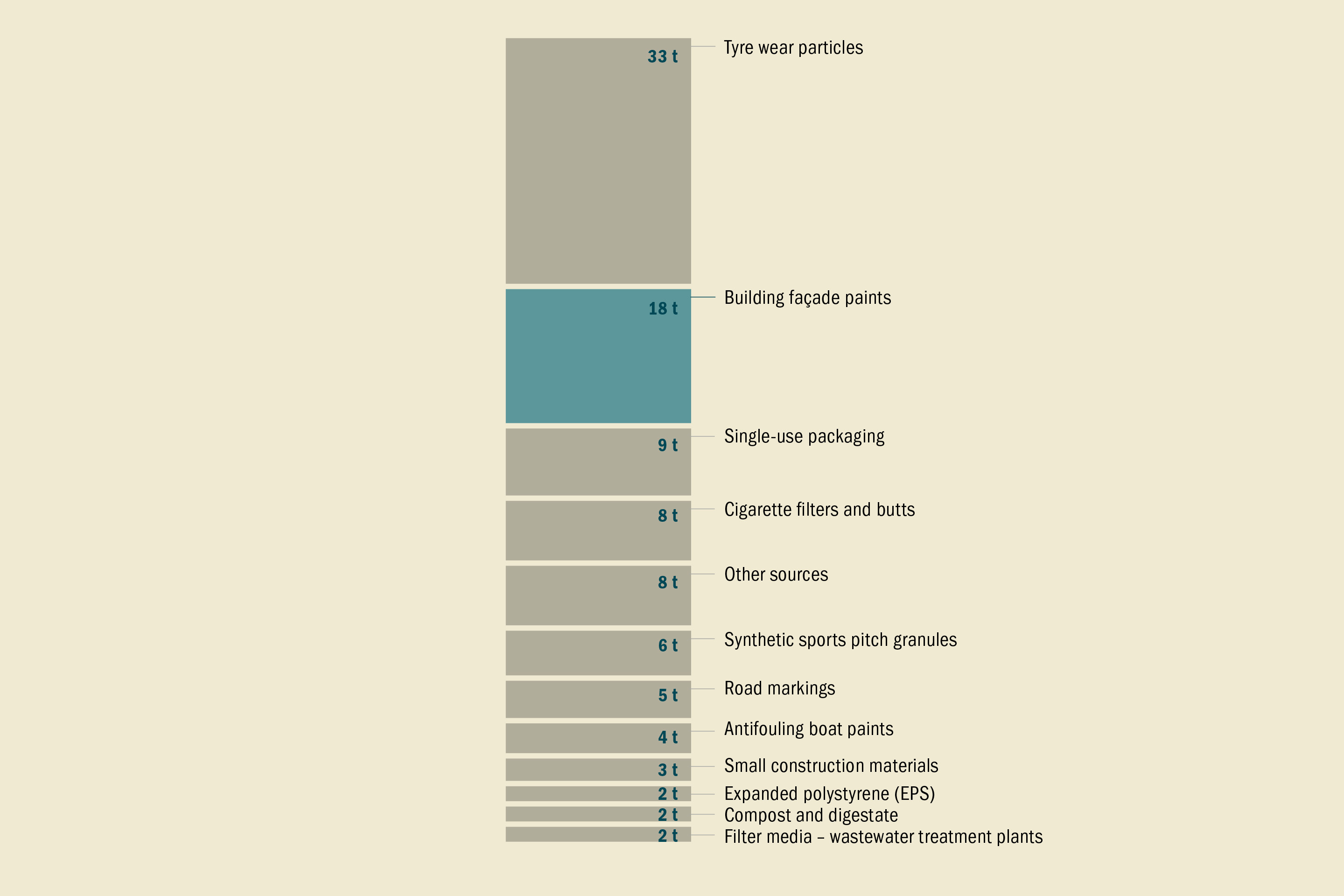
17 tonnes a year. This is the mean quantity of microplastics from façade paints that ends up in Lake Geneva, according to a recent study1 commissioned by the Association pour la Sauvegarde du Léman (ASL). During rainfall, these paint residues mix with runoff water and enter the lake, which supplies drinking water to much of the lakeside population. In this watershed, façade paint is the second largest identified source of plastic pollution by weight, accounting for 18 %, after tyre dust at 33 %. It ranks ahead of single-use packaging at 9 %, cigarette filters at 8 % and granules from synthetic sports surfaces at 6 %. Plastic pollution threatens both public health and biodiversity; construction-sector stakeholders therefore need to recognise a problem that remains insidious and still too little known.
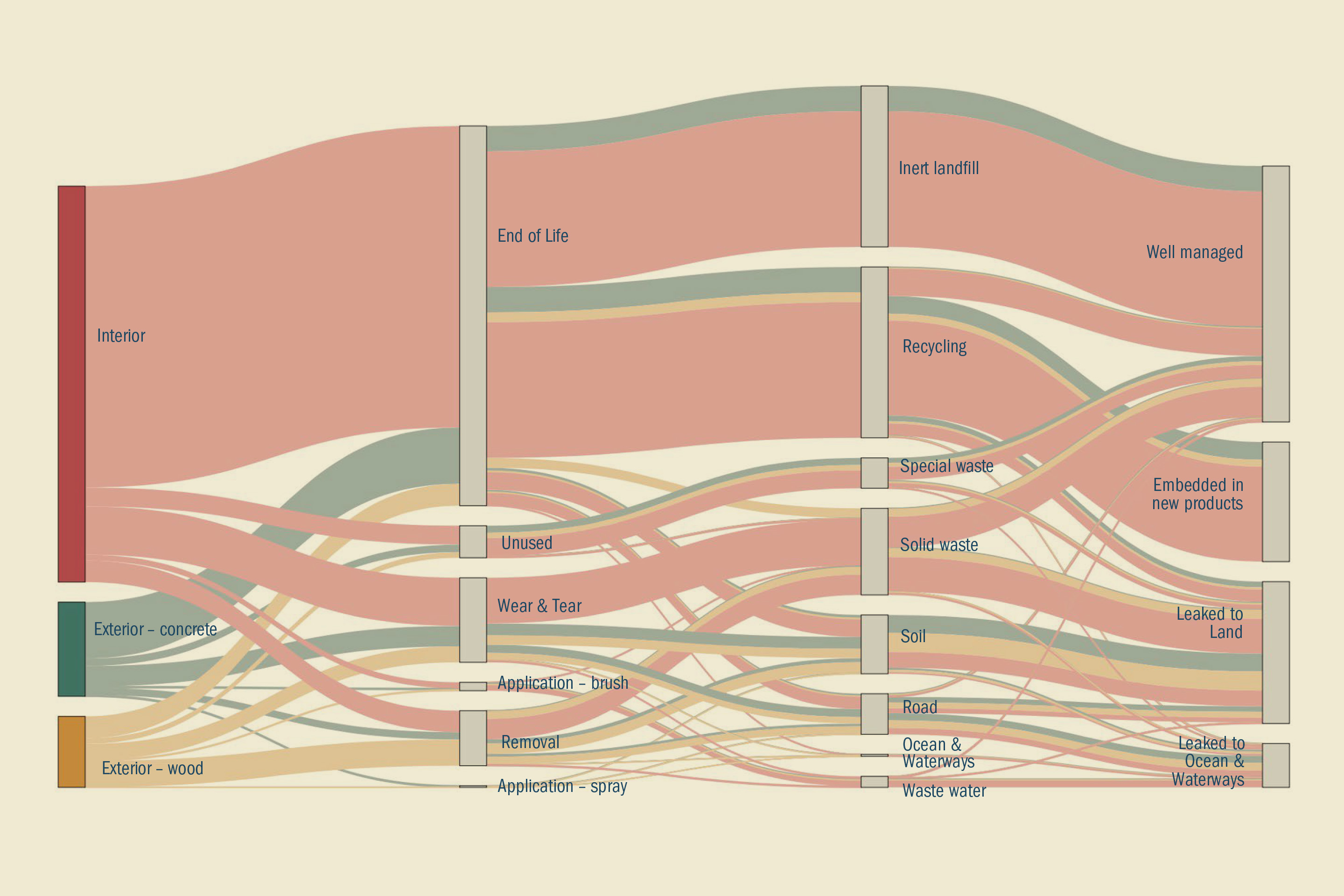
The study’s findings were produced by Earth Action, the Lausanne-based consultancy that is far from new to the subject. In a global assessment published in 2022, it evaluated the contribution of paints2 to plastic pollution on land and in water. The 52 million tonnes of paint sold worldwide – based on 2019 figures – contained, on average, 37 % plastic polymers, present as binders and additives. The construction sector uses 28.8 million tonnes of these products, roughly one third of which is applied to façades. Paints and varnishes are designed to protect a wide range of substrates and extend their service life. Yet the plastics they contain are dispersed throughout their life cycle: during roller or spray application; when the surface starts to chalk; during stripping, scraping and sanding before new coats are applied; and, finally, at end of life, when paint residues adhering to demolition rubble are removed. Potentially, a substantial share of the paint applied is transferred to soil before reaching rivers, lakes and oceans. Globally, paint generates an estimated 7.4 million tonnes of plastic leakage a year. The same assessment attributed 58 % of modelled microplastic leakage to oceans and waterways to paint, showing how greatly its contribution had been underestimated.
Which alternatives should be favoured outdoors?
The least polluting material is the one that is not applied. Starting from this observation, should we abandon protective varnishes and coloured paints? Is that even conceivable? For many applications that are primarily aesthetic, it may well become so. The plastic contained in conventional paints is only one part of the problem; the arsenal of chemical additives is another. Most manufacturers do not disclose the full list of components, either on
the packaging or in the technical data sheet. Formaldehyde, for example, may remain below declaration thresholds. We asked Luc Meige, a supplier of sustainable materials, about the ecological options currently available. He would recommend abandoning façade paints altogether, since they too often contain the now familiar biocides, fungicides and algicides that are harmful to the environment. Instead, he argues, we should return to renders, including lime-based renders. These are slightly thicker, but can now be applied to virtually any substrate.
And for interior surfaces?
Indoors, current efforts focus on limiting potential sources of pollution that affect air quality. The Canton of Geneva, a genuine pioneer in this field, has established the Très Haute Qualité des Matériaux, de l’Air intérieur et des techniques constructives programme (THQMAT: Very High Quality Materials, Indoor Air and Construction Techniques), under the guidance of Dr Philippe Favreau, a chemist and toxicology specialist. The programme supports construction-sector stakeholders in their choice of materials, in response to a major public-health challenge. Eight families of hazardous and concerning substances3 have been identified, including volatile organic compounds (VOCs)4 and semi-volatile organic compounds (SVOCs), which are released into the air. To discourage their use in industry, Switzerland has levied an incentive tax on VOCs since 2000, although the future of this measure is now politically contested.5
Awareness of the health of painters – and of future occupants – began to emerge as early as the 1950s. Yet lead paint continued to be used in construction despite its neurotoxic effects. In Switzerland, lead in paints was banned in 2005, with the relevant ordinance
entering into force in 2006. Glycero-
phthalic, or alkyd oil-based, paints then dominated the market until the turn of the century. With their high VOC content, they gradually gave way to water-borne acrylic paints. More recently, mineral paints have gained visibility. One benchmark on the Swiss market
is Keim’s potassium-silicate mineral
formulation, based on an 1878 patent. Manufacturers, meanwhile, continue to innovate. Bio-based paints, which still occupy only a small market share, may gain a stronger position, although rising raw-material costs are hampering this prospect.
Whatever solution is chosen, Joëlle Goyette Pernot, Professor at the School of Engineering and Architecture of Fribourg (Haute école d’ingénierie et d’architecture de Fribourg, HEIA-FR) and President of the Observatoire romand et tessinois de la qualité de l’air intérieur (ORTQAI),6 points out that «ventilation is a cornerstone of indoor air quality, and that a ventilation concept meeting the relevant requirements must be established from the preliminary design stage, in accordance with Swiss Society of Engineers and Architects (SIA) standard 180.»
When labels obscure rather than clarify
Faced with an immense variety of solutions and uneven ecological commitments, it has become difficult to
orient oneself. Numerous labels have emerged: Blue Angel, EU Ecolabel, NF Environnement, Oecoplan, Nordic Swan Ecolabel, ecobau, Natureplus and others. Their sheer number is enough to muddy the waters. And when there is no direct correlation between a low-impact formulation and low emissions into indoor air, further labels for indoor-air emissions come into play: Emicode, Eurofins, Indoor Air Emissions and so on. Losing track? You are not alone.
In 2022, Jean-François Dedominici, a master painter specialising in the renovation of historic buildings, criticised the CFC 2267 façade-rendering tender for one of the Plaines-du-Loup lots, subject to SméO and Minergie-Eco requirements. The use of biocides, fungicides and algicides was banned, while a silicone-resin binder was recommended. In the painter’s view, this was an ecological contradiction, since it contains a non-biodegradable polymer that is difficult to recycle. Clearly, a little continuing professional development for specifiers8 would not be superfluous.
Notes
1 Association pour la sauvegarde du Léman, Léman Plastic Action.
2 Paruta, Pucino, & Boucher, Plastic Paints the Environment.
3 Canton de Genève, «THQMAT – Référentiel sur le choix des matériaux sains dans la construction.»
4 Volatile organic compounds (VOCs) are a heterogeneous group of substances found in paints, varnishes, adhesives, floor coverings, furniture, carpets and other products. They readily pass into a gaseous state and, when harmful, can reduce indoor air quality. Semi-volatile organic compounds (SVOCs) are less volatile, but may still be emitted from materials over time.
5 Services du Parlement, «La fin de la taxe sur les COV reportée en Suisse».
6 Observatoire romand et tessinois de la qualité de l’air intérieur, «ORTQAI»
7 In Switzerland, the Code des frais de construction CFC (Construction Cost Classification) structures construction costs; CFC 226 covers façade rendering.
8 Haahr, Mannov Christiansen, Vourdougiannis, Tosi, & Lynge Lyng. Problematic Chemicals in Paint.
Bibliography
– Association pour la sauvegarde du Léman. Léman Plastic Action: Rapport final. Genève, Association pour la sauvegarde du Léman, 2025.
– Canton de Genève. «THQMAT – Référentiel sur le choix des matériaux sains dans la construction». République et canton de Genève, 20 August 2024.
– Haahr, Stine Pagaard, Nanna Rose Mannov Christiansen, Leonidas Vourdougiannis, Irene Tosi, & Nadja Lynge Lyng. Problematic Chemicals
in Paint: Study of Unwanted Chemistry in Interior Paint. Danish Technological Institute, Taastrup, 2024.– Paruta, Paola, Margherita Pucino, & Julien Boucher. Plastic Paints the Environment:
A Global Assessment of Paint’s Contribution to Plastic Leakage to Land, Ocean & Water-ways.
EA – Environmental Action, Lausanne, 2022.– Services du Parlement. «La fin de la taxe sur les COV reportée en Suisse», 5 December 2024.