Semiotics of Substitution
The new Ueberlandpark promises reconnection: an urban lid over a wound carved by the motorway. Yet its calmness conceals a deeper continuity: logistics dressed as landscape, infrastructure translated into amenity. What appears to be a park of reconciliation may, in fact, teach us how to live gently above the machine, not against it.
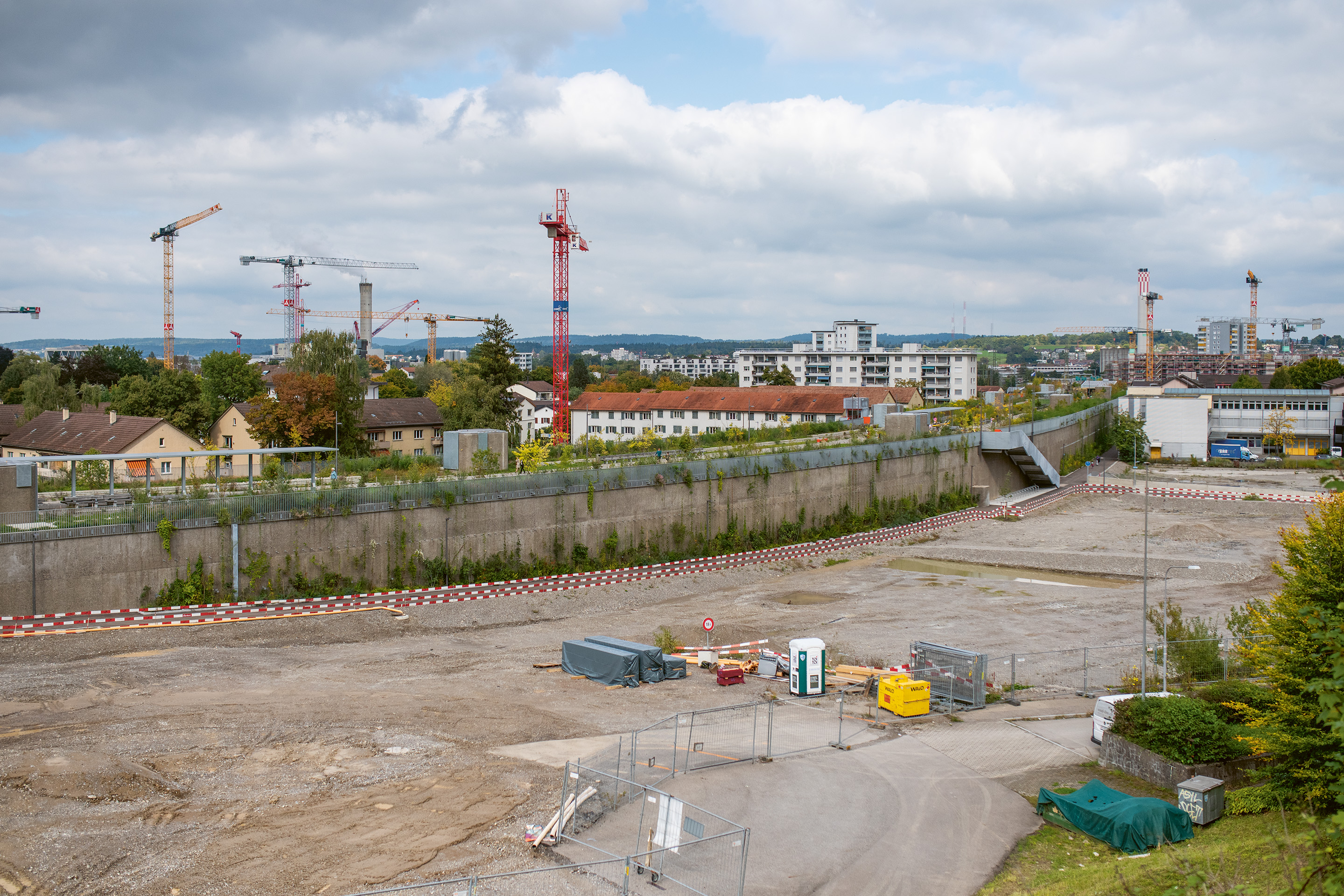
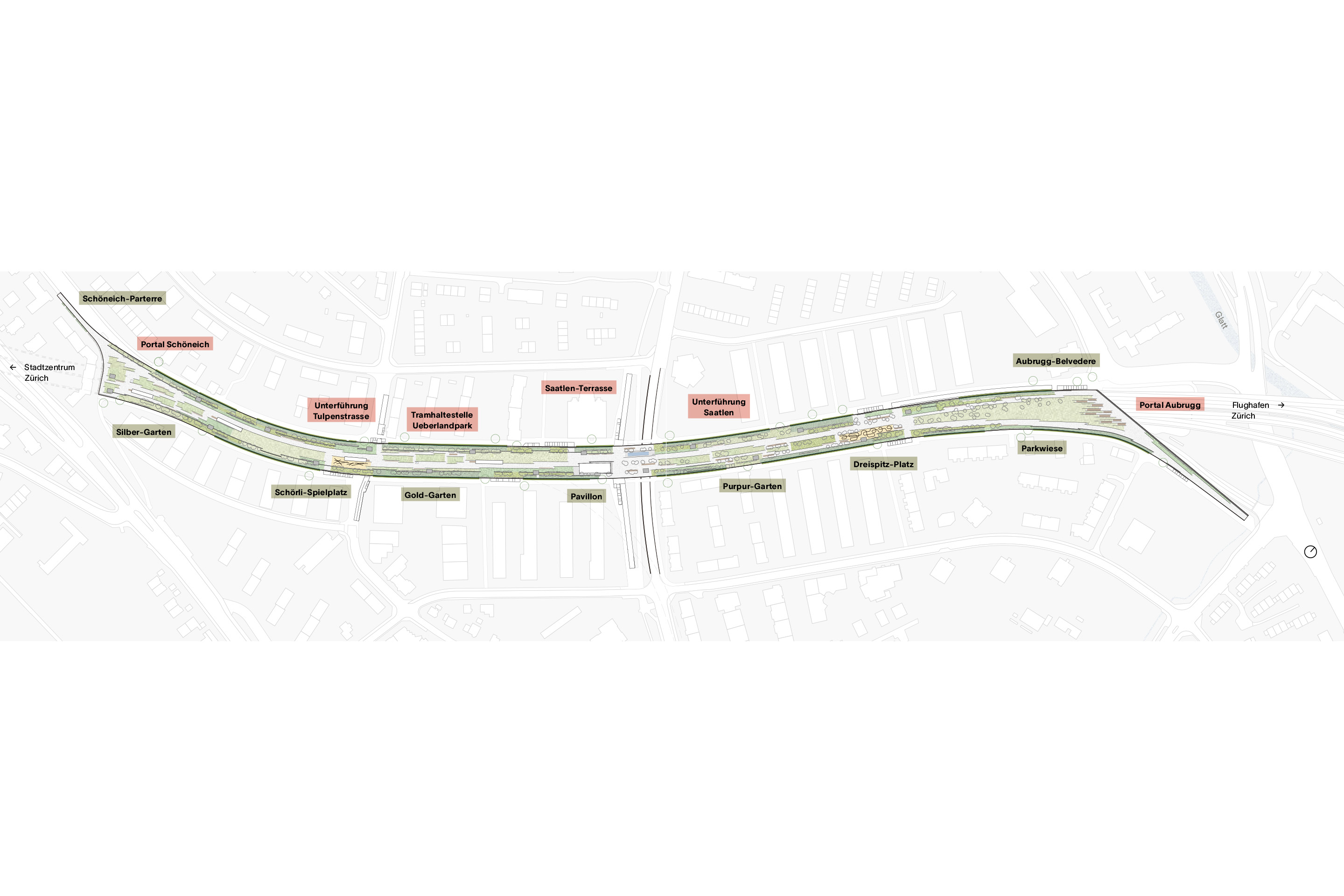

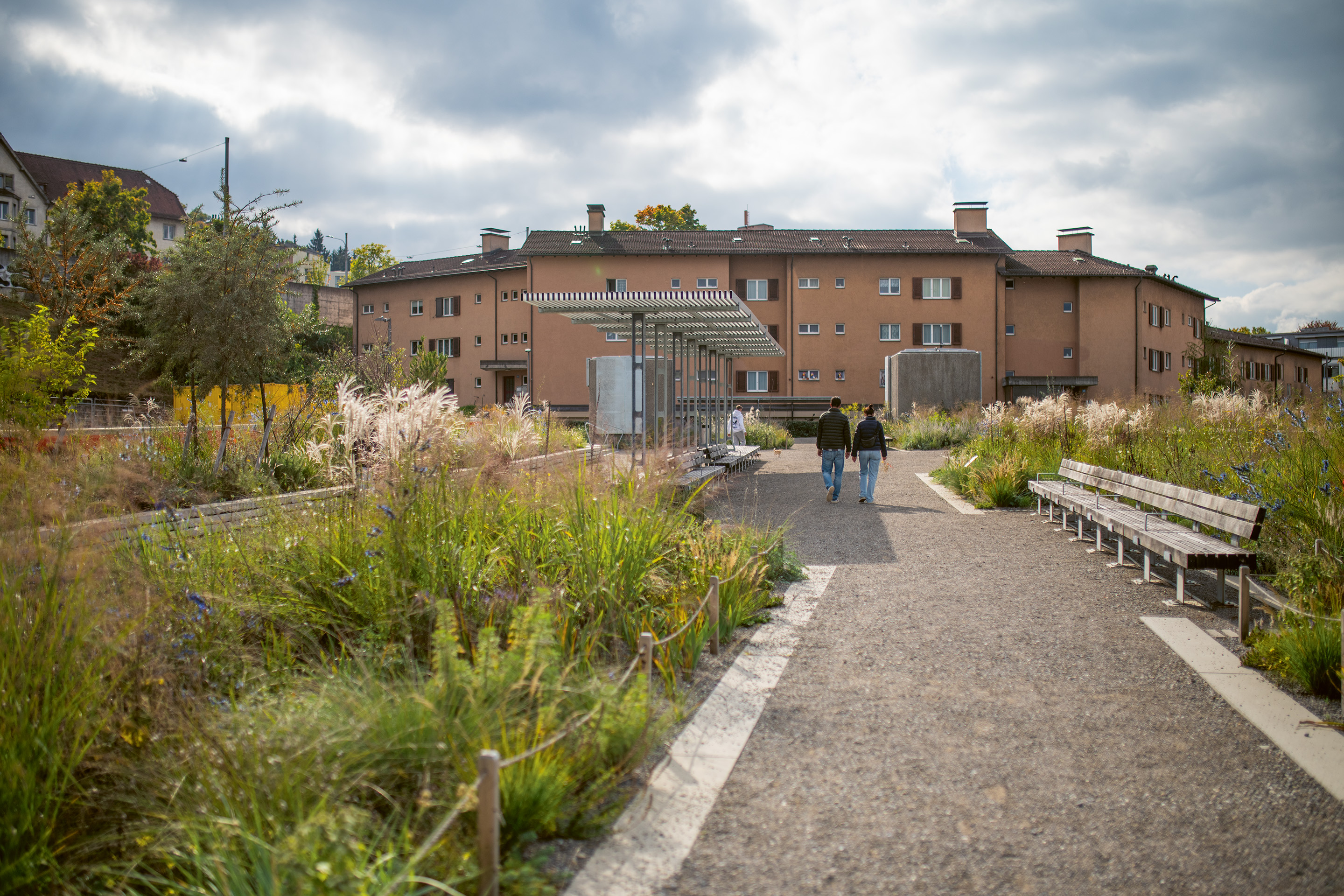
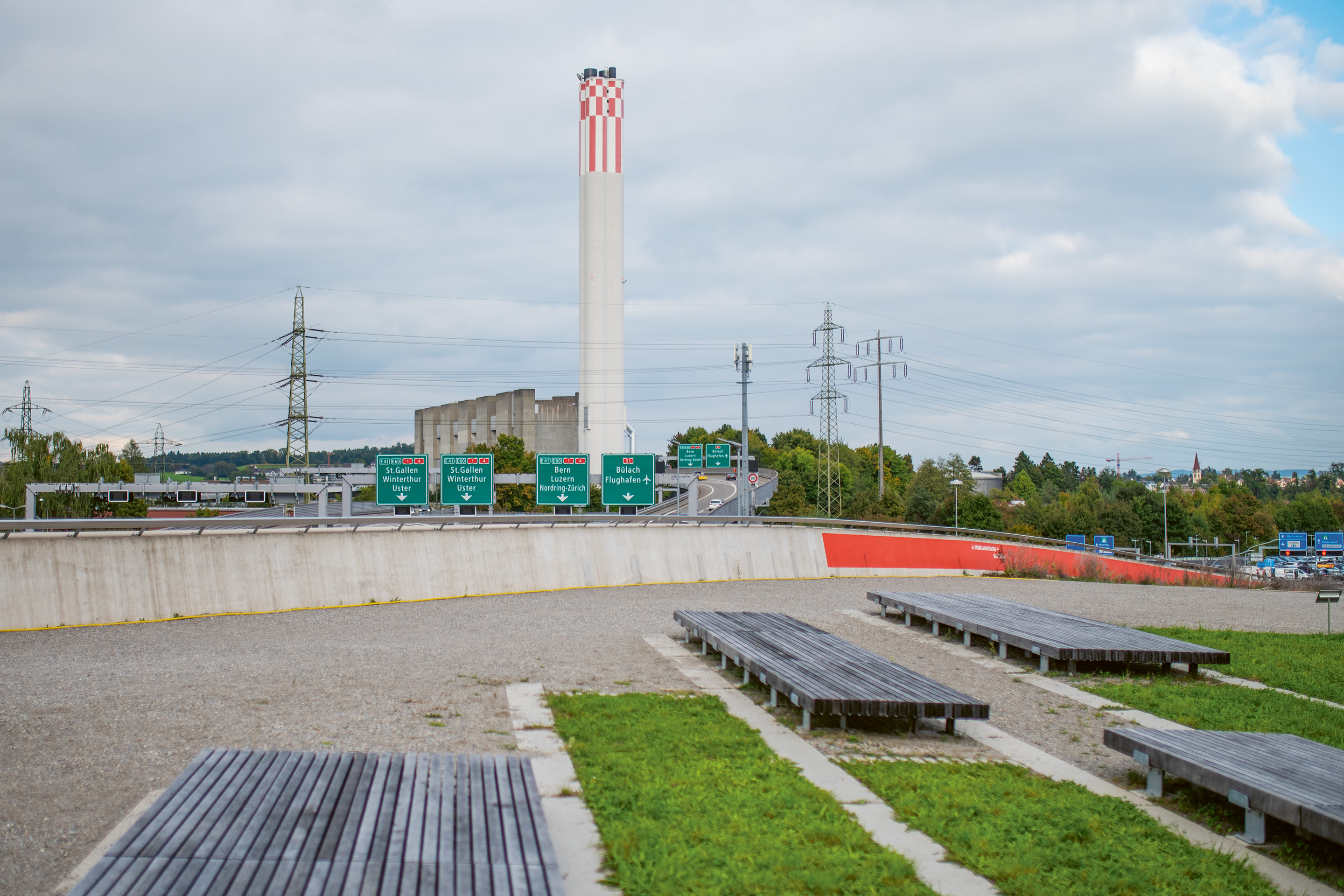
Ueberlandpark: a lid, not a cure. A green surface laid over a concrete sleeve. Above: play, benches, a neat promenade. Below: the machine that never sleeps. Numbers behave nicely in press releases: 950 m of cover, 30 m wide, 30 000 m2 of parkland added. Noise down, fumes redirected, benefits tallied. The narrative behaves nicely too: residents suffered, residents acted, the state delivered.
Read the thing as a sentence, not an object: Subject: motorway. Verb: continues. Adverb: quietly. The park is the adjective that softens the noun. Rebranding infrastructure as «public nature» does not negate its sovereignty; it naturalises it.
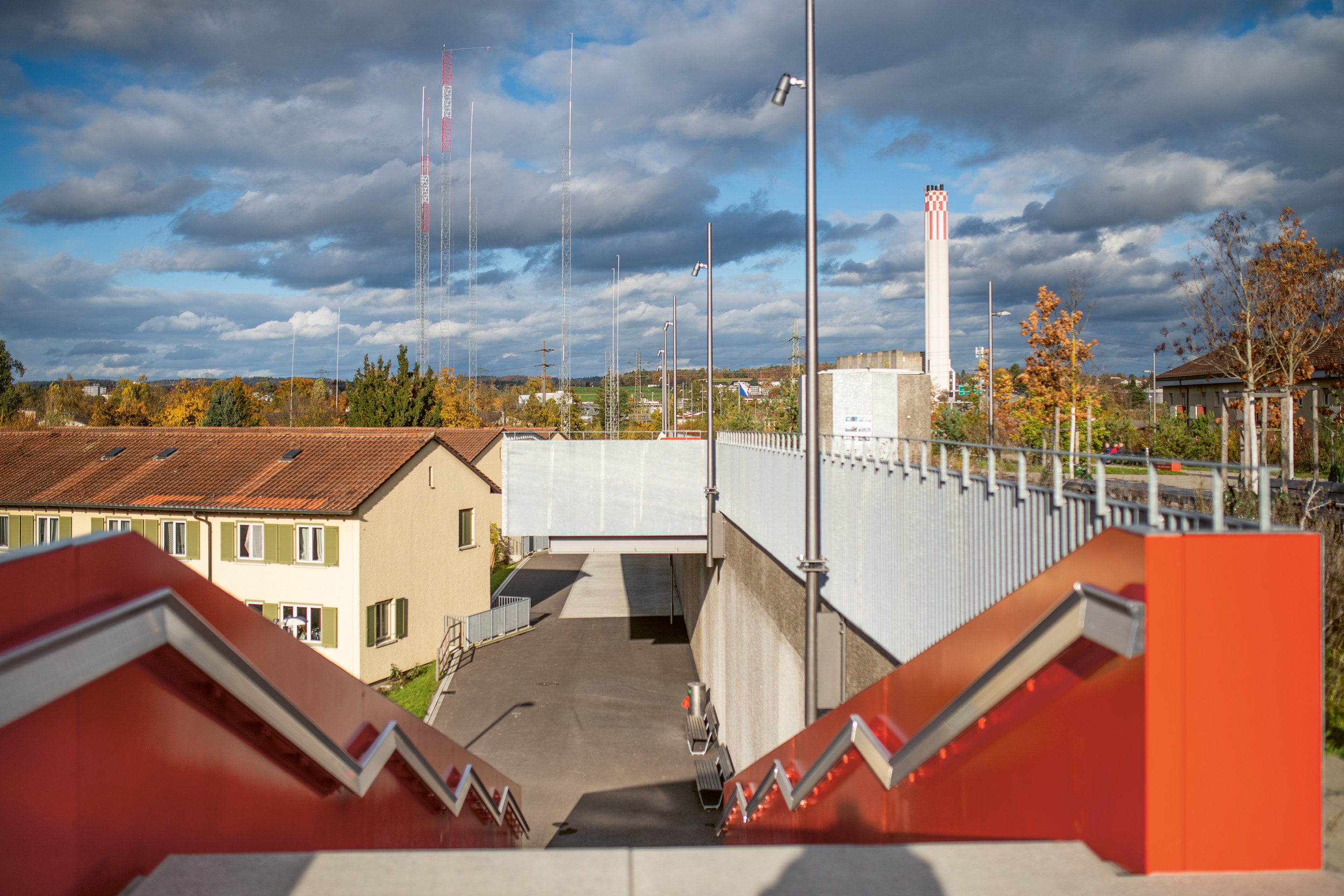
This is not a city of Vitruvian proportions. Bodies do not set the module; throughput does. The ramps, rails, parapets, gradients: a spatial schedule, not a spatial dialogue. Verticalised speeds: slow walkers above, regulated metal below. Calm is curated, not won. The deck does not heal the cut; it frames it as scenery. «Reconnection» was the promise. Did it happen? The long history of the cut remains. Two sides still read each other across a controlled edge. One can cross by the appointed paths, in the appointed places, at the appointed slope. Connection becomes itinerary. The fracture survives as a programme.
e-dossier Einhausung Schwamendingen: Damaris Baumann berichtete im Sommer 2025 detailliert über die Einhausung und den Ueberlandpark in Schwamendingen.
Weitere Architekturkritiken der Studierenden sowie Berichte über das Projekt seit 2015 sind ebenfalls hier gesammelt.
At the edges, new projects learn the new language quickly. Facades and balconies disciplined to the lid; bridgelets, sightlines, a pavilion or two. Value accrues. The existing fabric, meanwhile, is asked to assimilate: accept the gradients, accept the vents, accept the new pace of the street. Compensation urbanism at work: environmental relief traded for legitimacy and another turn of spatial sorting.
At the centre, the former Saatlen school, in a former park, is demolished. In its place rises the city’s largest educational complex, a structure of courtyards and halls designed for nearly a thousand students. Construction advances; the debate has faded. Function expands, form dissolves.
Substitution proceeds. A new park replaces an existing one; a new school replaces an old one. Opposite, the Reformierte Kirche Saatlen still stands: precise, intact, already declared obsolete. The project Agora Zürich-Nord is converting it into an interreligious compound with housing and landscaped roofs. The congregation has dispersed; redevelopment follows in faith’s absence.
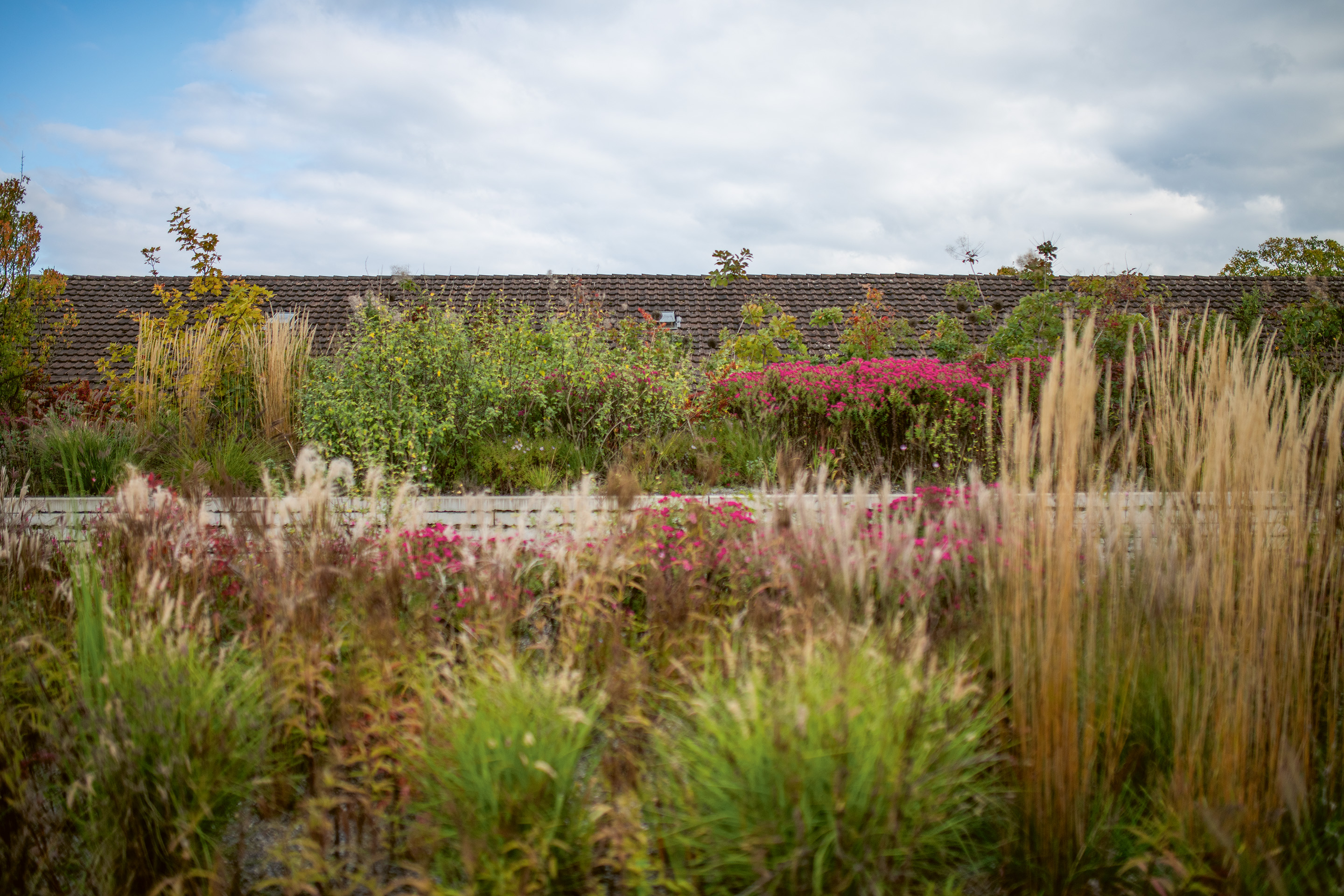
Vestigial function fades first in purpose, then in form. Substitution proceeds smoothly. Steiner’s garden-city green worked as porous ground: coexistence rather than camouflage; a counterpoint to Howard’s moral geometry, where nature buffered and ordered, and to the postwar Swiss estates, where greenery signified distance and hygiene. A lived terrain: continuous, collective, improvisable, without firm lines between cultivation and passage, rest and movement.
Imagine if ideas remained. If continuity were spoken rather than erased; if the wound had to be covered, yet not at the cost of what still breathes. Children would scatter through the district like quick strokes of coloured light: rolling cartwheels in the tall grass by the old Saatlen school, leaping to catch the low branches of the veteran trees, then dashing toward the Reformierte Kirche Saatlen, where weekday lessons drift between biology, theology, and the odd hour of logic, and where the Ethiopian congregation gathers on Sundays. Others would slip away toward the bright craft rooms on the long new bridge, or pass beneath it on their way to the sunlit Au Schulanlage pool. A small, steady magic threading the neighbourhood together.
Elisaveta Maria Kriman ist Architektin, Forscherin und Editorin. Ihre Forschung im MAS gta ETH befasst sich mit feministischen und
diasporischen Raumpraktiken, Wohntypologien sowie Architekturen der Fürsorge.