

Rebuilding Gaza
Three models, one underlying dilemma
Reconstruction is never neutral. Through three visions for the future of Gaza, this essay shows how reconstruction means deciding who can stay, return and live there. Beyond the project itself, reconstruction emerges as a matter of justice, memory and rights.
Testo in italiano al seguente link
There is a before – the war – and there is an after: the material reconstruction of the places struck. We are attached to this idea that separates wars from reconstructions in time, that distinguishes those who produce destruction from those entrusted with rebirth. But today this view appears anachronistic.
The spiral of the war-real-estate cycle has, in fact, a disturbing coherence of its own: arm, destroy, rebuild, generate profit. Within this dynamic, the interests of those who produce damage and ruins tend to converge with those who manage reconstruction. Behind the rhetoric of rebirth, neo-colonial economic logics are increasingly concealed, and they need to be understood.
Contemporary wars produce a continuum of accumulation: from the production and sale of weapons, to reconstruction entrusted to state agencies or private companies, and on to the political and economic control of devastated territories. There is a real-estate logic at work within «the Third World War fought ‹piecemeal›»,1 working to erase territorial identities; for this reason we cannot disregard what is happening in Gaza,2 the challenges posed by its destruction and the hypotheses of reconstruction, which require of us new moral equipment before design instruments.
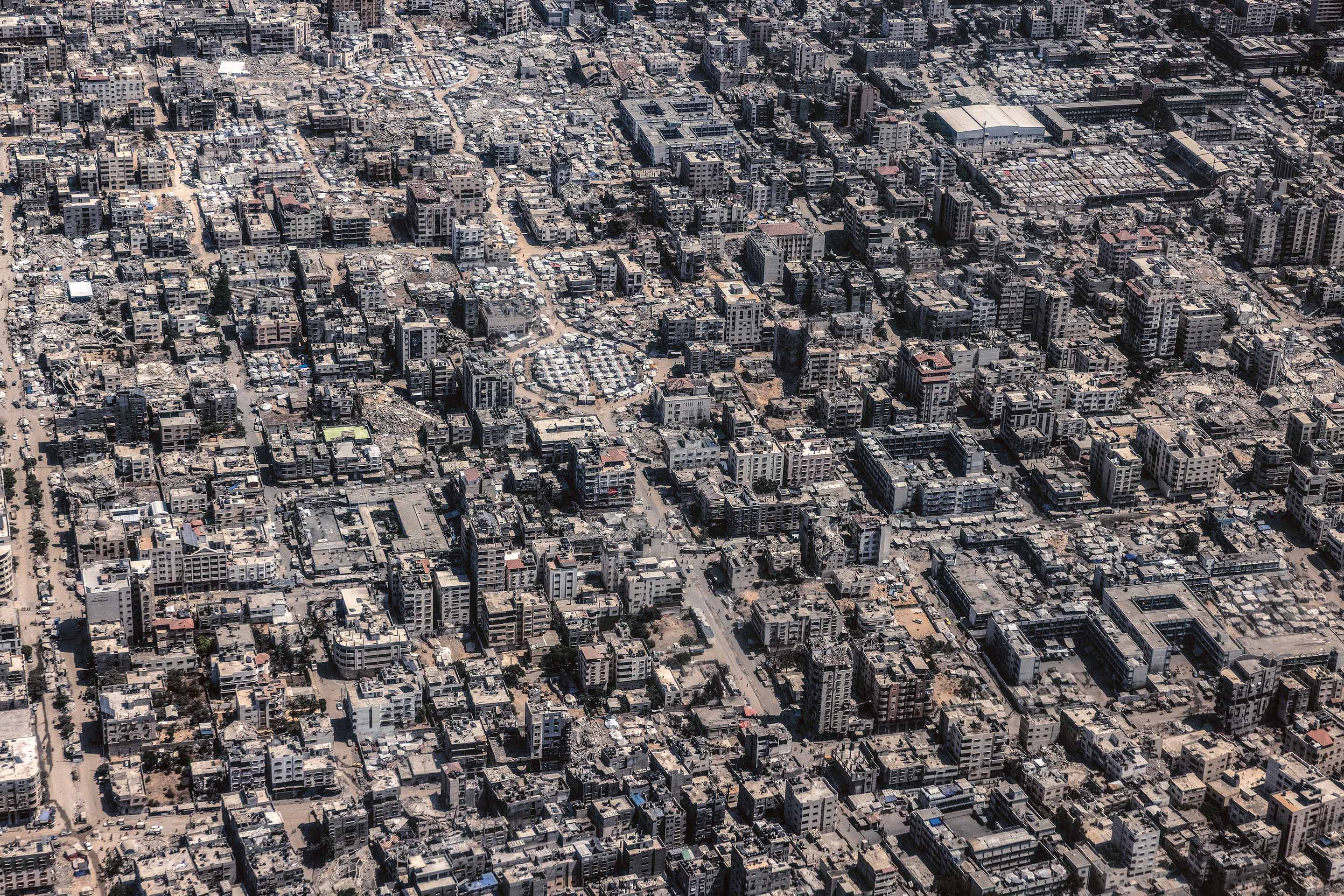
As an urbanist, I am used to recognising, in satellite images, the form of buildings, the weave of streets, the density of the urbanised fabric. In Gaza, however, devastation prevails: a void that no longer points back to what, until only a few months ago, was a living and complex urban tissue. Let us try to give this destruction a name. Some speak of urbicide3 or ecocide,4 because nature too has been annihilated. But perhaps these words are not enough. The Palestinian writer Zena Agha speaks of «dis-invention»:5 the systematic will to erase the very existence of a place from collective memory. As though that place had never existed. In Gaza, urban destruction has taken on an industrial scale and a programmatic logic, aimed at dismantling every fabric of life. A true tabula rasa.6
In this context, rebuilding cannot simply mean repairing what has been destroyed, but redefining the very meaning of territory, community and political sovereignty.
For this reason, with no claim to exhaustiveness, we have chosen to reflect on three models of reconstruction, very different from one another, not comparable, and each in its own way an ideal type of how reconstructive action may be understood7 (based on the few documents available): a political-real-estate imaginary, an institutional plan and a technical-academic strategy.
The first model, the American one, embodies the myth of force and tends to erase the complexity of the place through a new and radical rewriting, at once semantic and architectural, imposing a new form and a new meaning. The second – the proposal advanced by the Arab countries – is centred on the search for «identity» and «memory»: it tends to idealise reconstruction, evoking the metaphor of the olive tree that resists everything, even ruin, as the figure of a possible rewriting of identity. The third model, developed by a multidisciplinary team at the Università Iuav di Venezia, is founded on «technology»: it places instruments of analysis and diagnosis at the centre and interprets reconstruction as a problem of procedural effectiveness, to be optimised through technical and procedural devices capable of governing its (impossible) complexity.
These three models bring into focus three recurrent risks of reconstruction: «erasing» the territory and its memory, «idealising» identity by turning it into a pacified image, and «optimising» complexity to the point of depoliticising it.
All three models force us to pause before a number of radical questions. Are we capable of thinking reconstruction as an act of reparative justice before it is a technical, economic or procedural project? Are we prepared to ask who has the right to remain, to return, to decide?
Without these premises, every discourse around physical reconstruction – as it is often imagined today – risks perpetuating a form of colonial violence in which the oppressed-oppressor relationship is never called into question.
From tabula rasa to the design of real-estate finance
It was on 4th February 2025 that American president Trump first relaunched the idea of transforming Gaza into a «Riviera of the Middle East», resettling the Palestinians elsewhere.8 Many dismissed it as a boutade. Yet today that project appears less impromptu than it first seemed: Gaza’s climate is similar to Florida’s, and Trump’s Middle East envoy, Steve Witkoff, is a long-standing property developer. It is no coincidence that, in 2020, the Peace to Prosperity plan9 had already described Gaza as an area of «extraordinary potential», translating peace into an operation of real-estate development.
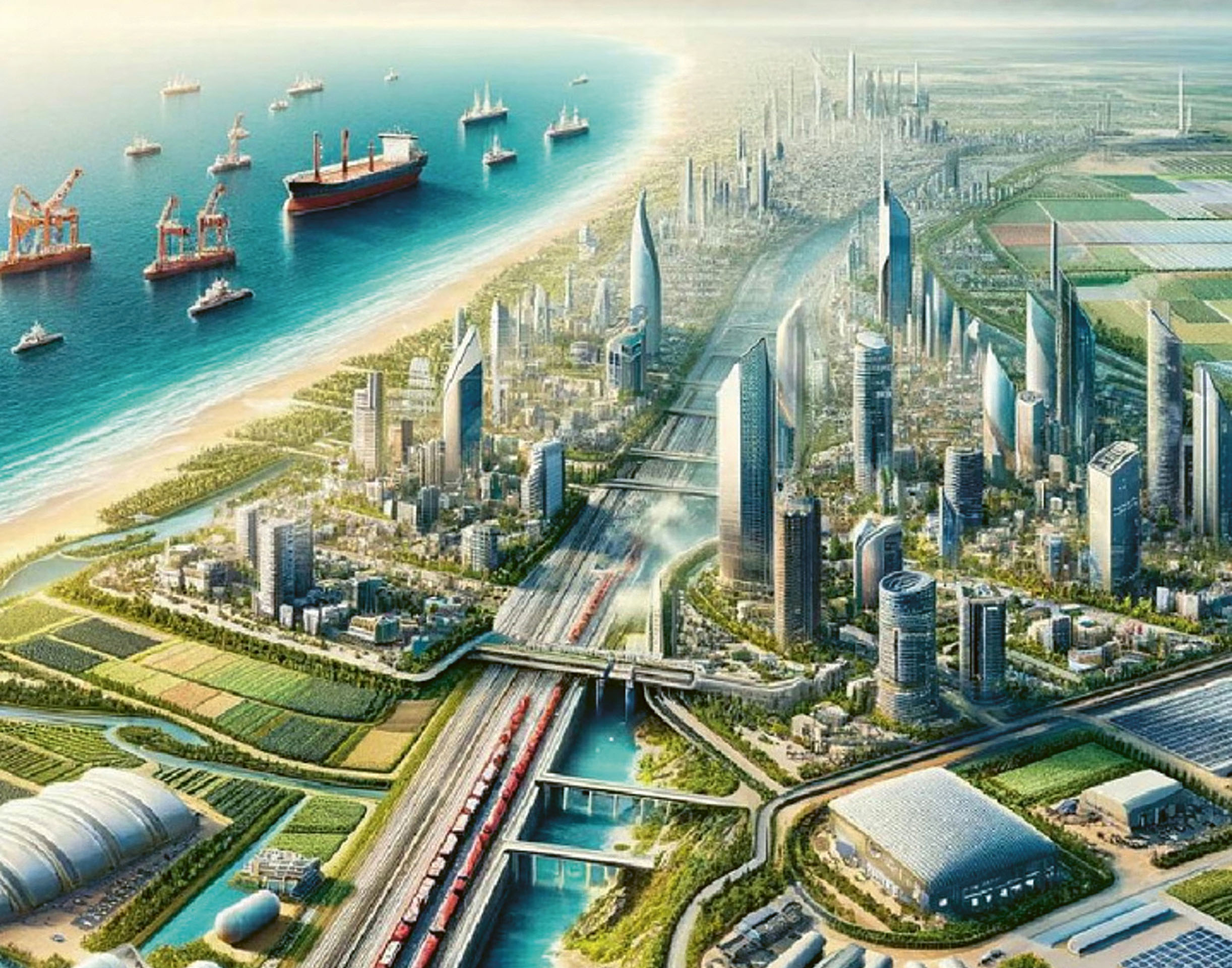
We all have in mind the images of Gaza’s reconstruction circulated by American president Donald Trump himself: Gaza embodies the architectural imaginary of Riviera-style holiday luxury, dominated by skyscrapers, tree-lined avenues and green spaces, where vast swimming pools alternate with leisure areas. What would be normal in the brochure of a tourist agency becomes obscene when superimposed on a context of war and death. Gaza – a field of rubble – becomes an investment platform, a space to be refounded according to logics of efficiency, attractiveness and yield.
That proposal is not reconstruction, but replacement. Destruction is converted into an opportunity for economic valorisation, and Gaza is reduced to available land. The aesthetic of the new city, inspired by the imaginary of global cities and by the aesthetics of branded architecture, is thus accompanied by an erasure of memory.
This tabula rasa unsettles us, but we need to look it in the face: it is one of the most significant elements of the new real-estate imaginary running through urban transformations, conflicts and global politics. A deep drive towards the «absolute new», which also courses through contemporary cities and new property markets: to erase every trace of what existed before in order to rewrite the world as a blank page. This aesthetic-political tabula rasa translates into a damnatio memoriae of the urban, where the past is perceived as an obstacle to economic optimisation and to the rewriting of the city.
I have described this, in an earlier work, as real-estate urbanoclasm:10 a removal of cities, an ideological project that does not merely transform space but seeks to rewrite the city by erasing its historical and social memory, intolerant of every pre-existence. It is a politics of demolition in which the founding gesture is to raze to the ground, setting in motion new cycles of rent and power, often without any real regenerative intent.
On the other hand, this idea that one can begin again from scratch is dear to President Trump. Already in March 2023, during the election campaign, Trump had launched the proposal to build ten new cities, the so-called Freedom Cities,11 giving form to an idea of urban innovation founded on luxury and exclusion. Designed on federal land and entrusted to competitions among private masterplans, these cities mark a radical shift: rather than transforming existing cities, the preference is to found new ones, from zero.
The Freedom City embodies the ideal of an exclusive city, translating into material and symbolic form the idea of an urban-architectural perfection freed from the limits of what already exists. It is an aesthetic of self-segregation and security, fuelled by a hedonistic and anaesthetising imaginary: infinity pools, roof gardens and panoramic gyms coexist with perimeter walls, surveillance systems and devices of control. A fortified beauty that excludes in order to protect.
A model consistent with the belligerent logic of is second term
In recent months, other visions have aligned themselves with this view. What does the proposal by the Israeli minister Israel Katz to build a «humanitarian city»12 on the ruins of Rafah, intended to accommodate the entire surviving population, actually mean? The term «humanitarian» appears profoundly ambiguous, evoking a prison-city rather than a place of welcome.
Gaza thus risks becoming the most extreme laboratory of the new inhuman city, where rent and exclusion disguise themselves as innovation and futurism.
The use of urbanism as a weapon of war has long been analysed by Eyal Weizman in the West Bank:13 a control of land and infrastructure that separates above and below, mobility and confinement, access to resources and deprivation.
A logic that Achille Mbembe defined more than twenty years ago as necropolitics:14 the power to decide who may live and who must be exposed to death, confining entire populations in «zones of slow death», camps, prisons, occupied territories, shanty towns and migrant detention centres. From Gaza to «Alligator Alcatraz»,15 as far as the centres in Albania.16
It is no coincidence that Mbembe described Palestine as one of the most accomplished forms of necropower. Here territorial fragmentation and vertical sovereignty produce a stratified geography: a single inhabited landscape arranged on different planes, no longer merely horizontal but profoundly vertical.
Erasure thus becomes the very objective of an urban policy that treats the past, memories and social relations as obstacles to the maximisation of profit.
A hierarchical plan that idealises history
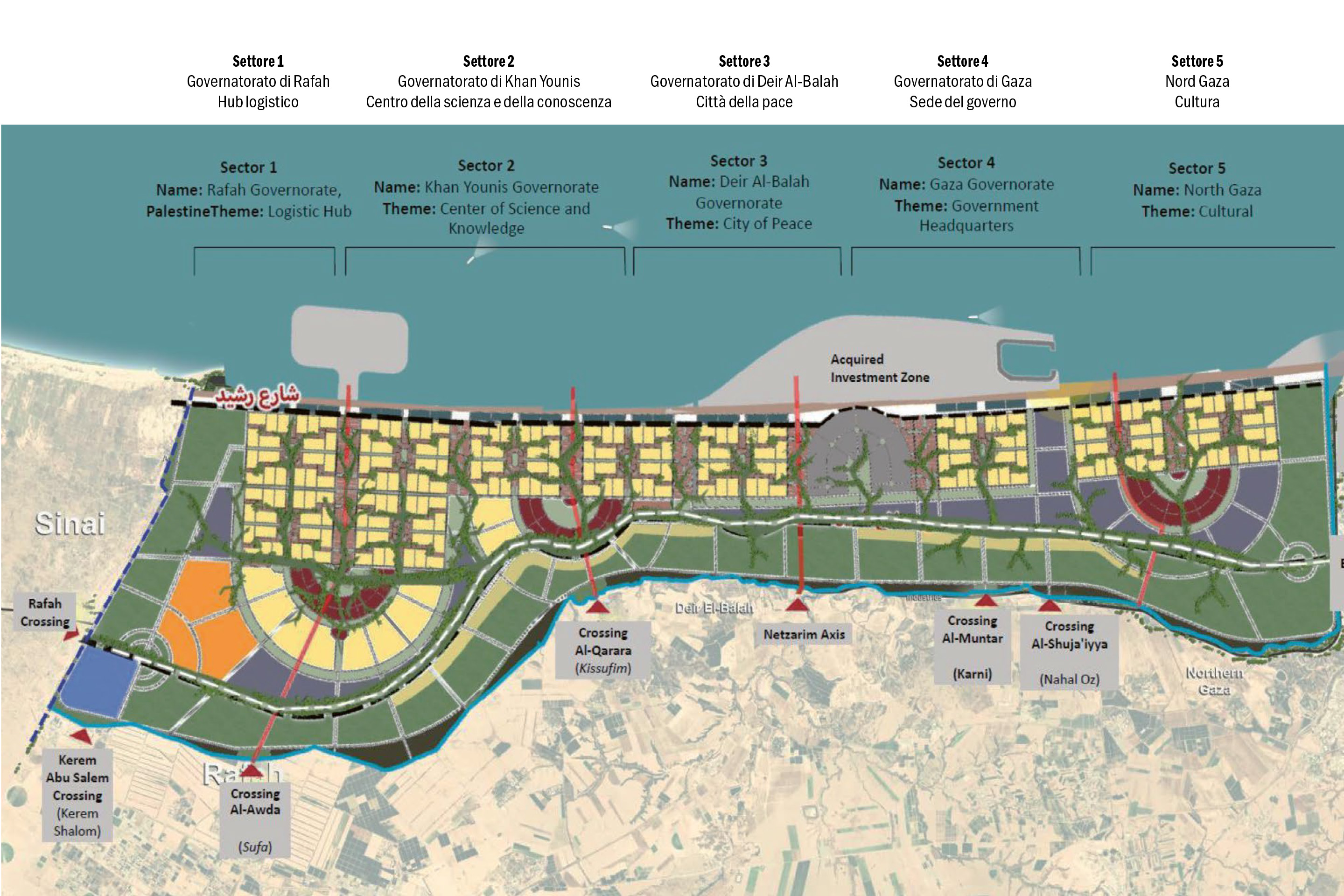
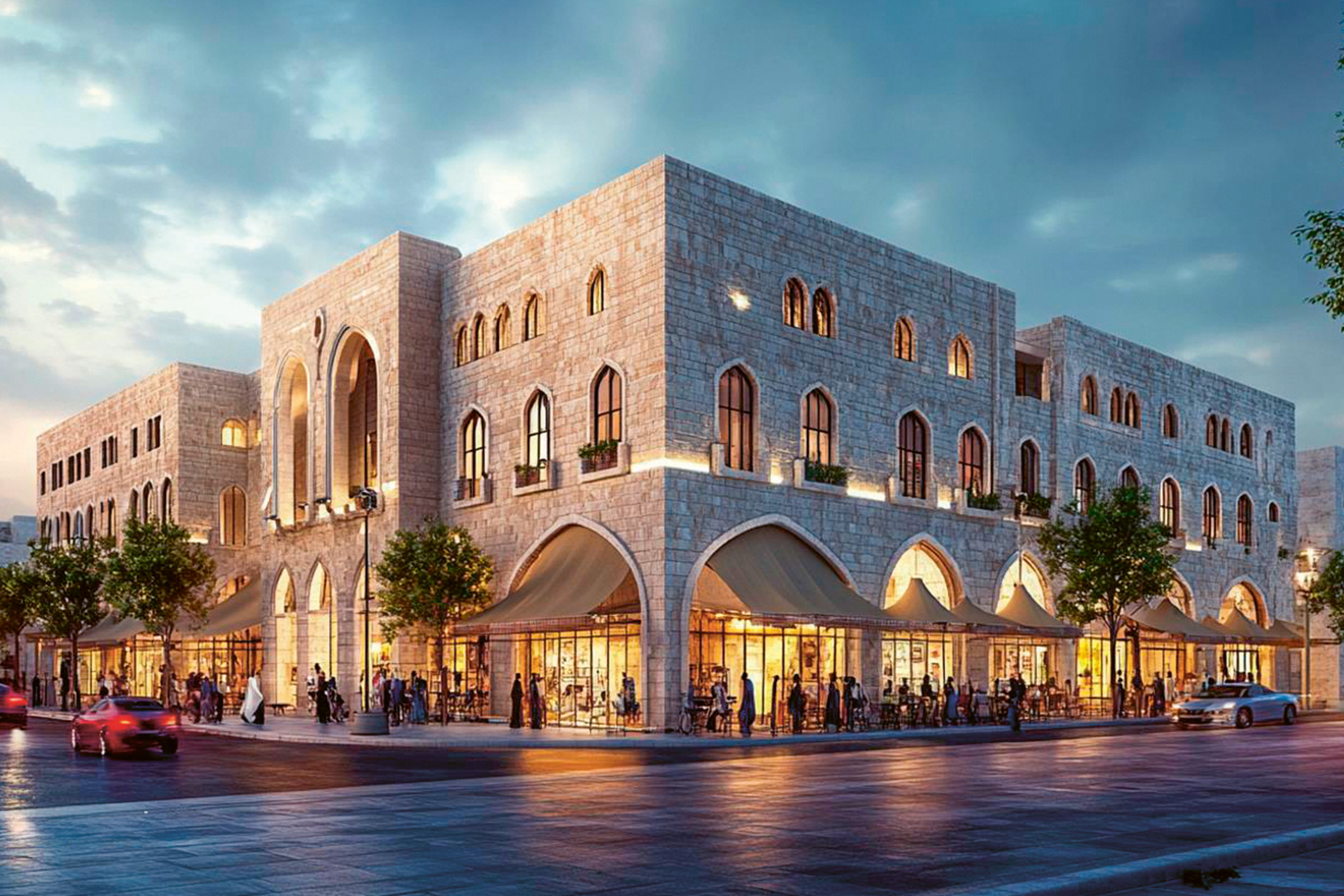
The Gaza Recovery, Reconstruction and Development Plan,17 presented on 4th March 2025 at the extraordinary summit of the Arab League in Cairo, represents the principal Arab proposal for the reconstruction of the Strip. Drawn up under the coordination of the Arab League, with Egypt as its promoter, it was developed in consultation with the Palestinian authorities and submitted to the United Nations as a unified and shared position.
Unlike models founded on rupture or on the radical substitution of the existing, the plan relies on a more traditional rational-comprehensive vision of planning: that is, it assumes that the process of urban transformation can be predicted, ordered and governed as a whole. At the centre of the programme are the Palestinian community, the memory of places and the right to rebuild one’s habitat by knotting again the threads of tradition.
Reconstruction is conceived as a gradual process that integrates emergency and development within a unified long-term vision. This approach, however, is translated into a strongly prescriptive structure, in which timelines, functions and urban arrangements are largely predefined yet entirely detached from the reality on the ground.
The plan in fact combines a declared flexibility and an openness to the involvement of local actors with an extremely rigid and systematic spatial control, based on advanced surveying technologies, satellite imagery and the continuous updating of data. Implementation of the programme is imagined as a multilevel process involving the Palestinian Authority, international organisations, donors, civil society and the private sector, presupposing a high degree of institutional integration.
The economic and temporal dimensions are defined with precision: an estimated requirement of 53 billion dollars, articulated in three phases. A first phase, lasting approximately six months, concerns the removal and reuse of rubble, the provision of temporary accommodation for around 1.2 million people and the restoration of essential services. This is followed by a reconstruction phase expected to extend to 2027, with approximately 200 000 new housing units, the recovery of damaged buildings and the decontamination of the territory. Finally comes the development phase proper, running to 2030, which envisages the completion of strategic infrastructure – ports, airport, industrial areas – and the construction of a more autonomous economic system, aimed at reducing dependence on external aid.
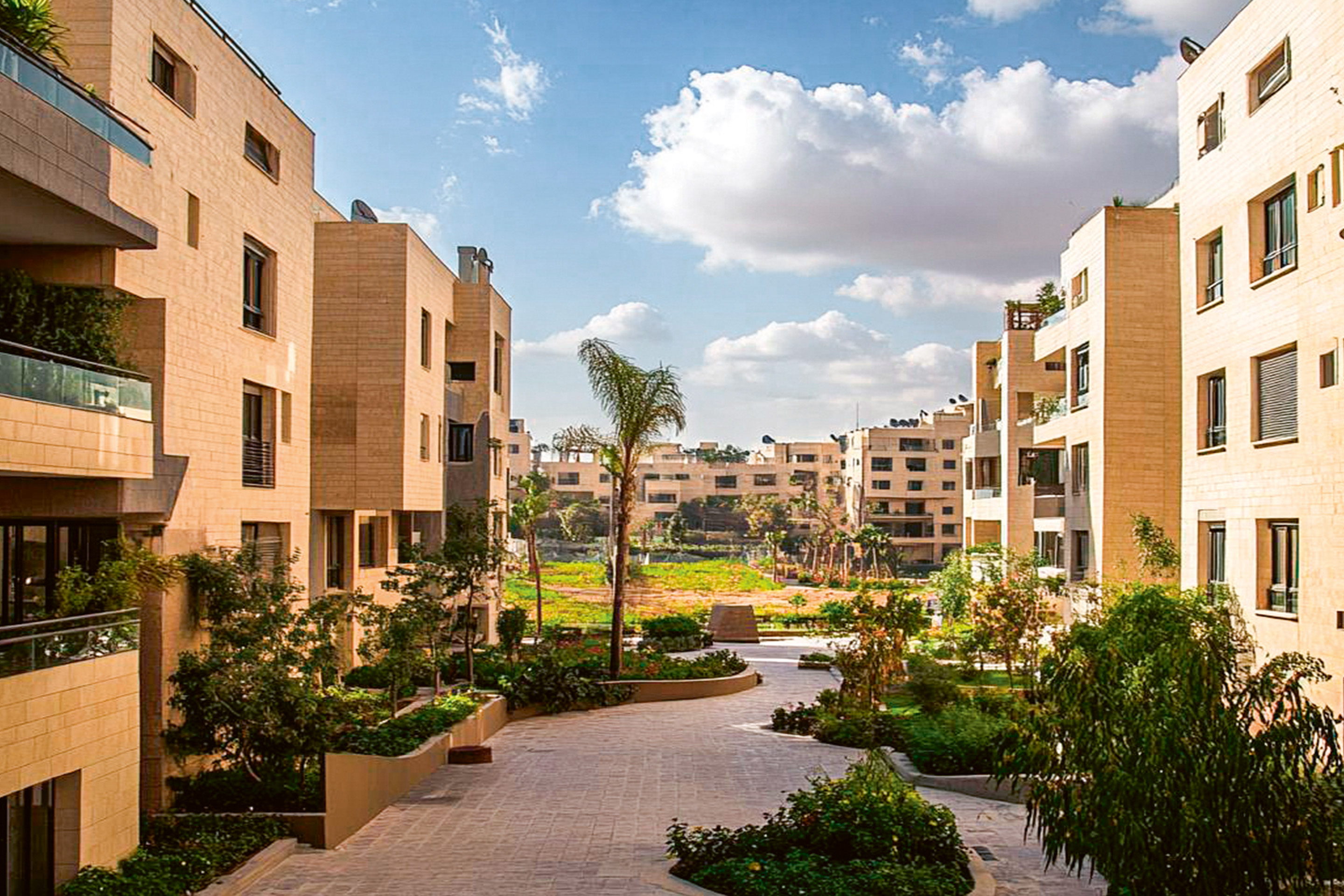
The city is organised around individual Integrated Development Units (IDUs), each of approximately 21 km2, conceived to accommodate between 250 000 and 300 000 inhabitants. Each unit is conceived as a complete urban system, in which housing, work, services and recreational spaces are integrated. Residential densities are distributed differentially – low, medium and high – in relation to infrastructural nodes and commercial corridors, while urban centralities and mixed-use areas ensure accessibility and efficiency. A pure exercise in style, apparently oblivious to the failures of this kind of urban design throughout the twentieth century (from Le Corbusier’s Ville Radieuse to Frank Lloyd Wright’s Broadacre City).
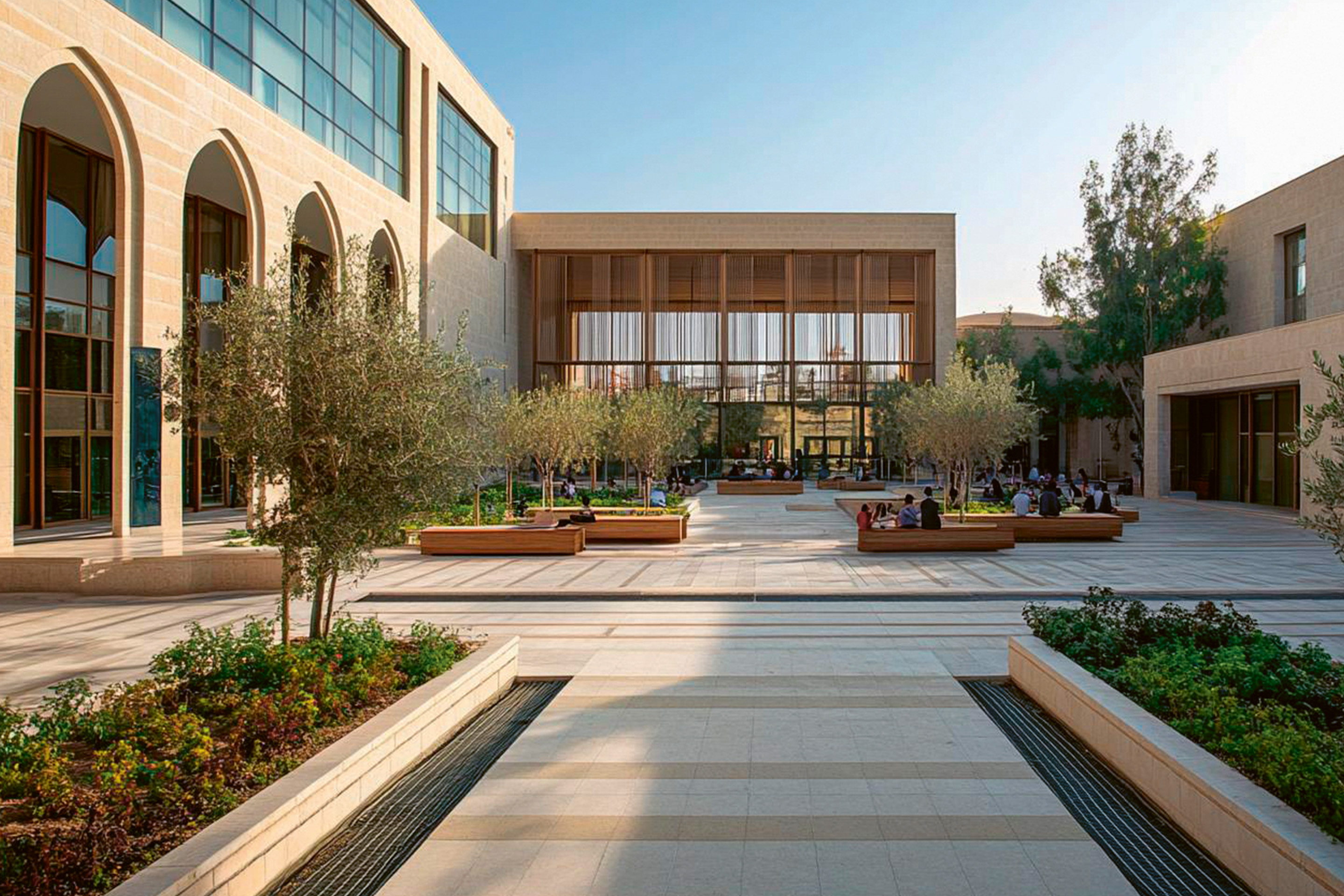
The proposal gives particular descriptive prominence to green corridors and public spaces, which structure the urban fabric and contribute to environmental quality, together with the enhancement of the coastal strip as a recreational and landscape space. Service centres – schools, hospitals, public offices and cultural facilities – are distributed to ensure proximity and access to essential services. That the city should be imagined as rigorously green without mentioning the disaster, including the environmental disaster, that is devastating it is disconcerting.
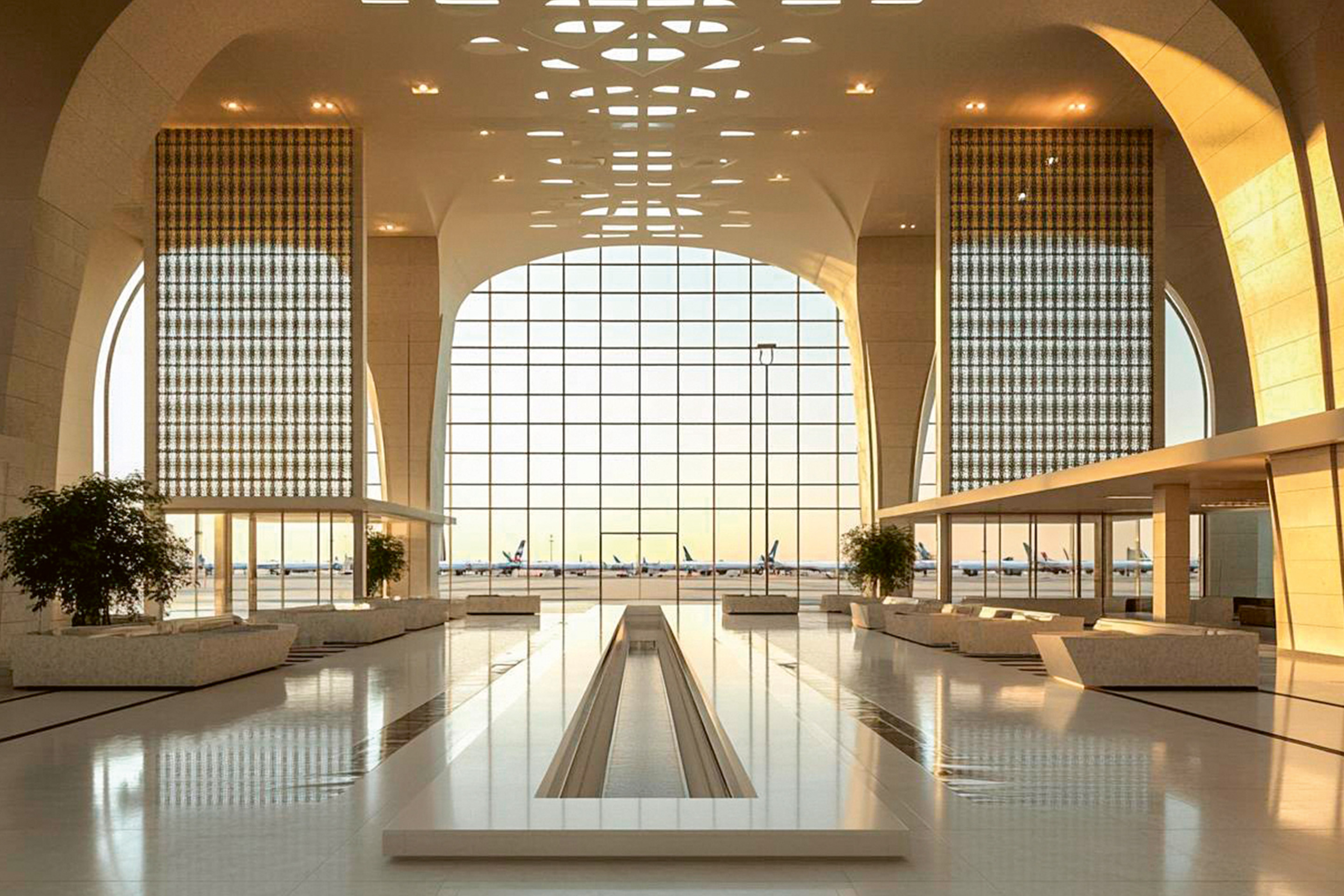
Architectural identity is treated as a structural component of the project. The plan proposes a synthesis between Palestinian heritage and modernity, integrating traditional elements such as courtyards, arches and the use of stone with advanced construction technologies, eco-compatible materials, natural ventilation and renewable energy. Leafing through the plan, I wonder how one can place such confidence in the capacity of architecture and urban design to resolve geopolitical questions of such dramatic magnitude.
Optimising the process by entrusting it to the power of technology
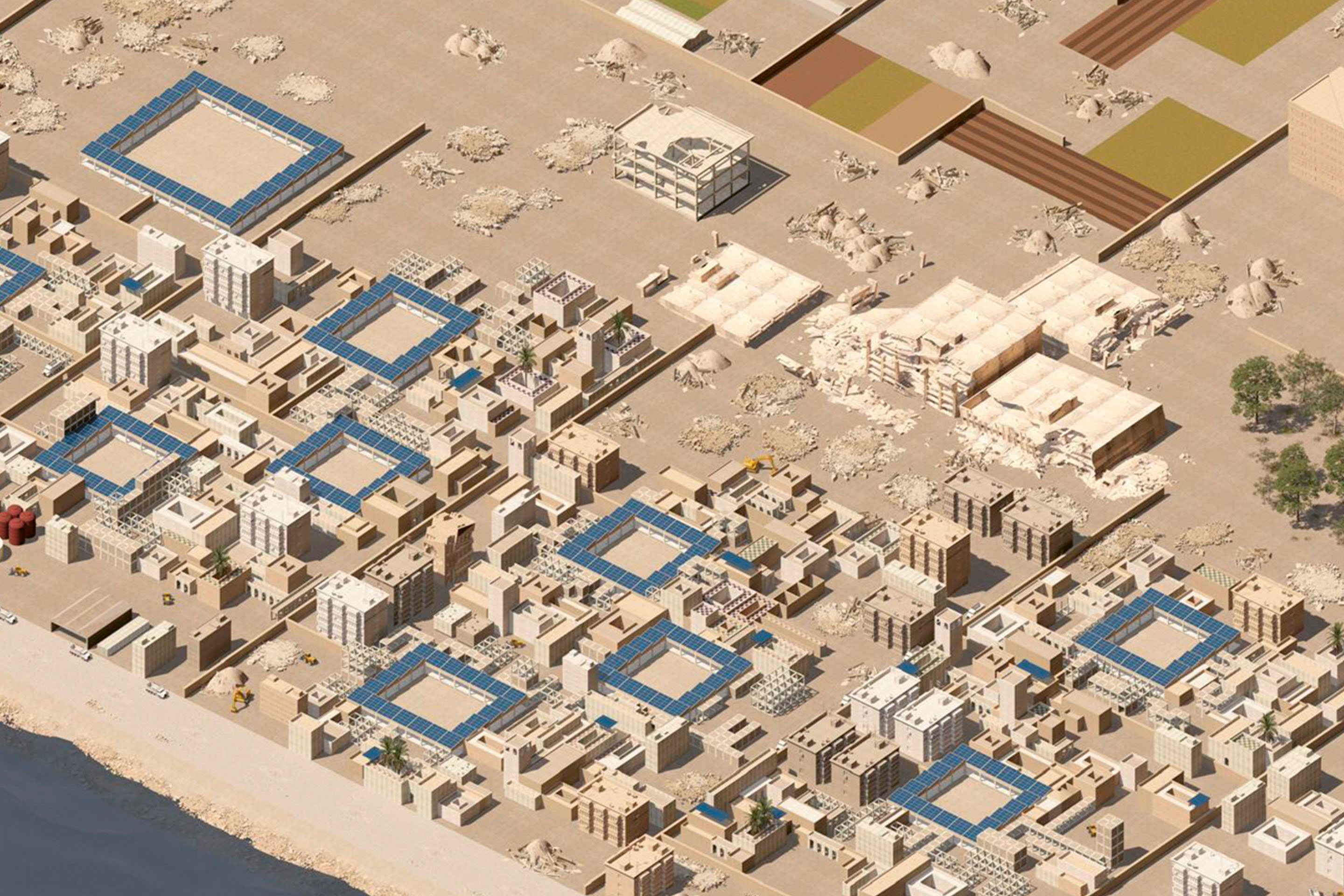
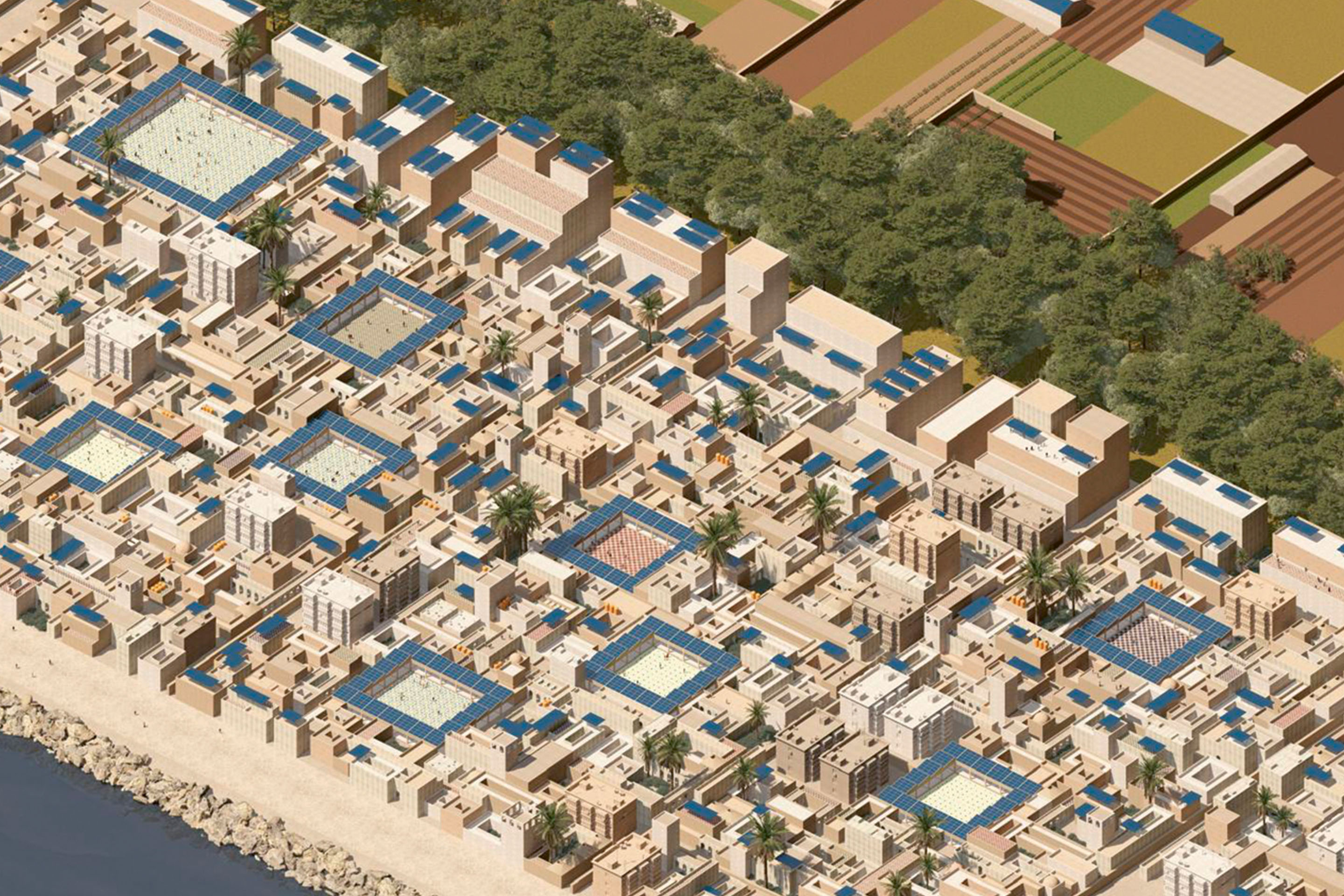
The model of reconstruction developed in the academic sphere – in particular, we have focused on the work carried out by the Università Iuav di Venezia – introduces a third register: that of complexity and adaptivity. In this third case, reconstruction is not entrusted to a defined design, but to an open process guided by data, algorithms and real-time monitoring systems.18 The Università Iuav has in fact signed a memorandum of understanding with the United Nations Development Programme (UNDP), which has tasked the university with developing a long-term strategy.
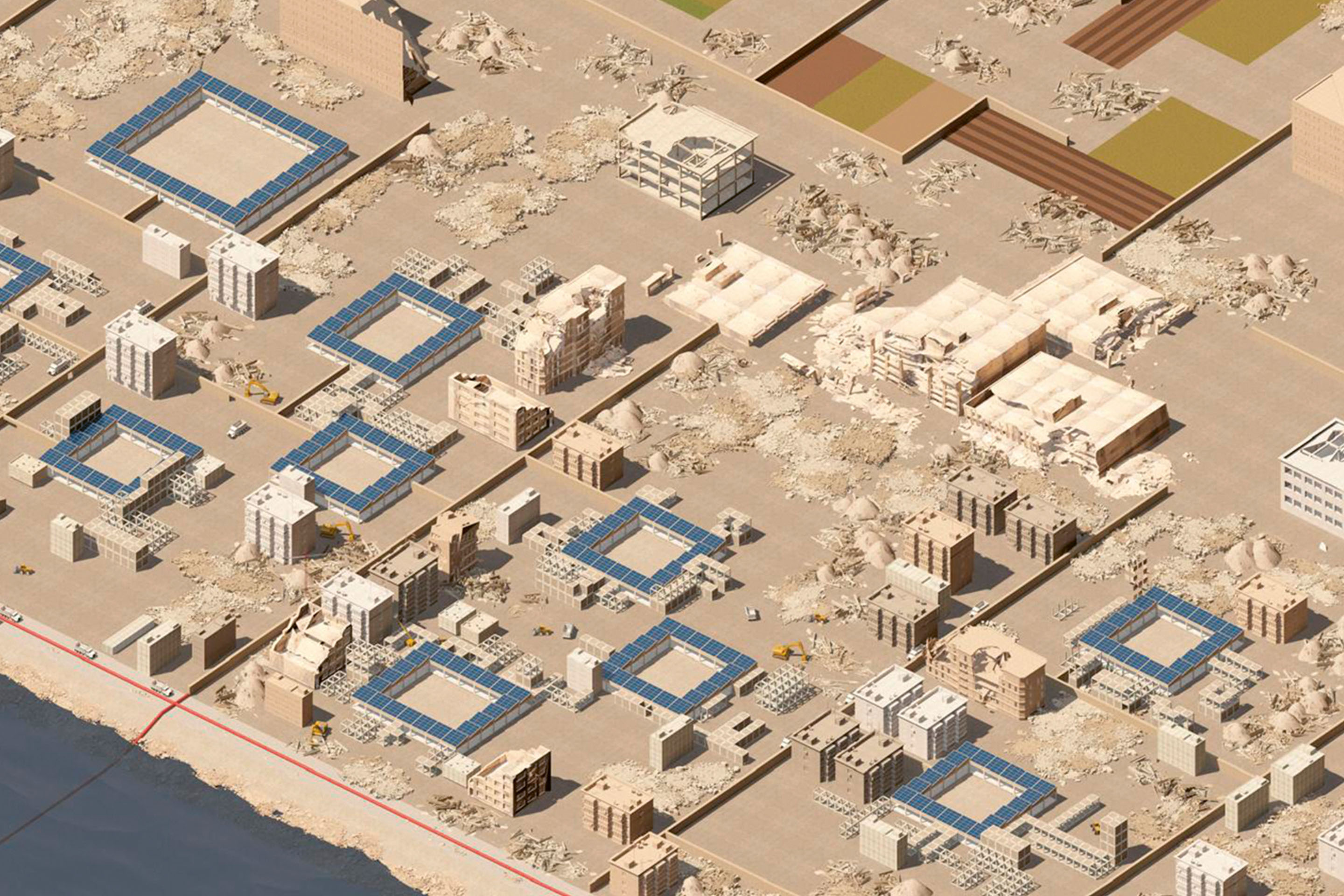
The urban model imagined for Gaza refers to a city structured around an organic constellation of cells or neighbourhoods.19 Urban destruction is seen as an opportunity to reverse current settlement mechanisms in favour of a city formed by defined and autonomous urban cells, each capable of accommodating a population of around 15 000 inhabitants. The urban cells can be built through decentralised, small-scale and diffuse interventions that make it possible to act simultaneously in different areas, optimising time, financial resources, infrastructure and labour while minimising land consumption.
Jacopo Galli, Andrea Fantin and Elisa Vendemini, who make up the venetian research group for UNDP in Gaza, set out the philosophy of their work in an article entitled «Neither plan, nor perspective, nor elevation»,20 which highlights four main axes: the construction of a knowledge framework, the definition of an operational network, the redefinition of the project as process and, finally, the emergence of the structural limits of reconstruction.
The strategy replaces the plan as a long-term orienting device, defining a flexible framework within which different and adaptable actions can be activated. The tools – especially computational ones – assume a central role in supporting real-time decision-making: analysis and simulation modules integrate heterogeneous data, assess alternative scenarios and guide choices under conditions of uncertainty. The catalyst, by contrast, represents a form of open project, founded on a minimal framework and on the capacity to activate processes of progressive transformation, leaving room for adaptation and for the contribution of local communities.
One element of particular interest is the definition of transitional neighbourhoods, which seek to move beyond the logic of temporary camps in favour of settlements capable of evolving over time while maintaining continuity with pre-existing social and spatial structures. This approach makes it possible to hold emergency and perspective together, working at the scale of the neighbourhood as the fundamental unit of social and urban organisation.
The authors state honestly the limits within which they operate: political limits, such as the condition of occupation and the control exercised by Israel over resources; material limits, such as difficult accessibility, which drastically reduce every operational possibility. Palestine’s lack of sovereignty prevents real decision-making autonomy and makes reconstruction processes structurally dependent on external actors. To these are added cognitive limits: fragmented, heterogeneous, often contradictory data, whose management remains insufficient both by international agencies and by local institutions.
This approach does not conceal the impossibility of governing reconstruction with traditional instruments in an unstable and changing context. Yet this third case also carries a risk: that of turning reconstruction into a technical problem, ever more sophisticated but progressively depoliticised. Because even the best algorithm must answer a fundamental question: who decides? Who establishes priorities, criteria and weightings? Who controls the data, and for whose benefit?
The idea that more intelligent processes or better access to data can automatically produce more just outcomes is one of the most persistent illusions of contemporary culture. But reconstruction is not a problem of optimisation. It is a field of conflict, in which rights, powers and possibilities of existence are defined.
Can a reparative urbanism exist?
For all their marked differences, the models now in play share a fundamental equivocation: they treat Gaza as a space to be organised – better, more efficiently, more justly – but not as a right to be restored. In different forms, they perform the same reduction. The American model erases, the Arab model idealises, the European model optimises. But none of them, fully, addresses the decisive question: who has the right to remain, to return, to decide.
Understood in this way, reconstruction risks becoming a practice that, however different its intentions may be, continues to exercise a form of violence: more subtle, more sophisticated, but no less incisive.
Perhaps it is the word itself, reconstruction, that proves insufficient. It evokes a return to form, to functionality, to order. But what has been destroyed in Gaza is not only a set of buildings or infrastructures: it is a tissue of relations, a continuity of life, a right to existence. It is the wounded soul of places and people. For Didier Fassin, author of a recent essay on Gaza,21 the conflict is fought not only on military terrain, but also on that of language, perception and public morality. Some lives become immediately recognisable, grievable, protected; others, by contrast, are rendered opaque, reduced to collateral damage or to an indistinct presence. It is in this asymmetry that what the author calls the «consent to destruction» takes shape: not necessarily explicit adherence, but a combination of silences, justifications, selections of attention and narrative frames that make the unacceptable acceptable.
For this reason, rather than reconstruction, we should speak of justice22 and reparative urbanism:23 a political process, situated and embodied in places, which does not merely design spaces but recognises rights, sutures wounds and returns voice. Not a model to be applied, nor an intervention to be delegated to the market or to an algorithm, but a path that demands listening, responsibility and restitution. And, in the immediate term, the concrete possibility of sustaining the survival of an exhausted population.
To rebuild is not to imagine a city ex novo, but to restore the possibility of inhabiting the one that has been denied. It is not simple to return to the word reconstruction its deepest meaning, its intrinsic and human modesty. For this is not a technical act, but a path of pacification, justice and listening. It is, before anything else, an act of restitution. It is not enough to raise buildings again, to rely on foreign companies or to mobilise academic expertise. To give life back to a community means first of all giving voice to those who have lived and suffered, supporting paths that arise from the victims, recognising their right to be protagonists of their own future. To rebuild is not to erase: it is to protect, to safeguard, to return.
It is an act of care, capable of returning to places their soul and to people their right to exist. As Pierbattista Pizzaballa, Latin Patriarch of Jerusalem, recalled on returning from one of his journeys to Gaza: «We encountered something deeper than destruction: the dignity of the human spirit that refuses to be annihilated. We met mothers preparing food for others, nurses tending wounds with gentleness and people of every faith continuing to pray to the God who sees and never forgets».24 It is from this dignity that we must begin again, from this minute care for people and for their places of life.
Notes
1 According to Pope Francis’s definition. The expression was first used on 18th August 2014, during the press conference aboard the flight returning from his journey to South Korea, in response to journalists’ questions about the growing international conflicts of that period. The expression later became one of the key formulations of his pontificate for describing global disorder.
2 A full-scale genocide is under way in Gaza, now extensively documented in both legal and academic contexts. We refer to the findings of the International Court of Justice in the proceedings «South Africa v. Israel, which ordered provisional measures against Israel on 26th January 2024, recognising the plausibility of certain rights invoked under the Genocide Convention. In September 2025, the Independent International Commission of Inquiry on the Occupied Palestinian Territory, including East Jerusalem, and Israel, an investigative body established by the UN Human Rights Council, concluded that Israel had committed genocide in the Gaza Strip. The Commission’s findings do not have the force of a binding judicial ruling, but they constitute an act of determination of considerable weight within international human rights law. These sources are joined by reports from independent Israeli human rights organisations, including B’Tselem, «Our Genocide», and Physicians for Human Rights Israel, «Genocide in Gaza», as well as peer-reviewed academic contributions in the fields of law and genocide studies, including Sultany, «A Threshold Crossed: On Genocidal Intent and the Duty to Prevent Genocide in Palestine».
3 Urbicide refers to the deliberate destruction of the urban environment not only as an assemblage of buildings and infrastructures, but as a space of coexistence, memory, social plurality and collective life. The term gained particular force in relation to the wars in the former Yugoslavia and was later developed by authors such as Stephen Graham and Martin Coward. Cfr. Graham, Cities, War, and Terrorism; Coward, Urbicide.
4 In June 2021, a group of independent experts – the Stop Ecocide Foundation – completed its pioneering drafting work and launched a proposed consensual definition of ecocide as an international crime. For the purposes of this Statute, ecocide refers to unlawful or wanton acts committed with knowledge that there is a substantial likelihood of severe and either widespread or long-term damage to the environment being caused by those acts.
5 The reference is to Agha, «The Dis-Invention of Gaza», where the erasure of Gaza is read not only as material destruction, but as an ideological attempt to remove the place from political and geographical memory.
6 Since 7th October 2023, the day of the Hamas terrorist attack, more than 2 million people – almost the entire population of the Strip – have been forced to leave their homes. According to UNOSAT’s comprehensive satellite analysis, based on imagery from 11th October 2025 and published on 31 October 2025, 198 273 structures in the Gaza Strip had been destroyed or damaged, amounting to around 81 % of the total. Of these, 123 464 were classified as destroyed, 17 116 as severely damaged, 33 857 as moderately damaged and 23 836 as possibly damaged. For the housing sector alone, the Final Gaza Rapid Damage and Needs Assessment, conducted by the World Bank, the European Union and the United Nations and published in April 2026, estimates 371 888 affected housing units, equal to 76.6 % of the total, of which 84.6 % are destroyed. The same report estimates total recovery and reconstruction needs at USD 71.4 billion over the next decade; the removal and management of more than 68 million tonnes of rubble and debris is estimated at more than USD 1.7 billion. According to UNRWA, based on figures from the Gaza Ministry of Health reported by OCHA, as of 29th April 2026, 72 599 Palestinians had been killed in the Gaza Strip and another 172 411 injured. The figures remain subject to update and should be checked again at the editorial closing date.
7 The literature on the subject is limited; three recent texts allow for some further investigation: Kryzhanovsky, Architecture After War; Munawar & Plets, Politics of Post-Conflict Heritage Reconstruction; Luckham, War and Peace in Ukraine and in Gaza.
8 Per una ricostruzione della proposta e del relativo concept progettuale si veda | For a reconstruction of the proposal and its related design concept, see De Luca, «Gaza: dalla guerra alla distopia».
9 The White House, Peace to Prosperity.
10 By real-estate urbanoclasm I mean the planned erasure of urban pre-existences in the service of new cycles of rent, valorisation and real-estate rewriting of territory. See Granata, «Urbanoclastia».
11 Per approfondire questo aspetto si veda | For further discussion, see Frontier Foundation, «President Trump Announces Freedom Cities».
12 Fabian & Magid, «Katz Calls for Confining All Gazans in ‹Humanitarian City› Built over Rafah’s Ruins».
13 Weizman, Spaziocidio; Weizman, Ungrounding | Weizman, Hollow Land; Weizman, Ungrounding.
14 The reference is to Achille Mbembe, who, with the concept of necropolitics, indicates forms of power that expose entire populations to death, extreme vulnerability or radically precarious conditions of life. See Mbembe, Necropolitics.
15 «Alligator Alcatraz» is the nickname given to the South Florida Detention Facility / Florida Soft-Sided Detention Facility South, a migrant detention centre opened in 2025 at the Dade-Collier Training and Transition Airport, in the Everglades area of Florida. The centre was promoted by the Florida authorities in collaboration with federal authorities for the detention of migrants awaiting deportation, and has been strongly criticised by human rights organisations for its detention conditions, geographical isolation, limited access to legal assistance and environmental impact.
16 The reference is to the Italy–Albania Protocol on the management of migration flows, signed in 2023 and made operational from 2024, which provides for the establishment, on Albanian territory, of facilities financed and managed by Italy for the accelerated examination of asylum applications and for the detention of migrants rescued or intercepted in the Mediterranean. The main facilities are located in Shëngjin and Gjadër, and have been the subject of extensive legal and political debate because of their role in externalising asylum and detention procedures.
17 League of Arab States, «Gaza/Palestine: Early Recovery, Reconstruction, and Development of Gaza».
18 The first public presentation of the collaboration took place on 20th June 2024 in the Aula Magna ai Tolentini, in the presence of the rector Benno Albrecht, the professor responsible for the project, Jacopo Galli, and Sufian Mushasha, Senior Policy Advisor of UNDP in Jerusalem (Urbicide Task Force). For further discussion of the project, see Iuav, «Building Peace»; Il Sole 24 Ore, «La ricostruzione di Gaza»; Rabbi, «Dal progetto al processo per ricostruire Gaza».
19 Vizzi, «Il progetto italiano per ricostruire Gaza».
20 Galli, Fantin, & Vendemini, «Non pianta, non prospetto, né alzato».
21 Fassin, Una strana disfatta.
22 In post-war contexts, restorative justice is a difficult process that seeks to give voice to victims: it allows those affected to express their suffering and to be heard directly; it seeks to foster truth and memory; it aims to encourage those responsible to assume responsibility, reconstructing what happened for families and for the entire community. It cannot replace international tribunals for war crimes or crimes against humanity: those responsible for serious violations must still answer criminally.
23 What would it mean to try to transfer the principles of pacification proper to restorative justice into the field of urbanism? The first step is to give voice to the victims, to begin from the places that have survived, from every small – very small –trace of resistance.
24 Latin Patriarchate of Jerusalem, «Opening Statement of His Beatitude Pierbattista Cardinal Pizzaballa after Returning from Gaza». Traduzione in italiano della redazione.