

Città Sospese / Waiting Cities
espazium quaderni 2026 4
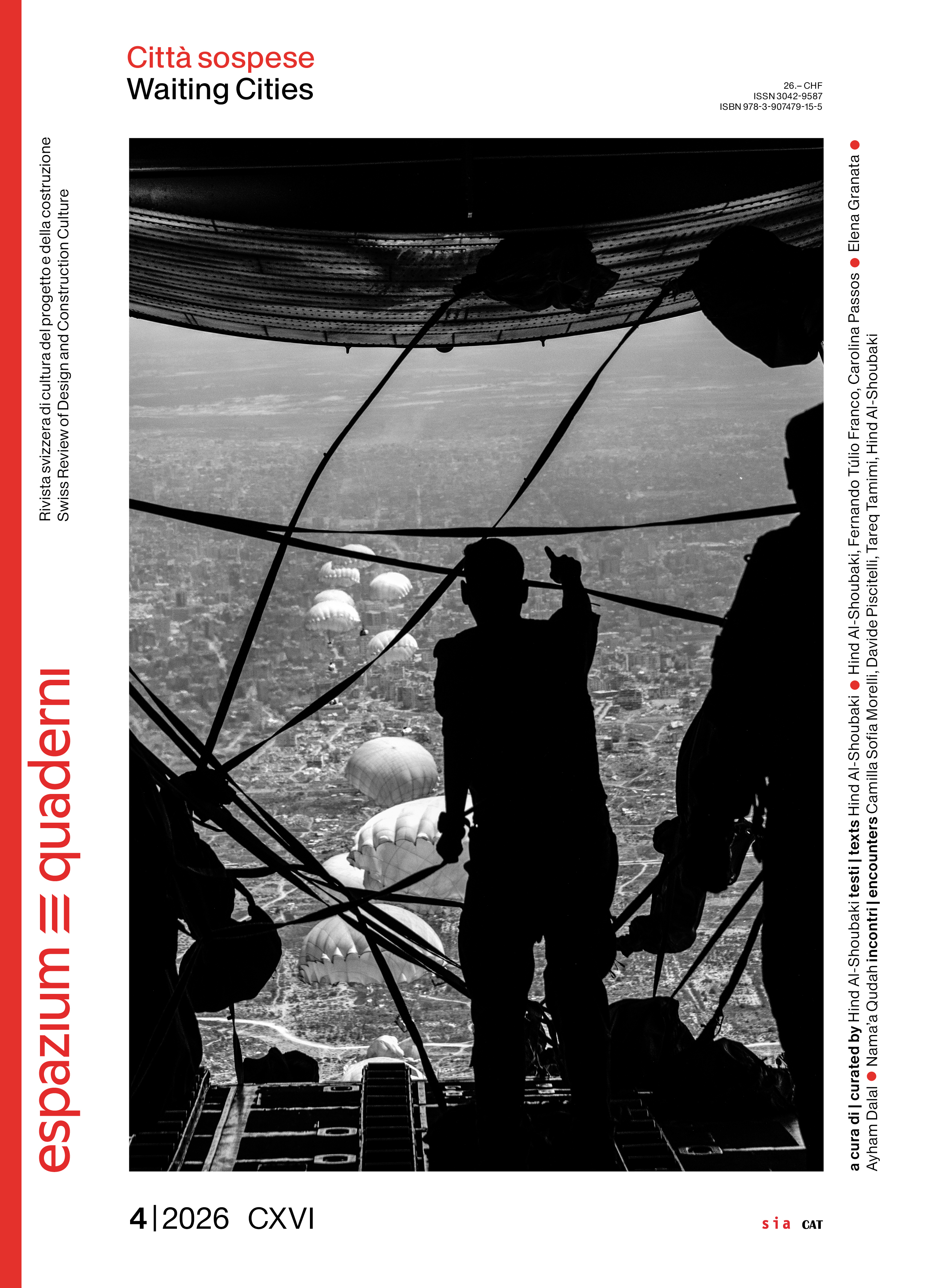
La quarta uscita di espazium quaderni, Città Sospese / Waiting Cities, affronta il rapporto tra architettura ed emergenza, interrogandone le implicazioni nel contesto contemporaneo.
Attraverso saggi, casi studio di rilievo internazionale e interviste, il numero approfondisce e destruttura il concetto di emergenza come momento straordinario, eccezionale, in funzione di una sua concezione quale dispositivo generatore di spazio, attraverso saggi, casi studio di rilievo internazionale e interviste che mirano a mettere in discussione concetti quali permanenza, temporaneità e la stessa definizione di emergenza.
«Invece che considerare l’emergenza come una parentesi eccezionale, il numero la interpreta come un regime spaziale: una condizione attraverso cui architettura, urbanistica e governance riorganizzano le relazioni tra corpi, confini, istituzioni e territorio. In questo senso, l’emergenza non è esterna alla questione urbana, bensì una delle modalità attraverso cui si configurano gli assetti urbani e territoriali contemporanei», afferma Hind Al Shoubaki, curatrice del numero e ricercatrice attiva nel campo dell’urbanistica e nello studio della condizione del campo.
Nel contesto dell'attuale scenario geopolitico, è emersa l’urgenza di affrontare il tema dell’emergenza attraverso un dibattito scientifico e critico sul ruolo dell’architettura nei contesti di crisi. Il numero indaga la sovrapposizione di dimensioni politiche, progettuali, territoriali e istituzionali che si condensano nel campo, articolandosi attorno a tre momenti dell'esperienza emergenziale: la permanenza, intesa come protrarsi nel tempo di strutture concepite come temporanee; la trasformazione, attraverso cui infrastrutture nate per rispondere alla crisi assumono nuove funzioni; e la ricostruzione, quando alla distruzione seguono progetti concorrenti per il futuro del territorio, della memoria e della vita collettiva.
Tra i principali contributi del numero figurano i saggi di Elena Granata, Ayham Dalal e Namaa Quada, insieme a una tavola rotonda con Davide Piscitelli (Forensic Architecture) e Tareq Tamimi (LIMINAL), moderata da Camilla Sofia Morelli e Hind Al-Shoubaki. Il confronto evidenzia come gli strumenti dell'architettura possano diventare dispositivi di indagine forense, capaci di documentare la violenza, leggere le trasformazioni dei territori e interrogare criticamente le pratiche della ricostruzione.
Invece che offrire risposte univoche, Espazium quaderni 4 si propone come uno strumento critico per interrogare le trasformazioni spaziali prodotte dall'emergenza. Il volume invita a guardare oltre tende, rifugi temporanei, macerie e ricostruzione, per riconoscervi infrastrutture di cura e di controllo, politiche della ricostruzione, violenza di confine e il valore probatorio delle rappresentazioni spaziali.
***
The fourth issue of espazium quaderni, Waiting Cities, explores the relationship between architecture and emergency, examining its implications in the contemporary context.
Through essays, internationally significant case studies, and interviews, the issue challenges the conventional understanding of emergency as an exceptional, temporary condition, instead proposing it as a spatial device that generates and shapes space. In doing so, it questions notions of permanence, temporality, and the very definition of emergency.
“Rather than considering emergency as an exceptional interruption, the issue understands it as a spatial regime: a condition through which architecture, urbanism, and governance reorganise relationships between bodies, borders, institutions, and territory. In this sense, emergency is not external to the urban question; rather, it is one of the ways in which contemporary urban and territorial configurations are produced,” says Hind Al-Shoubaki, guest editor of the issue and researcher working in the fields of urbanism and camp studies.
Against the backdrop of the current geopolitical landscape, the issue responds to the urgent need for a rigorous and critical debate on the role of architecture in contexts of crisis. It investigates the overlap of political, spatial, territorial, and institutional dimensions that converge in the camp, structuring the discussion around three key moments of the emergency condition: permanence, understood as the prolonged existence of structures originally conceived as temporary; transformation, through which infrastructures created to respond to crisis acquire new functions and meanings; and reconstruction, when destruction is followed by competing visions for the future of territory, memory, and collective life.
Among the issue's main contributions are essays by Elena Granata, Ayham Dalal, and Namaa Quada, alongside a roundtable discussion with Davide Piscitelli (Forensic Architecture) and Tareq Tamimi (LIMINAL), moderated by Camilla Sofia Morelli and Hind Al-Shoubaki. The discussion demonstrates how architectural tools can become instruments of forensic investigation, capable of documenting violence, interpreting territorial transformations, and critically examining the politics and practices of reconstruction.
Rather than offering definitive answers, espazium quaderni 4 positions itself as a critical tool for interrogating the spatial transformations produced by emergency. The volume invites readers to look beyond tents, temporary shelters, ruins, and reconstruction, recognising instead infrastructures of care and control, the politics of reconstruction, border violence, and the evidentiary role of spatial representations.