Smart, efficient and sustainable surfaces
Combining robotics, AI, and extended reality, Layered develops a new generation of building finishes through adaptive spray printing. The technology transforms a traditional process into a high-precision form of digital craftsmanship.
Testo in italiano al seguente link
Embedded in a long tradition of craftsmanship, surfaces inside or outside building structures are often coated, playing both functional and ornamental roles.1 Due to the rationalization of building processes in contemporary architectural practice, surface coating has largely been reduced to a simplified and standardized procedure optimized for time and cost efficiency, an approach that has also been reflected in construction robotics research. The attempts since the 1990s to replace the manual surface coating process with automation approaches aim to apply coating materials using multi-degree-of-freedom (DoF) robotic arms, seeking to directly imitate the steps of a simplified process rather than pursuing transformative innovation.2
As a young start-up company, Layered offers an adaptive, thin-layer, spray-based printing technique for surface coating and aims to introduce a revolutionary digital craft through additive manufacturing. In contrast to sole single layers (e.g. of painting or skim coating) or to the application of centimeter-thick layers (e.g. of plaster) that are then shaped with custom made tools or formwork (e.g. trowel, running mold), the proposed additive manufacturing method involves the spraying of multiple, millimeter-thin (or thick) adapting layers of coating to building elements, «where necessary and when necessary» as a material and resource efficient process.
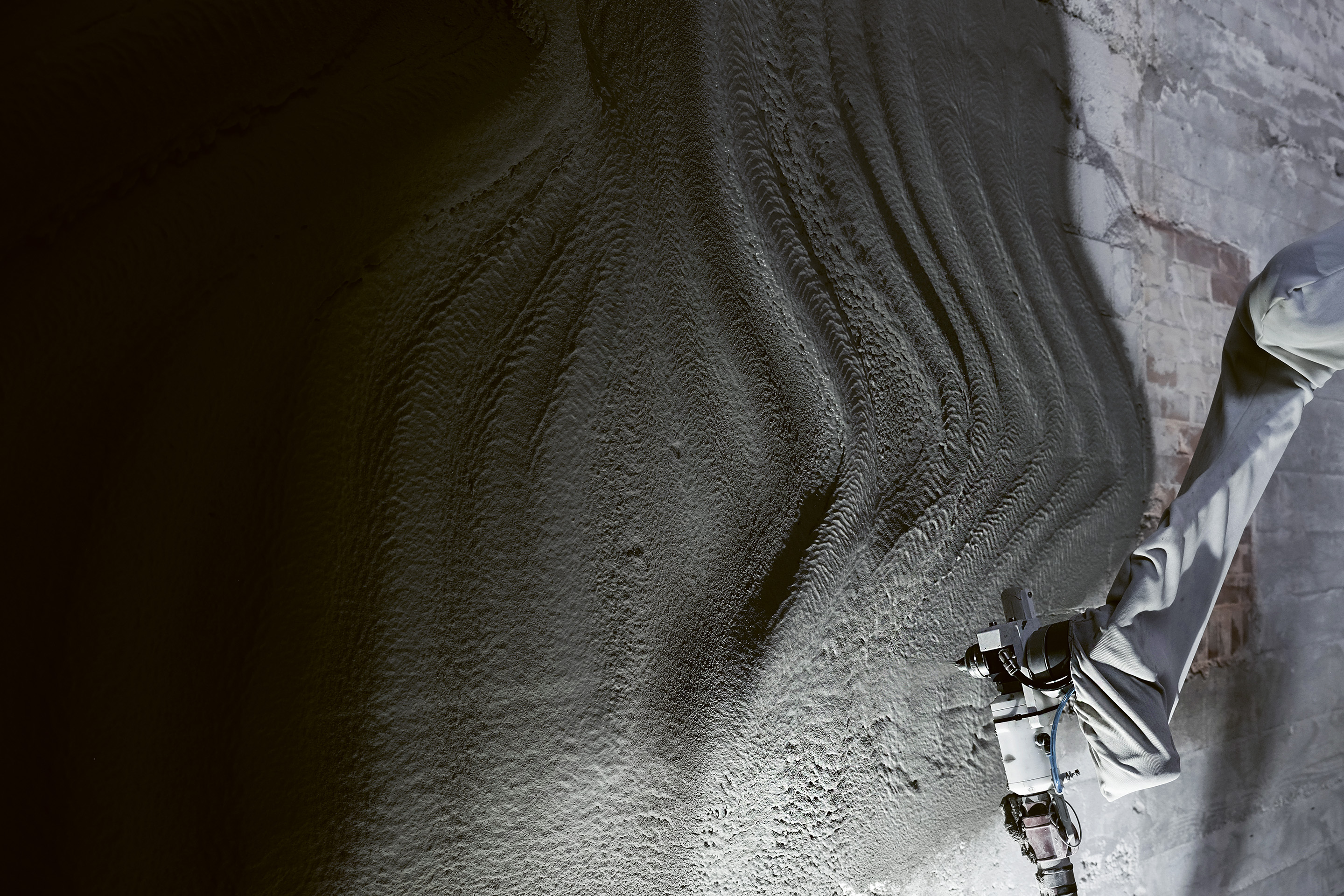
Layered is pioneering the next generation of autonomous mobile robots for high-precision, spray-based surface coating applications. The system automates a critical step in construction: the coating material is sprayed and formed directly on the surfaces of a building structure, a process that is otherwise laborious and at times hazardous. As such, it improves the conditions for craftspeople, makes on-site construction safer, efficient and more sustainable.
It is timely, if not overdue, to foster the creation of high-tech jobs in one of the least digitized industries, capitalizing on the power of traditional craftsmanship, autonomous robotics, Artificial Intelligence (AI) and Extended Reality (XR). Through the proposed approach, Layered actively supports Sustainable Development Goals (SDGs) 9 – «Industry, Innovation, and Infrastructure», 11 – «Sustainable Cities and Communities», 12 – «Responsible Consumption and Production» and 13 – «Climate Action».
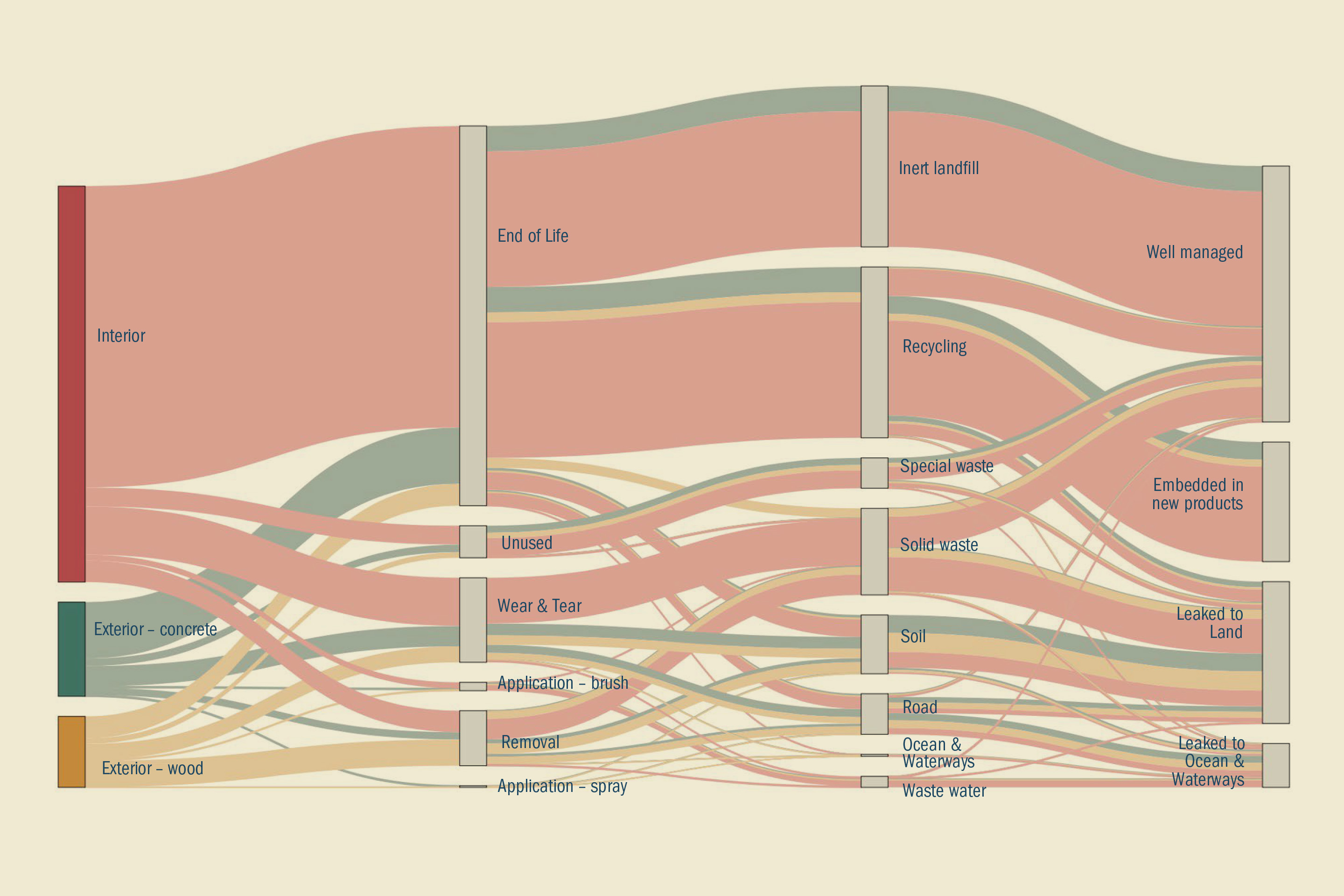
The environmental impact of the proposed technology is manifold and reduction in material waste is primary. Robotic precision in surface coating can reduce construction material waste by 20 %. This translates into fewer raw materials being used per square meter of finished surface and can reduce landfill contributions.
By reducing rework, the proposed technology can help cut embodied carbon emissions by an estimated 10–25 % per project phase. The automation and precision in task execution reduce the need for energy-intensive corrective work, corresponding to savings of 50-200 kg CO2 per 100 m² of coated wall surface.
Surface coating work is currently exposing craftspeople to hazardous dust and skeletal injuries at rates exceeding safety thresholds up to 30 % of European worksites.3 Layered proposed automation solution aims to substantially reduce direct human exposure to these harmful processes, thereby lowering the risk of long-term occupational illnesses.
The approach is at the forefront of circular economy enablement. In Switzerland alone, 84 % of total waste originates from the construction industry, with more than 500 kilograms of construction waste are generated every second across the cantons.4 Demolition and reconstruction practices contribute significantly to avoidable CO2-equivalent emissions and material waste, driven by energy-intensive demolition processes and the preventable use of newly manufactured construction materials.5 Moreover, 20 % of Switzerland’s total waste volume stems specifically from the demolition of buildings and infrastructure.6 Beyond new construction, Layered therefore seeks to unlock the potential of its innovative on-site construction technologies to upgrade and retrofit existing structures for continued use. By prioritizing reuse and targeted renovation, especially in areas where conventional practices are most inefficient, the technology aims to reduce unnecessary demolitions and associated environmental impacts.
Notes
- Spiro, Annette, Hartmut Göhler, & Pinar Gönül. Über Putz, Oberflächen entwickeln und realisieren, gta Verlag, 2012.
- Rosenfeld, Yehiel, Abraham Warszawski, & Uri Zajicek. «Full-Scale Building with Interior Finishing Robot». Automation in Construction, Vol. 2 (3), (1993) https://doi.org/10.1016/0926-5805(93)90043-W, 301-306;
Liu, Zhao, Dayuan Chen, & Xin Jiang. «Putty Plastering Realized by a Force Controlled Robotic Scraper». IEEE International Conference on Robotics and Biomimetics ROBIO, (2021) doi:10.1109/ROBIO54168.2021.9739274
Forsberg, Johan, Daniel Graff, & Åke Wernersson. «An Autonomous Plastering Robot for Walls and Ceilings». IFAC Proceedings Volumes, Vol.28 (11), (1995) https://doi.org/10.1016/S1474-6670(17)46989-8- «European Agency for Safety and Health at Work» (EU-OSHA), https://osha.europa.eu/en.
- «Abriss-Atlas», https://www.abriss-atlas.ch/.
- «Circularity Gap Report 2023», https://www.circularity-gap.world/2023.
- «Federal Office for the Environment (FOEN), statistics on demolition-related waste in Switzerland», https://www.bafu.admin.ch/en.