

No body is surplus
Designing a care-full justice in neighbourhood infrastructure
The essay reframes care as a spatial and urban ethic. Neighborhoods, relational infrastructures, and material invitations become tools of lived justice, turning the built environment into daily, inclusive, civic support where no one is left aside.

Niente e nessuno è di troppo, testo in italiano
Care as an urban form
Care is not simply an emotion or attitude; it is a spatial practice deeply embedded in social relations and material infrastructures. In neighborhoods, care reveals itself in thresholds, proximities, paths, and places where life unfolds collectively. Rather than abstract concepts of justice or equity, care offers an embodied ethic grounded in responsiveness, responsibility, and situated design. When framed through the lens of architecture and urbanism, care invites a rethinking of neighbourhood form not as a backdrop to policy, but as infrastructure for civic encounter and mutual responsibility. Drawing on Fisher and Tronto’s formulation, care can be understood as a «species activity» encompassing «everything we do to maintain, continue, and repair our world so that we can live in it as well as possible».1 This expansive definition moves beyond the private and interpersonal to include care for the environment, communities, institutions, and political processes. Care, in this sense, is not just about tending to others but about the active creation and maintenance of conditions that support collective flourishing.
Ethically, care is grounded in attentiveness, responsibility, competence, responsiveness, and solidarity – dimensions that foreground interdependence over autonomy and situated judgment over abstract universality. The ethics of care resonates with, and can even amplify, existing justice-oriented frameworks. Traditional accounts of urban justice, particularly those rooted in the highly influential political economy tradition of Harvey’s Social Justice and the City,2 focus on systemic redistribution, class-based struggle, and structural transformation. These accounts rightly foreground inequalities in access to resources, housing, infrastructure, and political power. A more local, people-oriented perspective, such as Fainstein’s Just City,3 highlights how equity and diversity often struggle in practice.
The practice of care is always situated; it emerges in relation to specific needs, spatial contexts, and relationships. From food cooperatives and shelters for the homeless to youth centers, care is enacted in modest, everyday ways. As Williams4 proposes through her concept of «carefull justice», integrating care into justice thinking allows us to imagine urban futures where healing, repair, and recognition are central to the political project of the city. Justice is not only about institutional arrangements; it is also about how we respond to others in shared space with attentiveness and commitment. This is where care ethics intervenes: as a mode of attunement to the relational, emotional, and material practices through which justice or injustice is made real.
Neighborhoods are the primary arenas where residents’ needs are most immediately negotiated: where housing, transport, food access, and social infrastructure intersect with identities, histories, and aspirations. They are also the scale at which care is practiced most frequently, not only through formal institutions like health centers or schools, but through informal networks, everyday encounters, and grassroots initiatives. Neighborhoods become testing grounds for «actually existing care» and thus for «actually existing justice».5 They can be spaces of solidarity and mutual support, but also sites of exclusion, neglect, and uneven responsibility. These small, unspectacular acts are not merely supportive but transformative: they constitute alternative urban futures in the present.
This article argues that neighbourhoods, as urban microcosms, are the factories of care. Here, justice is not only administered through institutional provisions but performed in material gestures: benches under trees, doors that stay open, markets scaled for the elderly, and libraries that become sanctuaries. From North America to Asia to Switzerland, this article traces how built form encodes care, and how architecture must underscore the claim that nobody is surplus.
Spatial logics of care
This essay reconceptualizes care not as a background sentiment but as a spatial and civic condition. In this context, the neighbourhood is no longer seen as a fixed territorial unit, but as a dynamic interface of infrastructures, proximities, and spatial typologies that sustain everyday life. Urban care unfolds where architecture enables encounter, where infrastructures are porous, and where spatial forms are attuned to the rhythms and vulnerabilities of diverse urban actors.
To navigate this redefinition, we articulate three architectural and urban planning lenses that emerge across a diverse set of cases: proximity and accessibility; relational infrastructure; and material and symbolic invitations. Together, these categories offer a vocabulary for designing neighborhoods that push boundaries, neighborhoods that stage justice not just as politics, but as lived spatial practice.
1. Proximity and accessibility
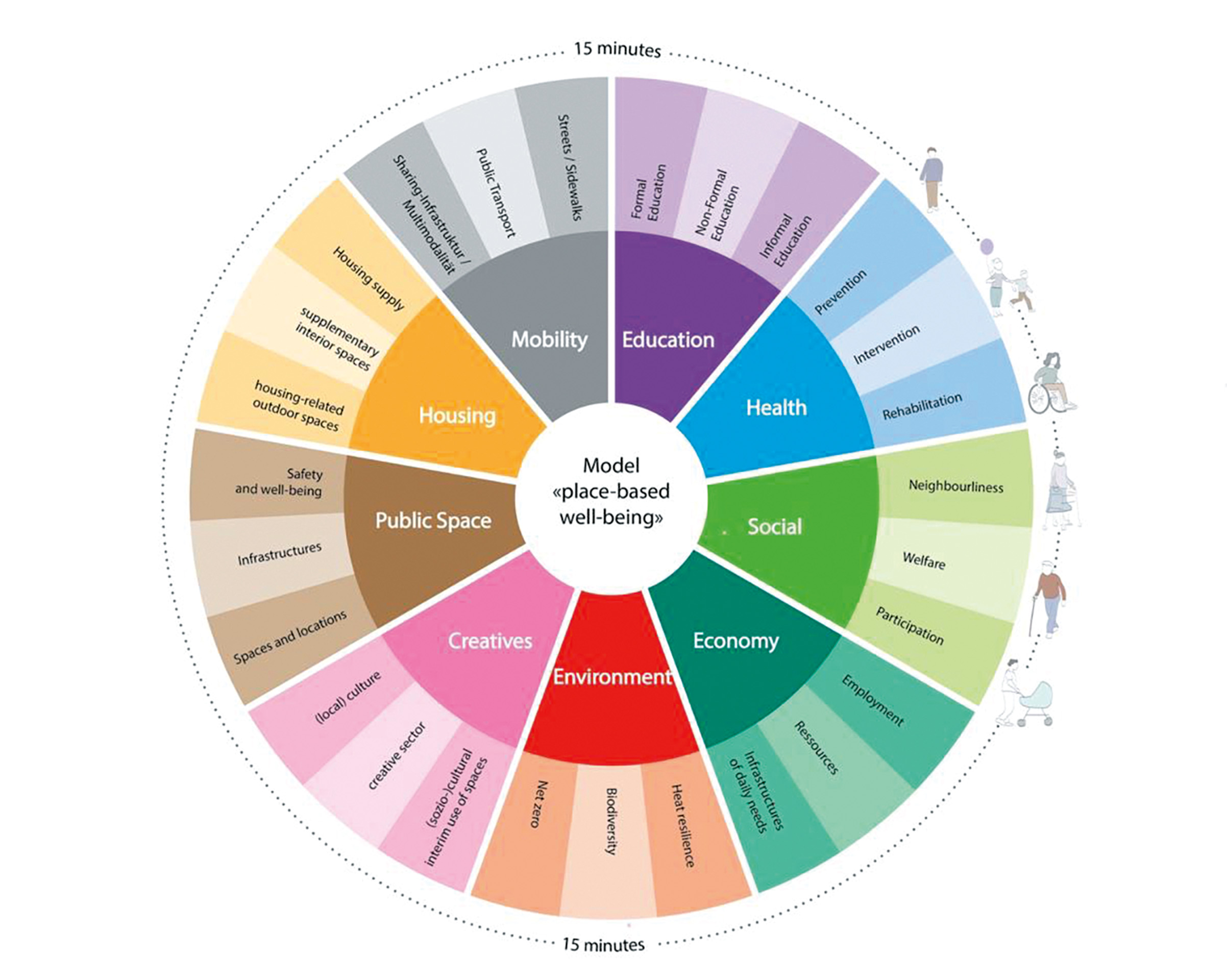
Proximity, in contemporary urbanism, is not merely about geometry; it is a condition of relational urban justice and thus care. Chrono-urbanist frameworks such as Carlos Moreno’s 15-Minute City, Zurich’s 10-Minute concept, and Aarau’s Basic Neighbourhood Provision prototype represent typological shifts where the temporal accessibility of services becomes an infrastructural right. Carlos Moreno’s model provided the initial spark. Since then, chrono-urbanism has proliferated globally. Melbourne, for example, integrates a 20-Minute Neighbourhood concept into its masterplan, retrofitting crossings and organizing community hubs so that daily needs can be met within a short walk. Zurich’s approach narrows this threshold to a 10-minute buffer, while in Utrecht, the entire city is conceived within this radius. Across Europe, temporal interventions such as «School Streets» – which close surrounding roads for thirty minutes before the morning bell – foster parental networks and reinforce informal supervision mechanisms.
Barcelona’s Superblocks similarly cluster everyday destinations, integrate safe crossings, and reduce the time burden of escorting children, allowing for the reinvestment of this time in other forms of care. Underlying these strategies is a shared premise: time is the currency of care. The smaller the everyday time handicap, the greater the residual capacity for neighbourly support and reciprocal aid.
Aarau’s model advances this ethos by reframing the question: rather than isolating target groups, it asks what every citizen needs to live well in place. This leads to a spatial programming of services: healthcare, culture, mobility, and social support, which are embedded within walkable proximities. The emphasis lies in weaving together formal and informal infrastructures, recognizing that care is not only institutionally mediated but emerges through the closeness of everyday spatial reachability (fig. 1).
2. Relational infrastructure
Relational infrastructures serve as the connective threads in the urban tissue, designed to accommodate collective use, civic density, and sustained encounters. When conceived as spaces of care, these infrastructures extend beyond their physical form to cultivate social cohesion, reciprocity, and inclusion.
In Berlin, Park am Gleisdreieck exemplifies a multi-scalar urban common that integrates spatial, programmatic, and symbolic layers of care. Redeveloped from a disused rail corridor between Kreuzberg and Schöneberg, the park’s porous design re-stitches formerly divided districts. Barrier-free pathways, water fountains, gender-neutral restrooms, and an all-abilities playground support a diverse public, embedding material care in the landscape. Programmatic care is enabled through a hybrid governance model: the public foundation Grün Berlin maintains the site, while neighborhood councils distribute micro-grants to citizen-led activities, such as walking groups, urban gardens, skate workshops, and real-world laboratories, often built by the participants themselves. These practices foster a solidarity network sustained by recurring engagement. Symbolic care takes shape in the park’s Gleisplateau, where salvaged track lines traverse wildflower meadows, an evocative gesture that honors industrial heritage while nurturing new ecologies of encounter. This transformation of a line of separation into a seam of reciprocity frames justice as something tactile and spatially legible. The public’s reception affirms the park’s inclusive ethos: a 2022 on-site survey commissioned by Grün Berlin recorded an overall satisfaction score of 8.8/10, with 97% of respondents indicating that they would return. Certified as fully accessible under Germany’s «Reisen für Alle» scheme, the park now serves as a model for the Urban Green Unit’s envisioned «care corridors» along Berlin’s Ringbahn. Here, adaptable public space, supported by participatory stewardship, forms both the hard and soft infrastructure of civic trust.
A parallel example emerges across the Atlantic in Calgary’s Central Library, where architecture similarly operates as a vehicle of care. Conceived as a civic landmark bridging downtown high-rises and the marginalized East Village, the library reclaims a former rail trench to establish a threshold space, an infrastructural hinge, between disparate publics. Designed with spatial generosity, the building features open sightlines, all-day access, informal seating areas, and dignified amenities including free restrooms, public Wi-Fi, and a low-cost café. These design choices enable visitors of all backgrounds, including unsheltered individuals, to dwell safely without segregation. The library institutionalizes care through embedded services. Since 2021, its Wellness Desk – staffed by social workers – has provided crisis support, health referrals, and harm reduction services. Integrated discreetly within a space already frequented by families, students, and entrepreneurs, these services reduce stigma while expanding the building’s social function. The library becomes a shared civic living room: toddlers clamber over sculpted wooden play elements, seniors rest beside sunlit atriums, and job seekers update résumés across from quiet readers. Security protocols explicitly permit resting, acknowledging the needs of vulnerable populations during Calgary’s long winters.
Both cases demonstrate that when designed with openness, encounter, and shared authorship in mind, architectural typologies – whether parks or civic institutions – can evolve into infrastructures of care. These projects show that justice can be materialized not only through policy but through the very form, use, and stewardship of space.
3. Material and symbolic invitations
Care is not merely delivered through programs; it should be embedded in the built environment. Spatial elements such as thresholds, signage, textures, and urban furniture construct a material and symbolic language through which welcome, dignity, and inclusion are communicated. These gestures of attentiveness transform the everyday city into a place where care is not only enacted but made legible.
Tokyo’s Sugamo Shotengai offers a compelling example of age-responsive urbanism. This 800-metre-long commercial street in the Toshima ward, affectionately known as «Harajuku for grandmas», reimagines the shopping arcade as a terrain of intergenerational care. Nearly 200 micro-retailers cater to the specific needs of elderly residents: Kampō herbal remedies, soft-soled shoes, incontinence products, easy-grip utensils, and mobility-aware barbers. Architectural strategies reinforce this ethic: shopfronts align flush with the pavement, curbs are eliminated, and chairs spill into the walkway to support slow mobility. A vivid red gateway and traffic bollards demarcate the street as pedestrian priority, turning the entire stretch into a spatial threshold of safety and attentiveness.
At the heart of the street stands Kōgan-ji Temple, a symbolic anchor that affirms spiritual continuity and provides a communal plaza for seasonal festivals and everyday encounters. Yet this spatial language of care carries ambivalence. The explicit age orientation through both merchandise and signage can unintentionally inscribe Sugamo as a niche enclave. While older residents feel recognized, some younger Tokyoites perceive the district as a space of otherness, where frailty is cordoned off rather than integrated. The relatively low shop rents, compared to youth-oriented retail hubs, suggest that branding a place around care may inadvertently influence its economic and symbolic positioning.
Nonetheless, Sugamo’s shop-owner-driven governance model resists enclosure. The street remains a functional urban connector; neighbors of all ages traverse it daily, and events attract a diverse public. This layered use illustrates how care infrastructures must remain flexible and intergenerational, lest they solidify into soft segregation (fig. 2).
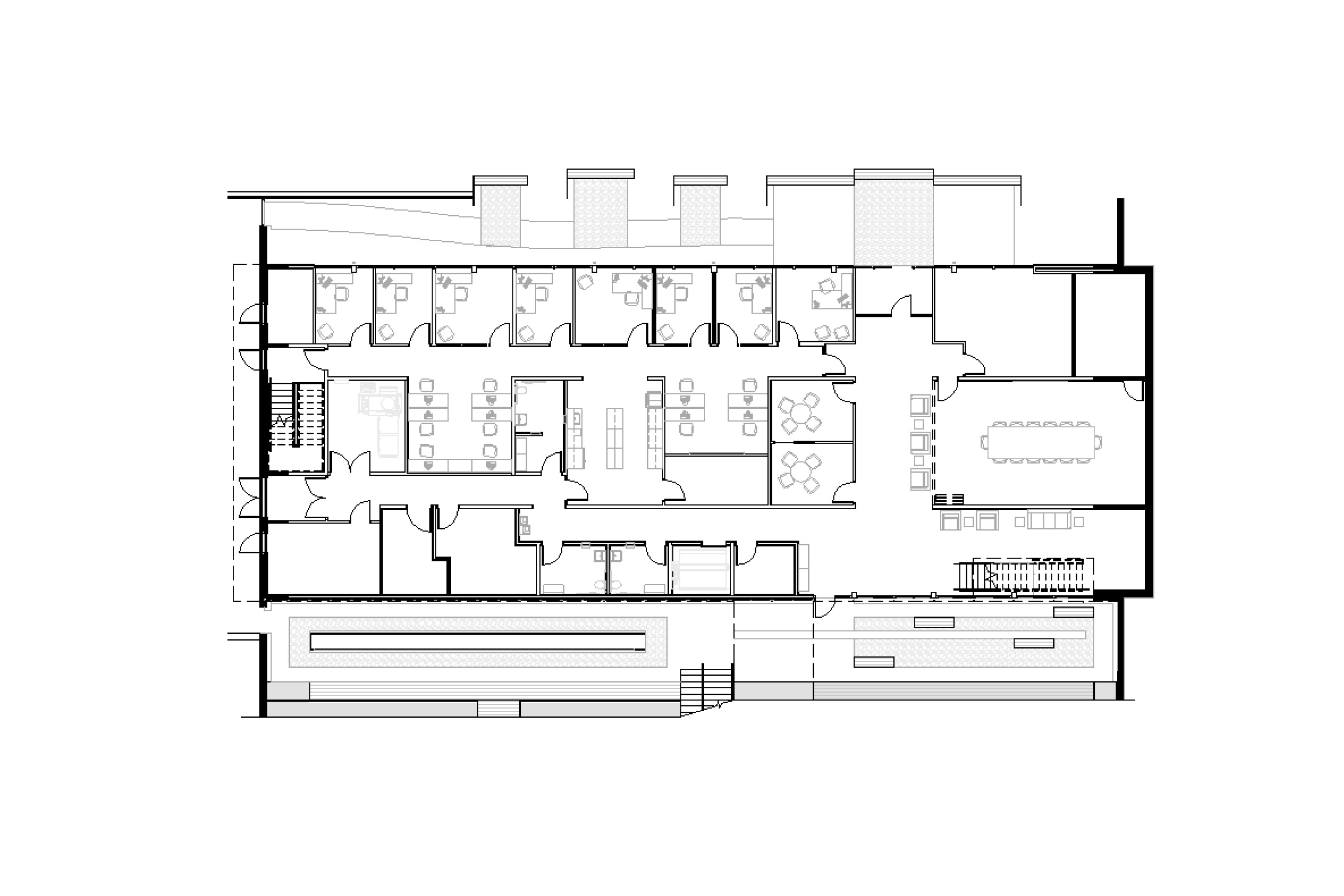
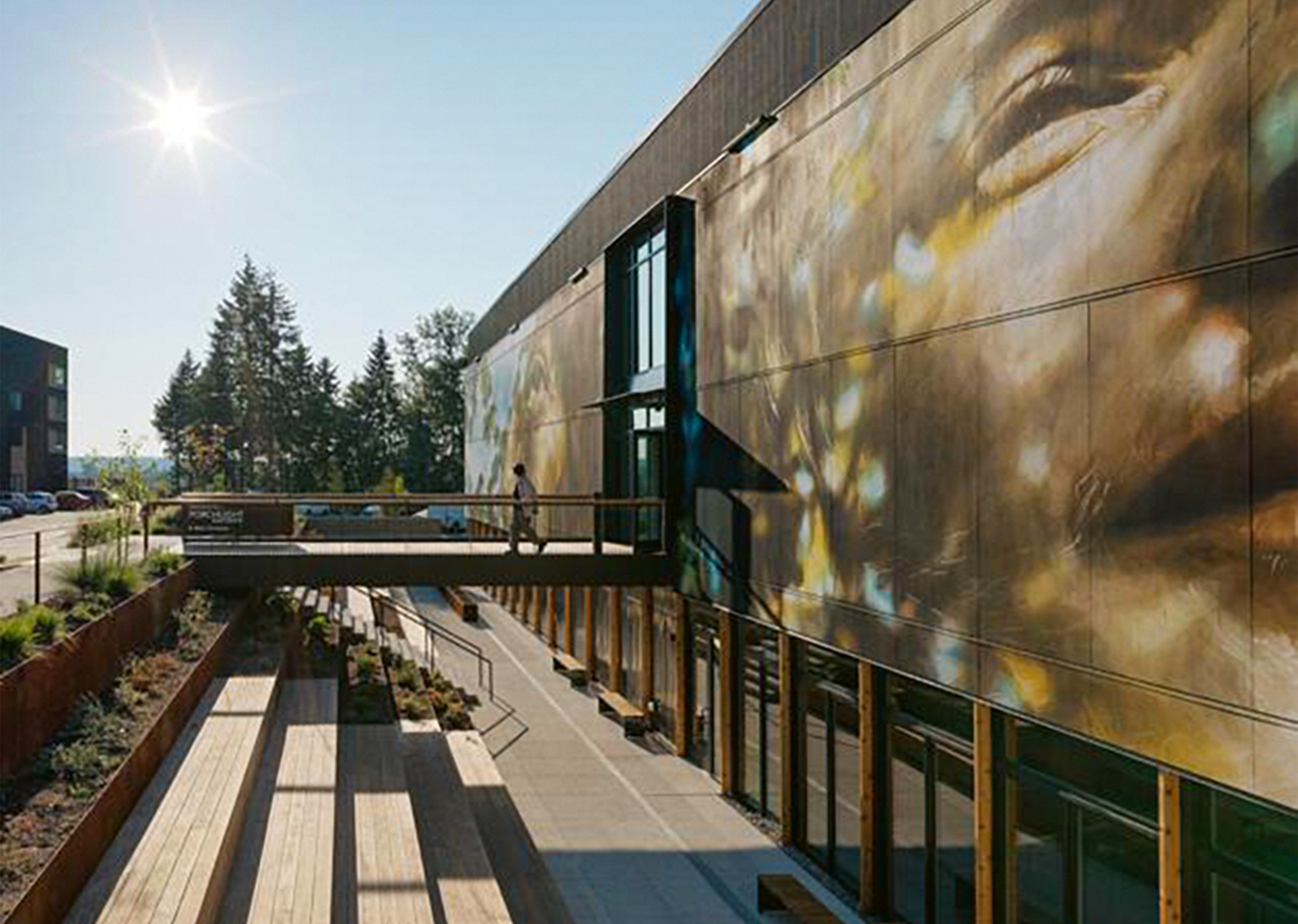
A similar spatial ethic animates Washington States PorchLight shelter, which reconfigures emergency accommodation through a vocabulary of material respect and dignity. Departing from the institutional coldness of conventional shelters, PorchLight deploys design gestures—always-lit entrances, personal lockers beside mats, robust bunk frames that signal safety, privacy, and belonging. Here, the architecture itself narrates care, making vulnerability a planned-for presence rather than an exception (fig. 3). The project exemplifies the spatial ambivalence of urban care. On the one hand, its low-threshold design offers essential services, including beds, showers, and case management, turning a marginal lot into a node of repair and continuity. On the other hand, its targeted mission draws boundaries: eligibility criteria determine entry, and its visibility can provoke neighbourhood anxieties. As a result, shelters like PorchLight are often caught in a double bind, embodying solidarity through built form, while simultaneously being read as symbols of disorder and exclusion (fig. 4).
This tension underlines the imperative that spatialized care must extend beyond architectural expression. To avoid becoming enclaves of concentrated need, caring environments require integrative strategies, such as affordable housing, inclusive public spaces, and participatory governance models that redistribute care across the urban fabric. Without such alignment, places designed to support may inadvertently reify the very marginality they seek to address.
Conclusion
The neighbourhood, understood as a layered spatial ecology, can no longer be designed solely as a service container or zoning unit. It must be read – and built – as an ethical and architectural proposition: where chrono-urbanist proximity enables care; where relational infrastructures hold civic encounter; and where material and symbolic invitations construct spatial justice. The cases sketched above show that care is never confined to one typology. And across them runs a common thread: architecture matters less as an object than as a set of invitations. Low-threshold doors, level pavements, generous benches, lockers beside mats, shared gardens and repairable walk-paths are small but durable signals that vulnerability is expected and welcome. Seen through an ethic of care, such gestures move through the whole cycle of caring about, taking care of, caregiving and care-receiving, turning material details into promises. They redistribute recognition long before policy arrives: a stroller-friendly curb lets a grand-parent linger; a temple forecourt dotted with chairs becomes an inter-generational commons; an open space design can symbols equality. By stitching symbolic, spatial and programmatic layers together, built form amplifies care without monopolising it. Indeed, the practice can begin anywhere, with a borrowed parish hall, a shady bench, the five-minute radius of a chrono-urbanist super-block, because its true medium is relationship, not concrete.
Yet space still carries responsibility. When shelters mark poverty or «grandma streets» become branding niches, we are reminded that caring places must be paired with permeable governance, mixed economies and guarantees of access. Neighbourhoods that «care with» their residents widen the circle of obligation beyond professional carers to the infrastructures, markets and regulations that make reciprocity possible. Architecture’s task, then, is twofold: to hold open material supports for everyday repair, and to dramatise – visibly, legibly, repeatably – the moral claim that no body is surplus. When it does so, neighbourhoods do more than host life; they enact a «care-full justice» that counters exclusion and keeps the civic engagement awake.
Notes
1 B. Fisher, J.C. Tronto, Toward a Feminist Theory of Caring, in E.K. Abel, M.K. Nelson (eds), Circles of Care: Work and Identity in Women’s Lives, SUNY Press, Albany, 1990, pp. 35-62.
2 D. Harvey, Social Justice and the City, Johns Hopkins University Press, Baltimore 1973, ISBN 9780801815322.
3 S.S. Fainstein, The Just City, Cornell University Press, Ithaca 2010, p. 212, ISBN 0801446554.
4 M.J. Williams, Care-full Justice in the City, «Antipode» 49(3), 2017, pp. 821–839,
doi: 10.1111/anti.12279.
5 M.J. Williams, Justice and Care in the City: Uncovering Everyday Practices through Research Volunteering, «Area» 48(4), 2016, pp. 513-520, doi: 10.1111/area.12278.
6 T. Libardoni, M. Drilling, Materialization of Ageing in Place, in M. Drilling, P. Suero, H. Al-Shoubaki & F. Neuhaus (eds), Ageing and Urban Planning. Routledge, New York 2025, pp.213-294, ISBN 9780367700676.