

Emergency as Spatial Regime
Camps, Transformation, and the Politics of Reconstruction
An emergency does not disrupt space: it creates it. Through refugee camps, reconstruction projects, cartography and forensic practices, this issue of espazium quaderni explores how architecture and urban planning contribute to the construction of territories, rights and futures, beyond the logic of the exceptional.
Testo in italiano al seguente link
Emergency beyond the temporary
Emergency is most often understood through the language of rupture: a sudden event, a moment of disruption, a temporary suspension of ordinary life that demands an immediate response.1 In architectural and planning discourse, this understanding has frequently been expressed in a technical vocabulary of shelter, protection, logistics, infrastructure, and reconstruction.2 Emergency appears, in this view, as a problem of speed and provision: how to house, how to repair, how to restore, how to respond. Yet such a reading risks reducing emergency to a short-lived condition, detached from the longer spatial and political processes through which crises are produced, governed, prolonged, and normalized.3
This issue of espazium quaderni begins from a different hypothesis. Emergency is not only an event that interrupts space; it is also a mode through which space is produced.4 It generates territories, infrastructures, administrative categories, regimes of mobility and immobility, and uneven forms of access to protection, care, and rights.5 Rather than treating the emergency as an exceptional parenthesis, the issue understands it as a spatial regime: a condition through which architecture, urbanism, and governance reorganize the relation between bodies, borders, institutions, and territory.6 In this sense, the emergency is not external to the urban question. It is one of the ways in which contemporary urban and territorial orders are made.
This shift requires moving beyond the image of emergency as an immediate humanitarian response. The tent, the shelter, the temporary unit, and the camp are not only material answers to displacement or destruction; they are also instruments through which populations are classified, assisted, contained, and governed.7 As Henri Lefebvre reminds us, space is never a neutral container of social relations, but is itself produced through political, economic, and institutional forces.8 Emergency spaces, therefore, cannot be read simply as provisional arrangements awaiting disappearance. They must be examined as spatial formations in which power becomes material, visible, and everyday life.9
The camp is perhaps the most significant figure of this condition. Planned as temporary, justified by urgency, and administered through exceptional procedures, the camp often persists far beyond the moment of crisis that produced it.10 It is constructed as a space of protection, yet it can also operate as a space of separation, dependency, and control.11 It is designed to host life in suspension, yet it becomes the site of ordinary practices of dwelling, exchange, education, work, and social reproduction.12 This paradox has been central to critical studies of humanitarianism and displacement, which have shown how the camp condenses the ambiguities of modern governance: care and confinement, assistance and surveillance, protection and exclusion.13
To approach emergency spatially, then, is to ask not only how architecture responds to crisis, but how crisis itself becomes architectural. How does an emergency take form? How is it planned, administered, inhabited, and transformed? At what point does a temporary response become a durable territorial order? And what kinds of political futures are made possible or foreclosed through the spatial management of emergency? These questions form the conceptual ground of this issue. They allow us to read camps, humanitarian infrastructures, and reconstruction processes not as marginal or exceptional spaces, but as central sites where the contemporary relationship between architecture, violence, care, and governance is produced.14
The camp as a political form
If an emergency is a spatial regime, the camp is one of its most explicit political forms. It is not merely a place where displaced populations are temporarily sheltered, nor simply a technical solution to the problem of humanitarian provision. The camp is a form through which displacement is made governable. It translates the disorder of crisis into a spatial order of registration, allocation, surveillance, service delivery, mobility control, and differentiated access to rights. In this context, the camp should be seen not just as an architectural or humanitarian structure, but as a form of political technology: a mechanism used to identify, classify, assist, segregate, and manage populations.15
The political significance of the camp lies precisely in its ambiguous status. It is established in the name of protection, yet it often functions through separation. It is justified as temporary, yet it frequently persists for years, decades, or even generations. It is presented as an exceptional response to a crisis, yet it can become a durable territorial order. Giorgio Agamben’s theorization of the camp as the “nomos of the modern” remains central to this debate because it shifts attention from the camp as a historical anomaly to the camp as a juridico-political structure produced through the state of exception.16 For Agamben, the camp is the space in which law is suspended while power remains fully operative; it is a threshold where inclusion and exclusion, protection and abandonment, inside and outside, become indistinguishable.17 Although this formulation has been widely debated and critiqued, it remains useful for understanding how spaces created in the name of emergency can produce specific forms of political life.
Yet the camp cannot be reduced only to the figure of bare life. Critical refugee and urban studies have shown that camps are not empty spaces of passive victimhood, but dense social, spatial, and political formations.18 Their residents do not simply inhabit a condition imposed from above; they also appropriate, transform, contest, and reinterpret the spaces in which they are placed. The camp is therefore a field of tension between humanitarian government and everyday life, between administrative order and lived spatial practice, between imposed temporariness and the production of dwelling. This tension is central to understanding the camp as a political form.
For this reason, the camp’s temporality is never neutral: it is itself a mode of governance. It structures investment, infrastructure, legal status, and political expectation. Because the camp is imagined as temporary, its infrastructures are often built as provisional; because it is provisional, long-term rights and urban integration are deferred; because integration is deferred, temporariness becomes prolonged. The camp, therefore, produces what may be called a durable provisionality: a condition in which people live for years in spaces officially imagined as temporary.19 This temporal contradiction is one of the defining political features of the camp.
However, the camp as a political form does not always take the same spatial shape. Its relation to the city, the border, and the state varies with historical context, legal status, duration, and geopolitical function. This becomes clear when Zaatari Refugee Camp is compared with older Palestinian camps in Jordan, such as Jabal al-Hussein and Al-Wehdat, also known as Wihdat or Amman New Camp. All three are called “camps,” yet they reveal different political geographies of displacement.
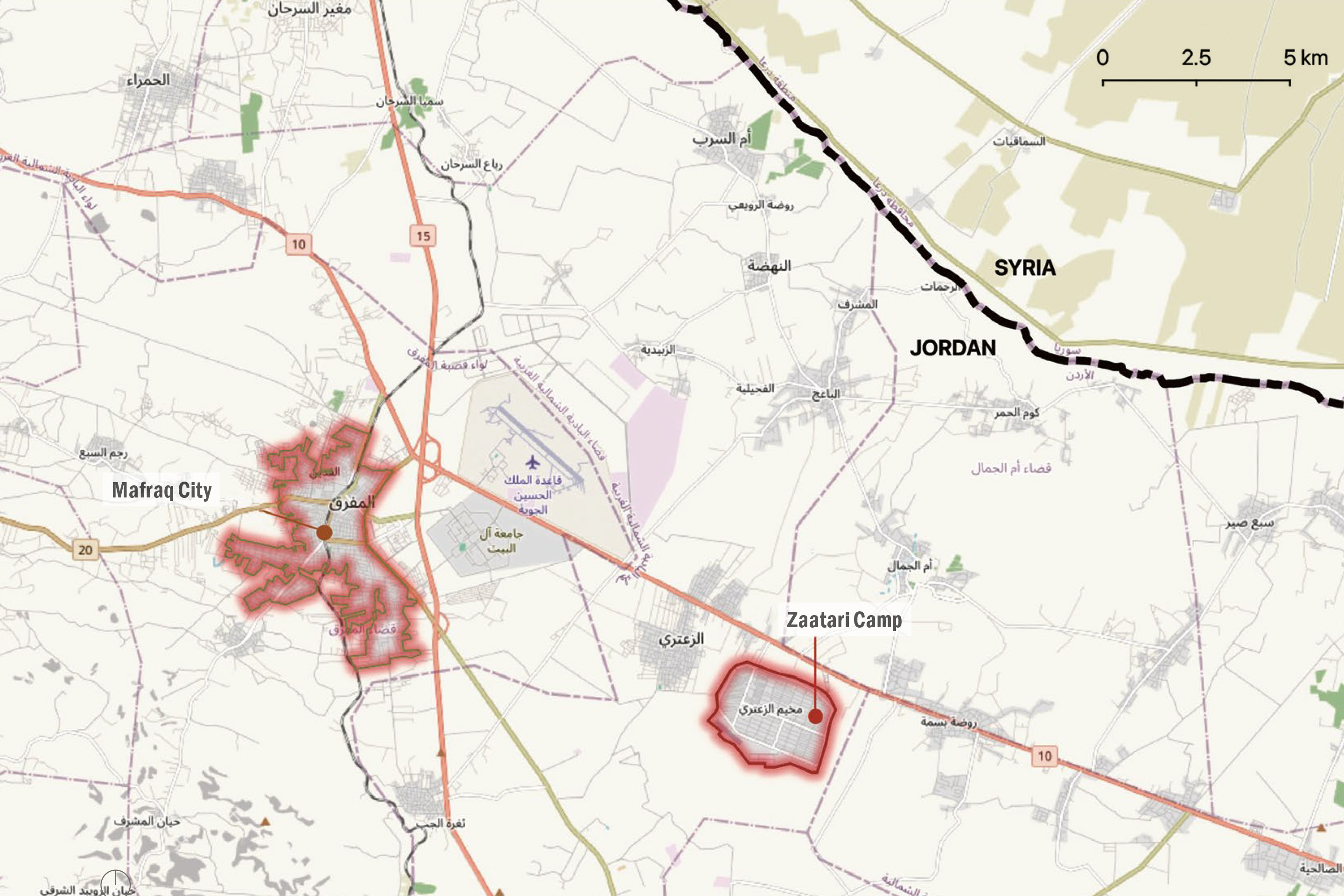
Zaatari, opened in 2012 in response to the Syrian displacement crisis, is located in Mafraq Governorate, approximately 12 kilometers east of the city of Mafraq and close to the Syrian border.20 Its spatial logic is therefore marked by proximity to borders, humanitarian administration, and a visible territorial separation from the consolidated urban fabric of Jordan’s main cities. The camp is connected to Mafraq through labor relations, supply chains, services, transport routes, and humanitarian infrastructures, yet it is not absorbed into the city. It remains a distinct territorial apparatus: urbanizing internally through streets, shelters, markets, schools, clinics, and service networks, while still governed as an exceptional humanitarian space (fig. 1)
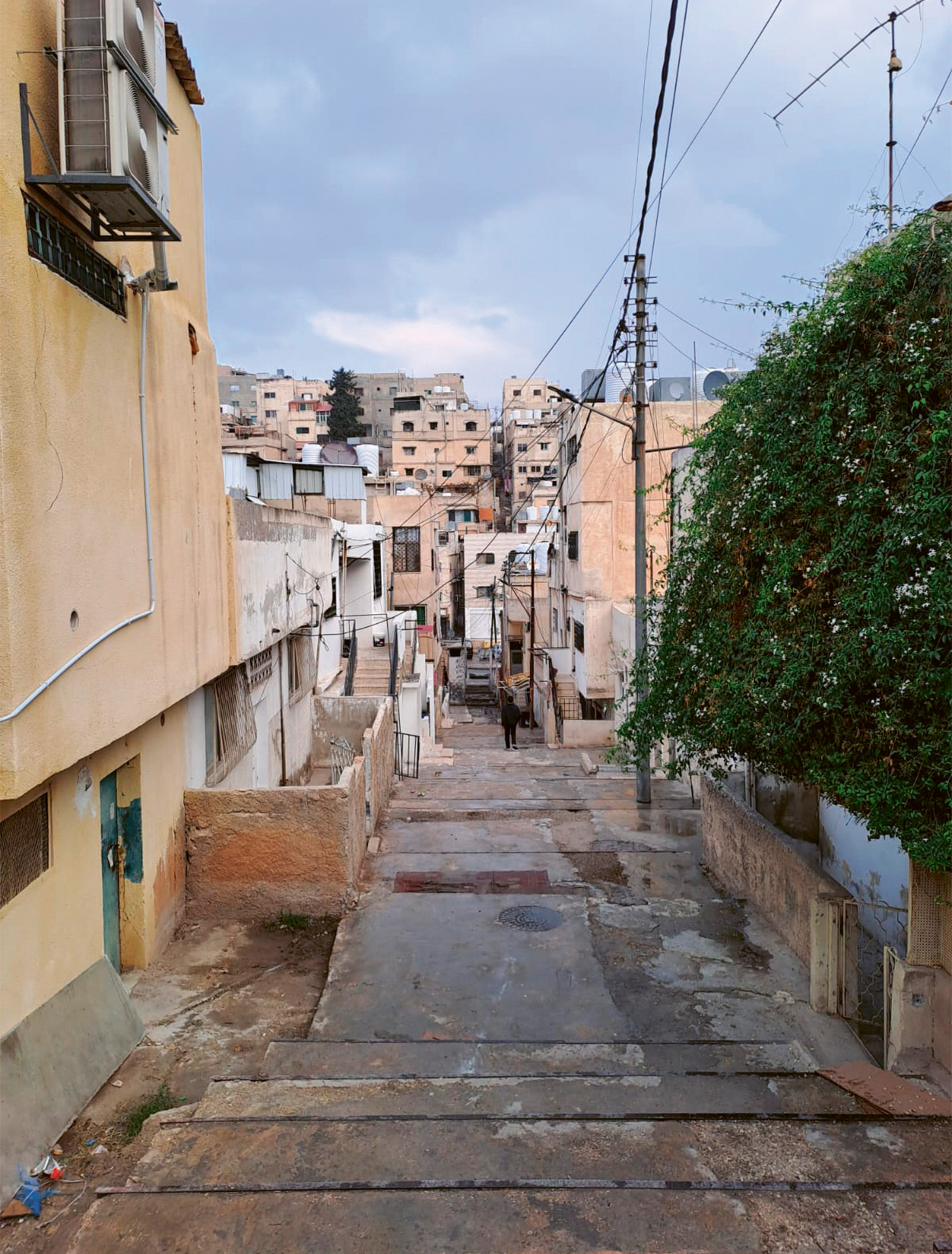
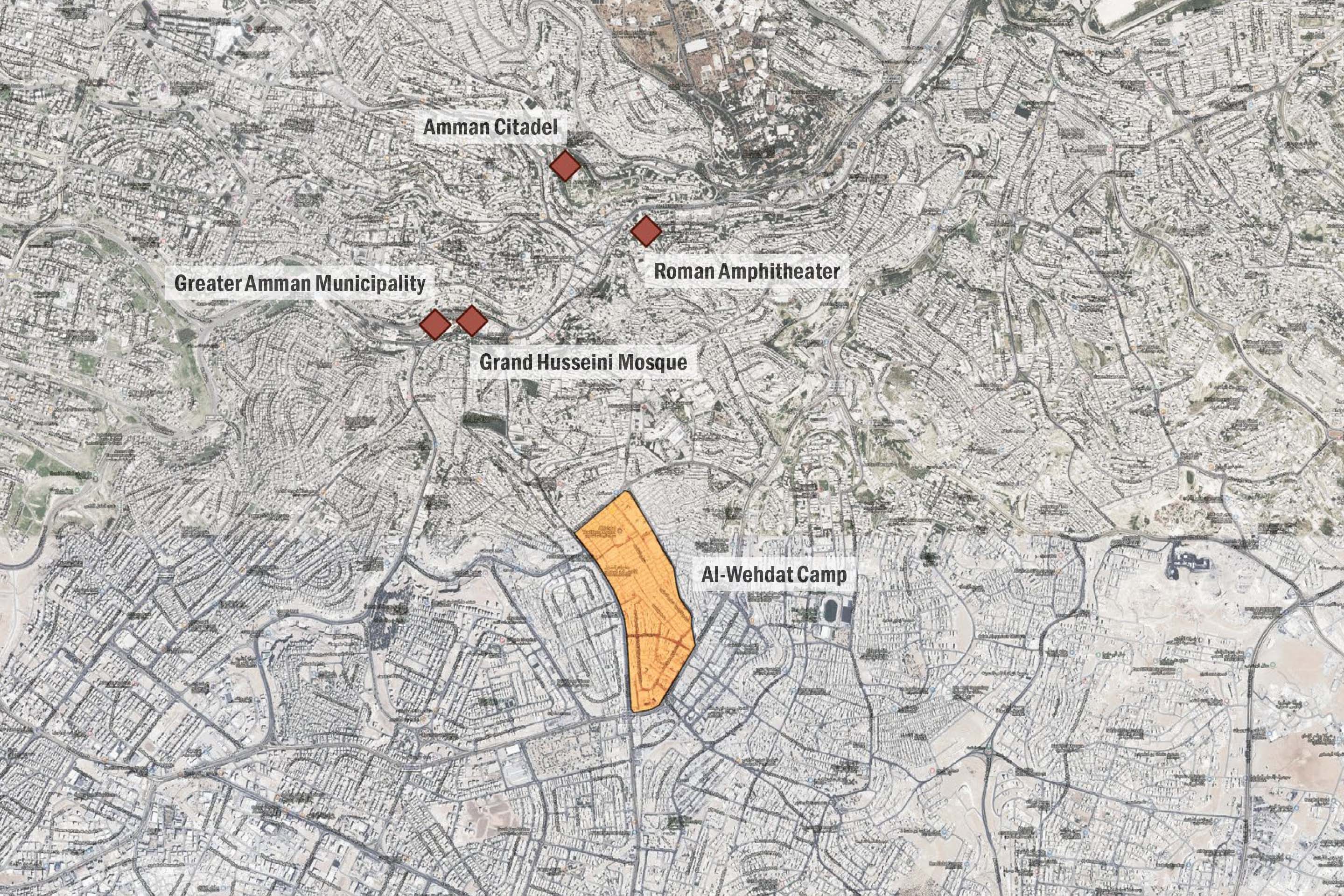
By contrast, Jabal al-Hussein and Al-Wehdat represent a different historical and urban condition. Both belong to the first generation of Palestinian refugee camps established in Jordan after 1948 to accommodate refugees displaced from Palestine. Jabal al-Hussein was set up in 1952, north-west of Amman, while Al-Wehdat, officially known by UNRWA as Amman New Camp, was established in 1955, southeast of Amman.21 Over time, these camps have gradually become embedded within the metropolitan fabric of the capital. Al-Wehdat, initially established on 0.48 square kilometers, has grown into a dense urban quarter, while Jabal al-Hussein, initially set up on 0.42 square kilometers, has similarly become part of Amman’s everyday urban morphology.22– In these cases, the camp and the city physically merge. Streets, shops, housing extensions, schools, services, and infrastructures form part of the everyday spatial life of Amman. Yet this urban merging does not erase the camp’s political condition. The camp remains marked by a distinct history of displacement, a particular administrative status, and the unresolved temporality of the Palestinian refugee question (fig. 2).
This comparison is important because it shows that the camp is not a fixed architectural type. It is a political form whose spatial expression changes over time. Zaatari represents a border-oriented humanitarian camp: spatially separated, internationally governed, and administratively exceptional, even as it develops urban characteristics. Jabal al-Hussein and Al-Wehdat represent another condition: camps that have become internal to the city’s built fabric, commercial life, and everyday rhythms, while still carrying the political memory and institutional traces of displacement. In the first case, the camp-city relation is structured through proximity without absorption. In the second, it is structured through urban merging without full political resolution.
The difference is therefore not simply morphological; it is political. Zaatari demonstrates how an emergency can produce a new territorial settlement at the edge of the national and urban order. Jabal al-Hussein and Al-Wehdat demonstrate how a supposedly temporary camp can become part of the city over generations, producing a condition in which the camp and the city physically merge while the question of displacement remains historically unresolved. Zaatari is urbanizing without becoming a fully fledged city; the Palestinian camps in Amman have become a city without ceasing to be camps. Together, these cases reveal that the political form of the camp must be read through its territorial relation: to the border, to the city, to humanitarian agencies, to the state, and to the unresolved futures of the populations it contains.
Understanding the camp as a political form also means recognizing that its spatial order is never total. Camps are planned but also modified. They are regulated, but they are also inhabited beyond regulation. Residents rearrange shelters, create courtyards, open shops, build informal extensions, produce social networks, and generate forms of collective life that exceed the administrative imagination of the camp.23 These practices do not dissolve the camp’s condition of control, but they complicate it. They show that the camp is not only a space of confinement but also a space of negotiation, adaptation, and political subject formation. The camp’s political form is therefore not fixed. It is continuously produced through the encounter between governance and inhabitation.
To design, study, or represent camps only as emergency shelters is to miss their political depth. The camp is a spatial answer to displacement, but it is also an institution of classification, a territorial instrument of governance, and a landscape of everyday life. It raises fundamental questions about the relation between care and control, temporality and permanence, protection and rights, urbanization and exclusion. If architecture participates in the making of camps through layouts, shelters, infrastructures, thresholds, service points, fences, roads, administrative zones, and service networks, then architecture also participates in the political ordering of displaced life. The question is therefore not only how camps are designed, but what forms of political life they make possible, delay, restrict, or foreclose.
The camp as a political form reveals the central argument of this issue: emergency does not simply interrupt
the existing spatial order of space. It produces new spatial organisation. It creates territories in which exceptional measures become routine, temporary infrastructures become durable, and humanitarian care becomes entangled with control. To read the camp politically is therefore to read it as one of the key spaces through which contemporary relations between displacement, sovereignty, humanitarianism, and urbanism are organized. The comparison between Zaatari, Jabal al-Hussein, and Al-Wehdat sharpens this argument: camps may be located at the border or inside the city, separated from urban life or absorbed into it, newly produced or historically consolidated. But in all cases, they reveal how displacement becomes spatially governed, how temporariness becomes durable, and how emergency continues to shape the city’s political geography
The Three Times of Emergency
Reading emergency as a spatial regime moves beyond the idea of crisis as a brief interruption of ordinary life. Emergency not only destroys, suspends, or displaces; it also produces territories, infrastructures, legal categories, forms of dwelling, and political imaginaries. For architecture and urbanism, this means that emergency cannot be approached solely as a technical field of response. It must be understood as one of the conditions through which contemporary space is made.24
The contributions gathered in this issue examine emergency through three interconnected moments: the temporary that becomes permanent, the transformation of provisional spaces into lived urban conditions, and reconstruction as a contested project of future-making. These moments should not be understood as a linear sequence. They overlap, return, and often coexist within the same territory. A camp can be planned as temporary and yet endure for generations. A shelter can become a house, a street, a market, or a place of memory. Reconstruction can promise repair while also reproducing displacement, erasure, or territorial control. What brings these moments together is the central question of this issue: how does emergency become architectural, and what forms of political life does it produce?
The first moment concerns the paradox of temporariness. Emergency spaces are often justified through the language of urgency: they are imagined as provisional, exceptional, and reversible. Yet the provisional frequently becomes durable. The temporary shelter, the camp layout, the service infrastructure, the administrative boundary, and the humanitarian protocol can remain long after the initial crisis. In this passage from temporary response to enduring condition, the emergency becomes a mode of spatial governance. It creates places that are inhabited as everyday environments, while still being framed politically as exceptional or incomplete. Temporariness is therefore not only a temporal condition; it is also a political instrument through which rights, permanence, integration, and responsibility may be deferred.25
The second moment is transformation. Emergency spaces are never shaped only by the institutions that design or administer them. They are also transformed by those who inhabit them. Residents adapt shelters, create thresholds of privacy, open shops, build social relations, establish routines, and produce forms of collective life that exceed the original logic of humanitarian provision. This transformation does not erase the violence, dependency, or constraint embedded in emergency spaces. Rather, it reveals their ambiguity. The camp, the shelter, and the damaged city are not only sites of vulnerability but also sites of spatial agency, negotiation, memory, and urban production. In this sense, emergency spaces must be understood as fields of tension between imposed order and lived spatial practice, between humanitarian government and the everyday production of space.26
The third moment is reconstruction. Reconstruction is often presented as the phase that follows emergency, as if rebuilding could mark a return to normality. Yet reconstruction is never a completely apolitical process. It decides what is remembered and what is erased, who is allowed to return and who is displaced again, which forms of life are restored and which futures are foreclosed. Reconstruction is not simply replacing destroyed buildings. It is to reorganize territory, rights, ownership, infrastructure, and collective imagination. For this reason, reconstruction must be read as one of the most political moments of emergency, not as its technical conclusion. It can become an act of repair, but it can also become a mechanism through which dispossession, dependency, or territorial control are stabilized under the language of recovery.
Across the contributions of different authors, from Al-Wehdat’s urban incorporation to Zaatari’s camp urbanization, from the spatial knowledge produced by camps to the contested reconstruction of Gaza, and from reconstruction debates to the evidentiary practices of mapping, visual analysis, and forensic investigation, emergency appears not as a temporary episode, but as a temporal-spatial regime. It is a regime through which territory is stabilized, inhabitation is regulated and reworked, rights are deferred, claimed, or suspended, and futures are planned, contested, or foreclosed. The cases discussed in this issue should therefore not be read as separate examples, but as analytical sites through which the spatial politics of emergency become visible. Together, they show how provisionality, transformation, reconstruction, and evidence operate as interconnected dimensions of emergency urbanism, in which architecture and planning are implicated not only in responding to crisis but also in producing the conditions through which crisis endures, changes form, and becomes governable.
Together, these contributions do not offer a single model for designing in emergency conditions. Rather, they shift the terms of the debate. They ask architecture and urbanism to look beyond the familiar images of crisis, tents, shelters, ruins, master plans, and reconstruction scenarios, and to examine the spatial regimes that these images often conceal. Emergency becomes architectural when it is translated into layouts, camps, borders, service infrastructures, markets, maps, images, and plans. It becomes architectural when displacement is managed through space, when destruction is transformed into a reconstruction project, and when evidence is produced through spatial representation. In this sense, maps, images, models, data, and forensic practices are not only representational tools; they are methods through which the spatial operations of violence, displacement, and reconstruction can be made visible and politically contestable.27
Ultimately, the issue does not close with a definitive answer. It opens a question of responsibility. If an emergency produces space, then architecture and urbanism must ask what kinds of spaces they help to produce in its name. Do they reproduce confinement, dependency, erasure, and control? Or can they support memory, justice, dignity, return, and political possibility? The task is not only to design for emergencies, but to understand how emergencies themselves design territory and how spatial practice might intervene without reproducing the conditions it seeks to repair. This is the critical horizon of this issue: to examine emergency not as an exception outside architecture, but as one of the contemporary forms through which architecture, urbanism, and political power organize life, territory, and future possibility.
Note | Notes
1 Calhoun, «World of Emergencies»; Fassin & Pandolfi, Contemporary States of Emergency.
2 Corsellis & Vitale, Transitional Settlement;
Davis, Shelter After Disaster; Sphere Association, Sphere Handbook; UNHCR, Emergency Handbook.3 Agamben, State of Exception; Calhoun, «World of Emergencies»; Foucault, Sicurezza, territorio, popolazione | Security, Territory, Population.
4 Lefebvre, Production of Space.
5 Agamben, Homo sacer; Agamben, State of Exception; Fassin, Humanitarian Reason; Malkki, «Refugees and Exile»; Ticktin, Casualties of Care.
6 Foucault, Security, Territory, Population; Martin, Minca & Katz, «Rethinking the Camp».
7 Agier, Managing the Undesirables; Hyndman, Managing Displacement; Malkki, «Refugees and Exile».
8 Lefebvre, Production of Space.
9 Agier, Managing the Undesirables; Martin, Minca & Katz, «Rethinking the Camp»; Ramadan, «Spatializing the Refugee Camp».
10 Agamben, Homo sacer; Diken & Laustsen, Culture of Exception; Turner, «What Is a Refugee Camp?».
11 Agier, Managing the Undesirables; Fassin, Humanitarian Reason; Hanafi & Long, «Governance, Governmentalities».
12 Ramadan, «Spatializing the Refugee Camp»; Sanyal, «Urbanizing Refuge»; Turner, «What Is a Refugee Camp?».
13 Agamben, Homo sacer; Agier, Managing the Undesirables; Fassin, Humanitarian Reason; Malkki, «Refugees and Exile»; Ticktin, Casualties of Care.
14 Martin, Minca & Katz, «Rethinking the Camp»; Ramadan, «Spatializing the Refugee Camp»; Sanyal, «Urbanizing Refuge».
15 Agier, Managing the Undesirables; Hyndman, Managing Displacement; Malkki, «Refugees and Exile».
16 Agamben, Homo sacer.
17 Agamben, Homo sacer; Agamben, State of Exception.
18 Agier, Managing the Undesirables; Ramadan, «Spatializing the Refugee Camp»; Sanyal, «Urbanizing Refuge»; Turner, «What Is a Refugee Camp?».
19 Ramadan, «Spatializing the Refugee Camp»; Turner, «What Is a Refugee Camp?».
20 UNHCR, «Jordan: Zaatari Refugee Camp Factsheet».
21 UNRWA, «Jabal el-Hussein Camp»; UNRWA, «Amman New Camp».
22 Ibidem.
23 Agier, Managing the Undesirables; Ramadan, «Spatializing the Refugee Camp»; Sanyal, «Urbanizing Refuge».
24 Lefebvre, Production of Space; Foucault, Security, Territory, Population; Martin, Minca & Katz, «Rethinking the Camp».
25 Agamben, State of Exception; Ramadan, «Spatializing the Refugee Camp»; Turner, «What Is a Refugee Camp?».
26 Agier, Managing the Undesirables; Malkki, «Refugees and Exile»; Sanyal, «Urbanizing Refuge».
27 Weizman, Forensic Architecture.