

What determines the way we build?
The ZHAW in Winterthur has developed DigiKon, a digital and interactive platform that teaches construction, and invites us to rethink the way we do it.
Testo in italiano al seguente link
Why do we build in a certain way, in a certain place, at a certain time? Michel Foucault dedicated much of his work to this question, focusing on what he called «Praktik»: the everyday practices through which societies produce their own reality. According to Foucault, what we consider normal, rational or technically correct is in fact the product of historical habits, power relations and cultural conventions accumulated over time, far more than the result of grand ideas or conscious decisions. If we apply this lens to the way we build today, many things we take for granted begin to seem less obvious.
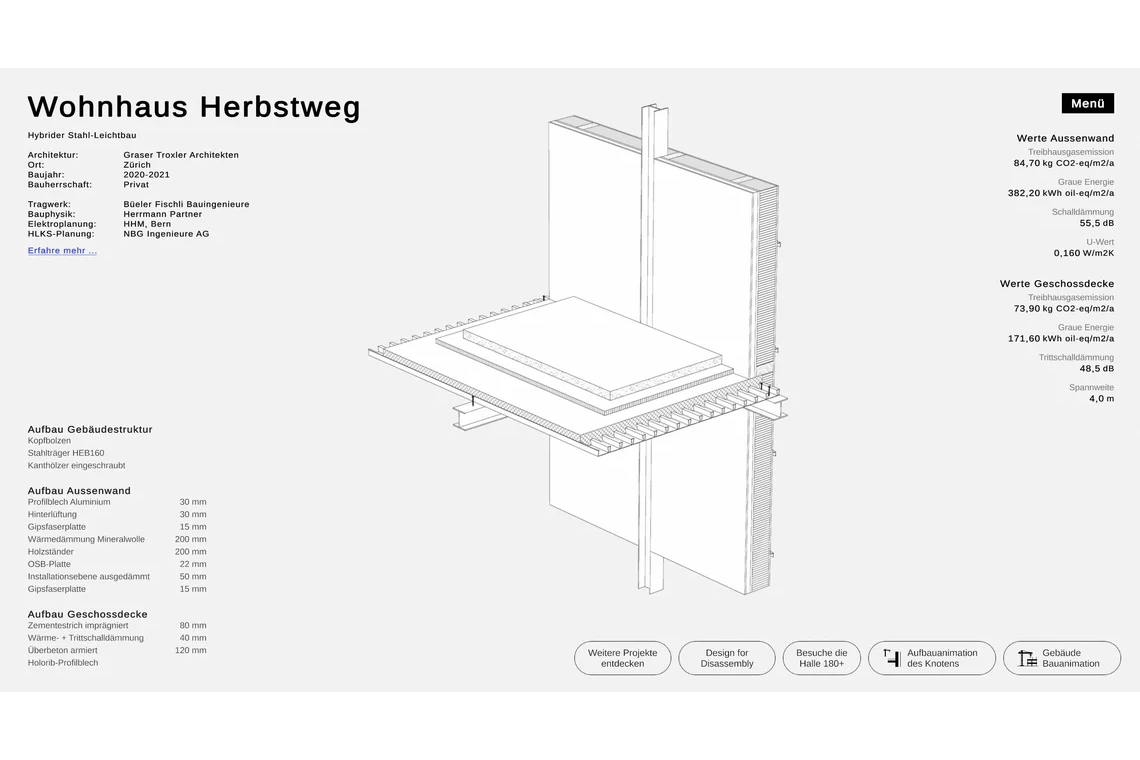
This insight, among others, can be found on the platform DigiKon (dkon.ch), a digital, interactive and open Konstruktionslehre developed by the Institut Konstruktives Entwerfen (IKE) at the ZHAW in Winterthur under the direction of Andri Gerber, professor at the institute. DigiKon was created to offer a digital and accessible way of gaining direct experience of construction: exploring construction types, digitally assembling details, combining walls, slabs and floors with different materials, while observing the environmental impact of each choice in real time. Every construction is accompanied by animated 3D models showing the assembly process, with life cycle assessment data and embodied energy values automatically linked to the KBOB database. The platform can be explored by material, by system or by project, and also includes real built projects, allowing users to verify how specific solutions have been applied in practice.
Yet DigiKon goes beyond the technical dimension: the platform is accompanied by a glossary of twenty-seven texts written by different authors from the institute, addressing topics such as Design for Disassembly, embodied energy, the reuse of building components or the role of concrete in contemporary construction. These texts reveal the conceptual foundations of the platform and the thinking behind its conception. In the opening text of the glossary, Gerber places the project within the Swiss tradition of Konstruktionslehre, citing the manuals of Neufert and Deplazes as historical references, while emphasising that DigiKon, unlike a printed book, is designed to evolve, incorporating new constructions and new research findings.
One of the most compelling reflections to emerge from these texts concerns the very concept of sustainability. Our language never stops evolving, and in recent years it has become more complex, adapting to a reality composed of numerous nuances. As Gerber writes, it is necessary to differentiate, to evaluate contexts, to consider the availability of materials and their cycles. Hybrid systems, combining steel, timber, concrete and regenerative materials such as rammed earth or hemp, respond to this complexity by using each material where it is most effective. Andreas Sonderegger, in his text on building regulations within the glossary, extends this reflection to the Swiss regulatory framework, showing how SIA standards, designed to guarantee quality, can generate conflicts when applied to existing buildings, in some cases leading to the demolition of structures that, from an environmental perspective, it would make sense to preserve.
DigiKon addresses this complexity with a digital tool, but it originates from a tangible experience. The starting point was the Werkstückhalle of the institute, where 1:1 mockups of hybrid and climate-responsible construction systems are exhibited. The platform also stems from the desire to make accessible to everyone what until then was only physically available within the institute.
At the same time, there is a critical stance towards digitalisation itself. The institute views commercial closed-source software with scepticism: in Gerber's words, BIM tends to compress the conceptual phase and to treat the digital model as something absolute. DigiKon stems from the desire to develop independent, open tools that serve the discipline. It is a platform that invites exploration, comparison and questioning, and in this sense is consistent with the spirit of a school that aims to educate conscious architects.