

On the future of architectural education
Between decarbonisation, reuse and new technologies, what role can architectural education play today? In this conversation with Annette Gigon, sustainability, construction and the transformation of existing buildings emerge as key skills for tackling the challenges of the contemporary built environment.
Testo in italiano al seguente link
Silke Langenberg: Annette, you completed your architecture studies at the Swiss Federal Institute of Technology in Zurich (ETHZ) in 1984. From 2012 to 2023, you were a professor of architecture and construction there. Prior to that, you taught architecture at ETHZ and the École Polytechnique Fédérale de Lausanne (EPFL). Over the past 40 years, architecture has undergone fundamental changes – not only in terms of its design language and planning tools, but also in terms of its ecological and economic parameters. You reflected on this in your keynote speech at the Future of Construction symposium 2024 from the perspective of your own practice.1
At the same time, buildings from the 1970s and 1980s and their further development are increasingly coming into focus – both in discussions about and publications on architecture and preservation, and in the design studios at ETHZ.2 Collaborating with you during the master’s thesis at ETHZ in 2022 and with Mike Guyer in 2023, we asked our students to come up with ways to preserve, repurpose, and extend such existing buildings. Your chair had prepared the overarching theme «Durability and/or Change?» for both Master’s semesters.3 When you look back on your practice and teaching during this period and consider the various challenges involved in maintaining and decarbonising the building stock, what role do you think architectural education can play in this complex field, where so many different stakeholders are active?
Annette Gigon: Increasing global warming and rising CO2 emissions worldwide are bringing additional and also changed implications for what constitutes good architecture, which solutions are valid and which actions are preferable. However, this perspective must first be explored, as greenhouse gases are invisible, odourless and therefore difficult to grasp. One has to rely on scientific findings for both their effects and their quantities – in other words, acquire «carbon literacy». Complicating matters, for buildings it’s not just the greenhouse gas emissions from their use that count, nor is it just those from the production and disposal of building materials alone; instead, the entire ecological footprint of a building must be considered through the whole (expected) life cycle.
No question that schools need to lay the groundwork and share knowledge on this new and complex topic! This requires more and broader-based expertise for informed discussion and, ultimately, effective action.
Construction plays an essential role here, regardless of whether it is a new building or an existing one: What building materials and elements do we (continue to) use? How much CO2 was produced during their manufacture and transport? And how long will they (still) last, or how much flexibility do they allow future users? – in addition to the important and ever-present question for us architects of how the materials can be used creatively, how we can design with them.
Today, attractive renderings of projects can already be produced using AI. It is not just students who can do this; building clients are also likely to make use of it in future. Unfortunately, there is a real concern that clients will no longer approach architectural firms with their wishes, but will go directly to general contractors, and that architects will only be needed as subcontractors in design competitions and for building permits.
A sound understanding of construction is not only crucial for a good design and, ultimately, for a successful and sustainable building. In my view, it is a core competence of architects, ensuring them a continued role in shaping the entire realisation process – from the initial idea to the completed project – in collaboration with clients, engineers and contractors. And, ideally, also engaged in productive and informative dialogue with the users. Their observations and experiences, as well as their appreciation and care, are key to a building’s longevity.
SL: Over the course of close to a decade, circularity, reuse and repair have become central topics in architecture and construction in Switzerland and across Europe, at least within the discourse. Nevertheless, the rapid demolition and replacement of buildings continues. Almost every conversation with the relevant stakeholders ends with financial and logistical constraints cited as obstacles to a genuine transformation of construction processes. We probably both agree that a more profound, systemic shift in mindset is necessary.
In a recent article, I put forward the argument that a future generation of «Sustainable Natives» could be the driving force behind this urgent change – provided we initiate a critical shift in didactics and pedagogy within the teaching of architecture and related disciplines.4 This transformation should encompass the combination of valuable lessons from the past with innovative thinking and interdisciplinary action. The «Sustainable Natives» would intrinsically value sustainability and existing structures more than the new, whilst at the same time challenging established building practices by integrating novel methods and technologies across generations and disciplines. Do you think this can already be noticed in the current generation of young architects?
AG: In recent years, schools have been experimenting on a broad scale with preservation and extension, using a variety of playful and creative approaches. The students in the semesters where we focused in depth on sustainability in construction – specifically in conversion and extension projects – were exceptionally motivated. And this despite the fact that, rather than designing prestigious projects, they «merely» expanded existing office buildings in Zurich, retrofitted them for energy efficiency and converted them for residential use. In fact, we could always count on the students to show great empathy towards older buildings. But of course we cannot leave this huge, complex task to the younger generation alone – when it comes to decarbonising the construction and use of buildings, we all have a part to play and must familiarise ourselves with this ‹new› subject matter.
And in practice, it is repeatedly evident that dealing with the building stock presents significant challenges. Existing buildings are under renovation pressure for a variety of reasons: one key reason being that a large proportion of Switzerland’s building stock is still heated with fossil fuels and, moreover, has little or no insulation – clearly, action is needed here. Other reasons include the fact that many older buildings do not meet today’s stricter standards, nor do they meet the increased expectations of us, the users. Thus, current requirements regarding sound insulation, fire safety, accessibility, earthquake resistance, etc., can be real deal-breakers when attempting to preserve the building fabric. Combined with zoning that allows to create more living space on a plot – quite understandable given the housing shortage – this often results in replacement buildings. In our experience, this is the case even with committed clients who are willing to go to great lengths to preserve and upgrade an existing building. And regardless of whether the project involves a major refurbishment or a complete rebuild, this raises a further practical question: namely, how this costly and labour-intensive process can be made socially acceptable.
SL: In your opinion, what else needs to change in architectural education – and perhaps also in the way architectural practices and the construction industry operate?
AG: The architectural profession is indeed facing an ever-increasing number of demands that require new skills and knowledge. That is why the list of schools’ offerings for their students is so long. It is a multi-semester «training programme» in designing well-conceived buildings – from hand and CAD drawing, rendering, model-making, critical reflection and argumentation, etc. right through to calculating greenhouse gas emissions for the construction and use of buildings. And all of this taking into account aspects of urban planning, history, heritage conservation, structural engineering, building services, sociology, landscaping and ecology. Ultimately, everything «materialises» in construction, therefore it should continue to play a central role during the design semesters.
Coming back to your question: architectural education is undoubtedly a major piece of the puzzle when it comes to advancing the decarbonisation of Switzerland’s construction sector and building stock. But even when we know the right means – insulation, heat pumps, photovoltaics –, the implementation is usually anything but straightforward, particularly in older existing buildings. And reducing emissions in the construction of new buildings is at least as demanding. Both require highly skilled, committed architects, engineers, researchers and contractors.
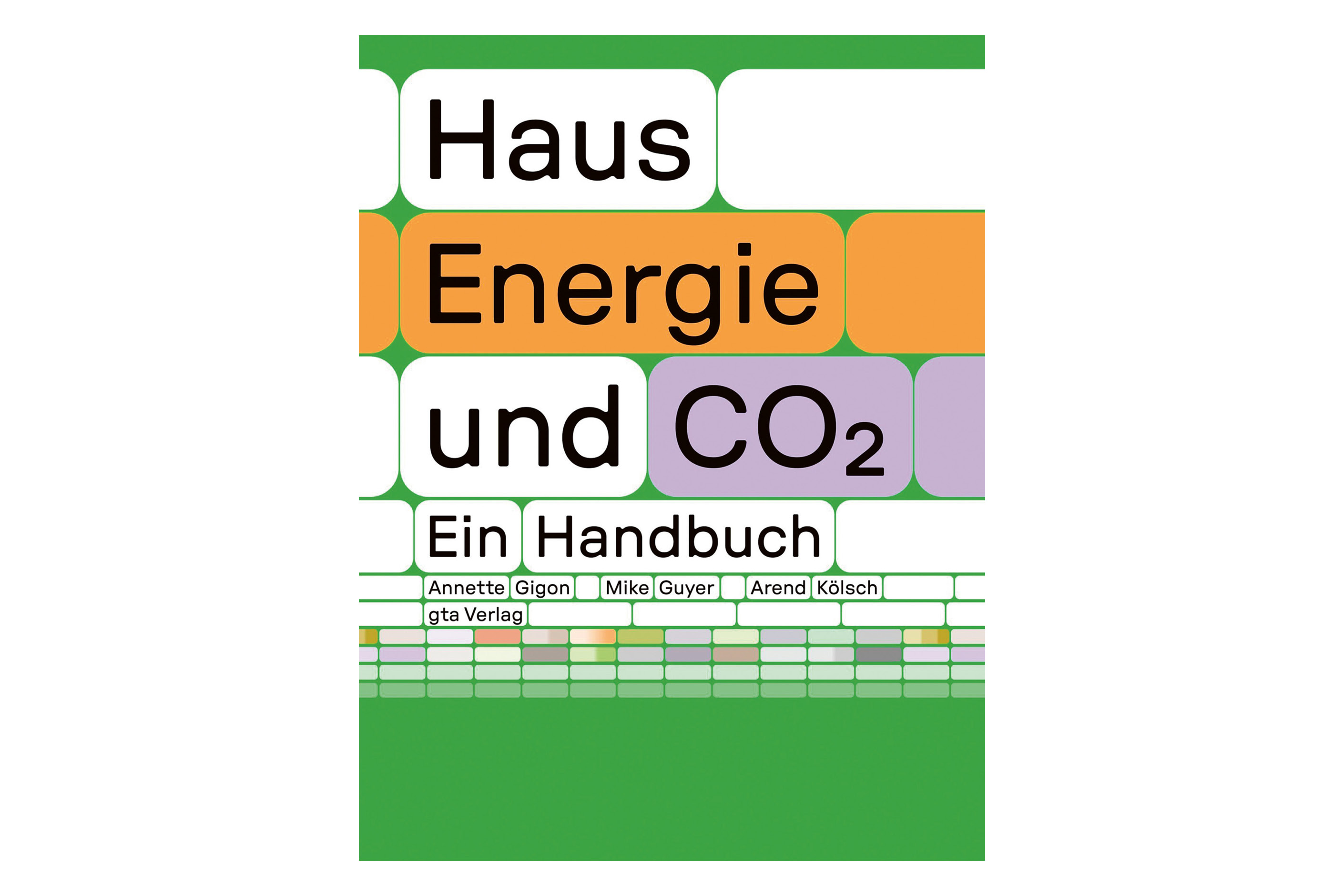
Following on from our last couple of semesters, a book we co-authored with Arend Kölsch has been published by gta Verlag (cfr. p. 11), in which we have attempted to make this complex matter accessible to interested non-experts. For it is clear that we must all contribute to solving this Herculean task – not only architects, but also clients, homeowners, the construction industry, public authorities, professional associations, politicians, the media, and even tenants.
Notes
- A video recording of Annette Gigon’s keynote speech at the Future of Construction symposium 2024 is available at the following link https://www.youtube.com/watch?v=F034MY8n6Uo
- The conferences Denkmal Postmoderne: Bestände einer (Un)geliebten Epoche, held at Bauhaus University Weimar in 2022, and High-Tech Heritage: (Im)permanence of Innovation, held at ETH Zurich in 2023, have initiated a critical discussion on the challenges of preserving examples of younger built heritage. Angermann, Kirsten, Hans-Rudolf Meier, Matthias Brenner, & Silke Langenberg. Denkmal Postmoderne: Bestände einer (un)geliebten Epoche, Birkhäuser, 2024.; Brenner, Matthias, Silke Langenberg, Kirsten Angermann, & Hans-Rudolf Meier. High-Tech Heritage: (Im)Permanence of Innovative Architecture, Birkhäuser, 2024.
- Professur für Architektur und Konstruktion, Annette Gigon, Mike Guyer, HS 22/FS23 Durability and/or Change? Themenplattform zur Master’s Thesis, ETH Zurich, 2022, https://gigon-guyer.arch.ethz.ch/wp-content/uploads/2023/01/mt-hs22_durability-and-or-change_reader_neu-1.pdf; Professur für Archi-tektur und Konstruktion, Annette Gigon, Mike Guyer with Professur für Konstruktionserbe und Denkmalpflege, Silke Langenberg, Kernprogramm Masterthesis HS 2022. Durability and/or Change? Commitment to the Long Term (ETH Zurich, 2022), https://gigon-guyer.arch.ethz.ch/wp-content/uploads/2023/02/diplomhs22_reader.pdf
- Langenberg, Silke, Orkun Kasap, & Matthias Brenner. «An Intergenerational Shift in Mindset» Ardeth 15 (2024), 2026, http://journals.openedition.org/ardeth/6156