

The Twelve Ideal Cities of Helvetica: Introduction
Set in the fictional world of The Pneumatic Passage, Klaus’s take on both Moebius’s «Le Garage Hermétique» and François Schuiten and Benoît Peeter’s «Les Cités Obscures» (with a touch of Justus Dahinden’s «Stadtstrukturen für morgen»), The Twelve Ideal Cities of Helvetica proposes a light-hearted tour of the history of Swiss modern architecture through comic-book fiction.
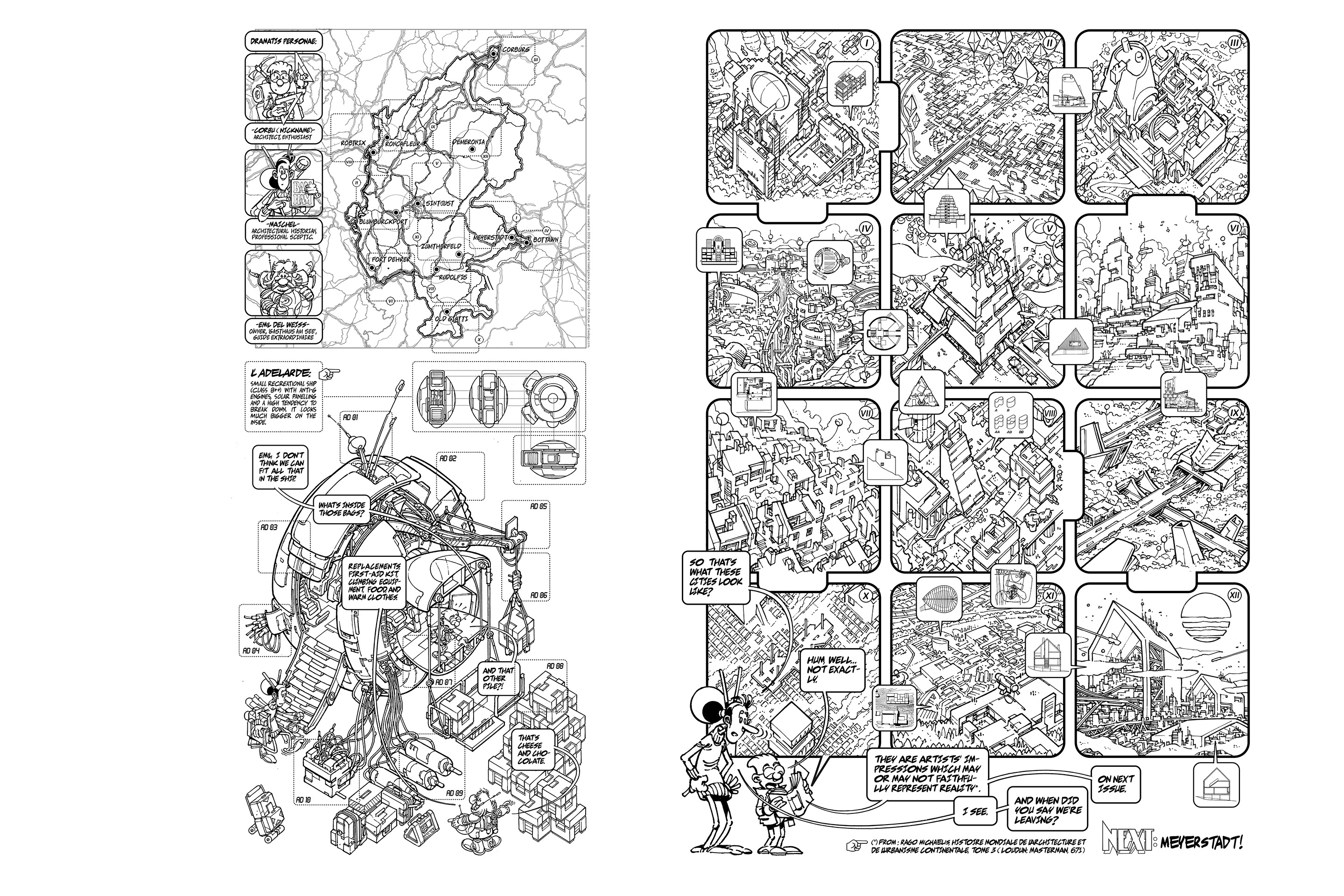
Located also somewhere between Italo Calvino’s «Le città invisibili», and the third tome, «Prospective et futurologie», of Michel Ragon’s Histoire mondiale de l’architecture et de l’urbanisme modernes, each tale of the Pneumatic Passage depicts the arrival of the main characters, lifted from Klaus’s1 defunct comic strip «El Corbu» (2004-2006), at a fictional city. These stories are thinly disguised excuses to revisit the visual history of architecture and urban planning, typically exploring different pro-jects of the 1960s-1970s visionary scene, the many metropolises of popular culture, or forgotten icons of the history of Architecture. In the case of Helvetica, a region located in the central area of the Passage, each city is shaped after the work of a Swiss architect or group thereof: Meyerstadt/Io-Hannesburg (Hannes Meyer), Corburg (Le Corbusier), Roncafleur (Flora Ruchat-Roncati), Blumburckport/Bachhesl (Elsa Burckhardt-Blum), Fort Dëhrer (Walter Maria Förderer), Rüdolfis (Rudolf Olgiati) …
Echoing the 12 oppida or fortresses described by Julius Cesar as existing in the Swiss area during the Roman invasion, as well as other historical precedents such as the Etruscan Dodecapolis, the series is intended both as a historical divertimento and a celebration of Switzerland’s modern architecture with perhaps some tongue-in cheek critique of today’s trends slid in.2
Notes
1 Klaus is the penname of Luis Miguel (Koldo) Lus Arana, architect, architectural historian, and professor of Theory and History of Architecture at the University of Zaragoza.
2 Other entries in the world of the Pneumatic Passage have been included in his collaborations with eVolo, The New City Reader, (In)Forma, Uncube (Germany), MAS Context, and Arquine. A dossier compiling some of them, together with texts, was published in 2021 in the Portuguese J–A Jornal Arquitectos.