

Standards: present and future
A conversation with Muck Petzet
In the interview conducted by Andrea Roscetti, Muck Petzet acknowledges the international significance of the SNBS standard, highlighting its limitations and potential, particularly when applied to existing buildings. From the primacy of technical efficiency to the need to measure what really matters: emissions, time and real-world impact. A lucid analysis that shifts the focus to reduction, reuse and design responsibility.
Testo in italiano al seguente link
Sustainability certifications have reshaped contemporary building practice, but their limits are now evident. In this interview curated by Andrea Roscetti, Muck Petzet recognises the international relevance of the SNBS standard while questioning its direct application to existing buildings. The focus shifts from technical efficiency to the relationship between intervention, emissions and time: reducing before refurbishing, accepting what exists, and measuring emissions when they matter. A clear reflection on what is still missing if Europe’s building stock is to be addressed.
Andrea Roscetti: How do you position the SNBS in an international context today?
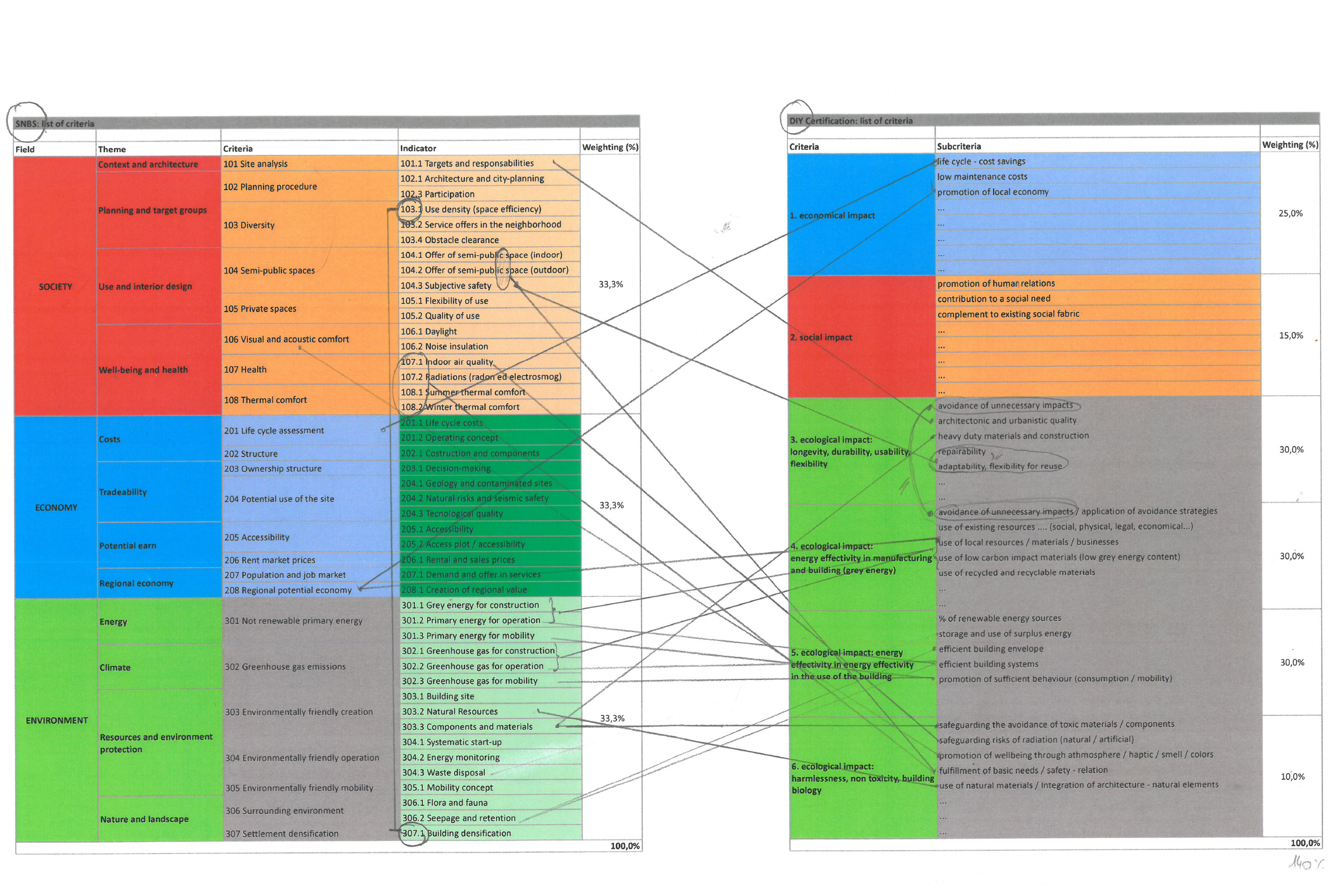
Muck Petzet: To make this clear in advance: I think the SNBS system is probably the best «sustainability» certification on the market today. Like all systems, it provides a helpful checklist to planners and clients – of topics to think about and points to address. The SNBS is holistic, including social and economic factors. It is also one of the most accessible systems, allowing you to answer many of the questions rather easily. It makes use of established and well-known calculation methods and data available in the SIA Standards. On the other hand, like all established certification systems, the SNBS is also quite limited in its scope towards «calculable» qualities – and the results reflect this. The systems tend to favour and support technical solutions and efficiency while neglecting everything that has to do with «intangible» fields like sufficiency or what I call effectivity in architecture. This is most obvious when we deal with existing buildings. We should try to achieve the most positive social and economic impact – but with the least negative ecological consequences. This equation, taken very seriously, will lead to a minimal intervention strategy as reflected in our Reduce/Reuse/Recycle hierarchy of strategies. With existing buildings, avoidance of the unnecessary should come first. We need to radically accept the existing conditions and make use of all available resources.
By applying the SNBS Standard for new buildings also to transformations, the SNBS follows the unfortunate examples of other international standards or energy legislations. Setting the standards and expectations too high and neglecting the specific logic necessary to deal with existing architecture leads to unwise measures and, in the end, also to costs that can be significantly higher than new builds.
The SNBS has recently introduced a new standard for managing building stock, which is a good start in at least getting to know and measure existing potentials. This starting point should be used to establish a new standard for dealing with this stock in a sensitive and rational way.
By following established calculation methods of the SIA, the SNBS also follows uncritically a set of established scientific assumptions which, in my opinion and experience, are questionable. For example, the assumptions about the lifespan of buildings and their building parts. This leads – combined with the calculation method of grey energy/m² per year – to wrong assumptions and consequences. Embodied energy and emissions should not be «amortized» during a theoretical lifespan of 60 or 80 years. Emissions are stored in our atmosphere for several hundred years. We should understand that every country, according to the Paris Agreement, has a fixed budget of CO2 emissions that it can be spent until 2050. This budget should be used wisely for necessary new buildings like additional housing but is constantly eaten away by unnecessary interventions or even demolitions and replacements. In writing off embodied emissions over 60 or 80 years, we also neglect the fact that in just 25 years our society and economy as a whole is supposed to be CO2 neutral. We have to make existing buildings fit to be operated with renewable energy – the grey-emission-impact of the measures we take has to amortize itself very fast. In this light, only the most effective measures will make sense and replacement projects have to be seen very critical. Instead of setting often unrealistically high standards, we should control what is really emitted and when. In my opinion, energy legislation should be replaced by a system of CO2 budget control. It would be quite easy to calculate local budgets for different sectors. For estimating the impact of planned interventions, we could make use of established calculation methods of SNBS or SIA, which should be further developed to include impacts of typical renovations or transformations – always looking at the combined effects of manufacturing and operating buildings.
So, with the SNBS, a lot has been achieved in the field of new buildings, but there is still a lot to do when looking at the building stock.
AR: How much can a certification scheme contribute to «improving» architecture or the approach to it? What is still missing and how could it be included in this practice?
MP: I think certification systems, if we take them a bit less seriously, could be a chance to establish methods and views that differ from the very slow-reacting legal measures. We could provide very simple tools that make us understand in which direction to move, instead of describing every detail of this way. We are at the moment developing a tool to understand impacts and compare different scenarios in dealing with existing buildings. Such a simple tool could be a good introduction to the important issues of sustainability in construction. Large and complex systems have so far tended to establish themselves as a marketing strategy for large-scale projects – we need simpler entry-level models.
AR: Looking at the actual situation, is a certified building enough?
MP: A very decisive no to that! Certifications can help to navigate the complex field of sustainability, but in the end, after checking all the boxes, the outcome might not be a good building or a good transformation at all. At the moment, the available certification systems or standards are very much driven by an engineering mindset of doing the technologically possible and following calculable paths. We know that these calculations are very often misleading – overestimating the energy use in existing buildings and neglecting the users
and their behaviour in optimistic calculations of efficient envelopes and building systems. We need to experiment and explore ways beyond certification models and standards in the real world with real buildings. A very good and successful way is the «building simply» practical research done by Florian Nagler and Transsolar. In the end, we have to learn from these «uncertified» but clearly right strategies how to simplify and create really resilient buildings.
AR: Has the approach to building changed thanks to the certification schemes? Which actors are more sensitive and why?
MP: Generally, our approach to construction has undergone a massive change in the last 10 years. When I remember the world in 2015, when I was starting to teach sustainable design at the Accademia di architettura in Mendrisio, the conditions and the whole discussion have changed. Ten years ago, the choice of materials was a matter of taste – today we are becoming very much aware of the consequences of these choices. Reuse has become the new normal and new buildings an exception (I am exaggerating here, but it’s at least a clear tendency). The certification systems like Minergie, SNBS or DGNB have played a pioneering role in this awareness process, followed by legislative initiatives. Still, we are not yet on the right track and moving much too slowly. We are dealing with a monolithic industry and massive economic interests that are trying very hard to steer us away from the right goals and slow down progress.
AR: The first R (Reduce, in the RRR concept) is still backwards?
MP: When I was introducing the 3R waste treatment system into the architectural discourse in 2012 (at the German Pavilion at the Venice Architecture Biennale), I was unsure whether this could make sense. In the meantime, I am very much convinced that – at least regarding the building stock – like in the treatment of waste, there is something like an objective «right» or «wrong». It is very clear to me that the first R – Reduce – holds the secret to a sustainable future. If we consequently reduce all unnecessary interventions and projects, we might have a very different economic system (quality instead of quantity-oriented), in a better and more sustainable world. This is me talking from a mid-European perspective, where we already have everything – and even more than we need. Here, the building stock is often treated as waste, so we should apply the RRR System in all its consequences: avoid interventions and replacement, reuse as long as we can – maintaining, repairing and constantly updating the existing. From the 3Rs we can also learn that the enthusiasm for circular construction is widely misguided and focused on recycling, which should be only a last resort solution. In looking at buildings as material banks, we are introducing methods and procedures from a consumer-product logic that clearly don’t make any sense in a transgenerational and immobile product like architecture.
AR: Can you recommend new approaches and initiatives?
MP: Recently we have seen a bit of an uprising with initiatives promoting a change in the way we deal with our building stock. I want to mention «House Europe» – a European citizen initiative to change the legal conditions for demolitions and speculation with housing stock. In Germany, the «Abrissmoratorium» was quite successful in generating awareness, and with Architects4Future or the «Bündnis für Bestand» in Germany or Countdown 2030 in Switzerland, we have more and more associations and groups which are very active in this field. There are interesting political or legal initiatives, like from Brussels, to make demolitions extremely difficult, and legal frameworks to limit the amount of CO2/m² for new buildings in France and the Netherlands. Recently there was a very good research initiative by professors from the construction sector in Germany proposing a reset in energy legislation and construction practice: the «Praxispfad CO2-Reduktion im Gebäudesektor». Shifting the focus from heightening efficiency standards towards making heat supply climate-neutral and heat pumps as a key technology. The authors propagate moderate renovation instead of over-optimisation: modernizing buildings in a targeted and needs-based manner instead of carrying out costly complete renovations, and a clear emission reduction path that is socially acceptable and climate-friendly. I hope that we can quickly learn and adapt these initiatives to form new legal frameworks – and improve constantly also our certification systems.
This publication was financed by the Swiss National Science Foundation (SNSF) as part of the National Research Programme NRP 81 “Baukultur” grant nr. 226622.