

Domestic Rituals
The enduring life of the single-family house



Testo in italiano a questo link
The single-family house is one of the most enduring residential and typological models in Western culture, due to the progressive rise of the middle class in metropolitan landscapes, which saw this social stratum gradually abandoning the urban core to enjoy the benefits of healthier air and greater privacy starting from the second half of the 19th century.
Having first conquered the cities and decisively influenced the residential model of the town palace – with a typological and distributive scheme shaped around the nuclear family that marked the development of metropolitan urban form between the 19th and 20th centuries, thanks to a radical separation between the privacy of the residential unit and the street as a space for the masses – the middle classes turned their gaze to the surrounding countryside as an opportunity to acquire the model of the noble country villa and adapt it to a broader social stratum with increasing economic capacity.
This expansion knew no limits, giving shape to what we today define as sprawl or dispersed residential suburbs: a vast and pervasive landscape of single-family dwellings, characterized by a clear settlement and typological structure, subject to infinite variations on the theme. An enclosing fence that protects, a garden, one or two habitable floors with the possibility of using the basement, a large living room separate from the sleeping area in dialogue with the outdoor space, and the pursuit of possible visual relationships with the surrounding landscape depending on environmental conditions.
The single-family villa, like the collective residence, is the true experimental laboratory in which modern architectural culture has exercised itself, in constant negotiation between the architect’s experimental ambitions and the client’s specific desire for self-representation—a weighty factor for this particular housing category.
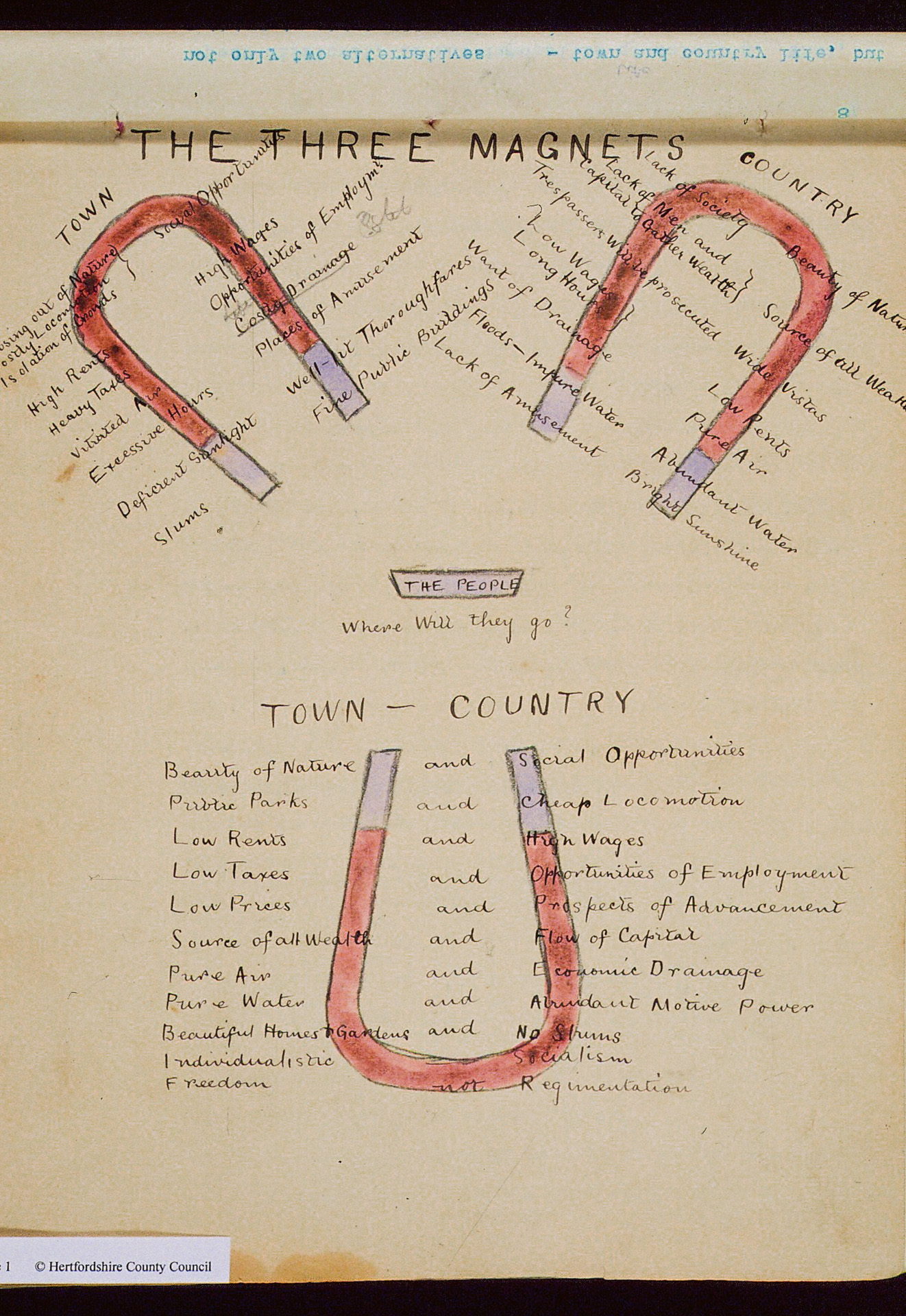
The single-family house is the ultimate expression of the concept of individualism as articulated by the West for at least two centuries, eventually becoming a globalized and universal image of a unique way of imagining a place where a single individual, or their specific family unit, can retreat from metropolitan turmoil, following an anti-urban dream that was initially born from the fragile utopia of the Garden City, only to multiply into millions of examples spread across every latitude and cultural and geographical condition.
A desire for self-expression that knows no boundaries, which has multiplied in our imagination far beyond the actual house, thanks to literature and cinema, which have transformed the single-family house into a contemporary archetype in which we all can recognize ourselves.
Yet the fragmented, boxy, and infinitely dispersed model that we all recognize today has a much deeper symbolic and material trajectory, worth recalling to grasp the changes and metamorphoses that we are beginning to perceive, particularly on the contemporary European scene.
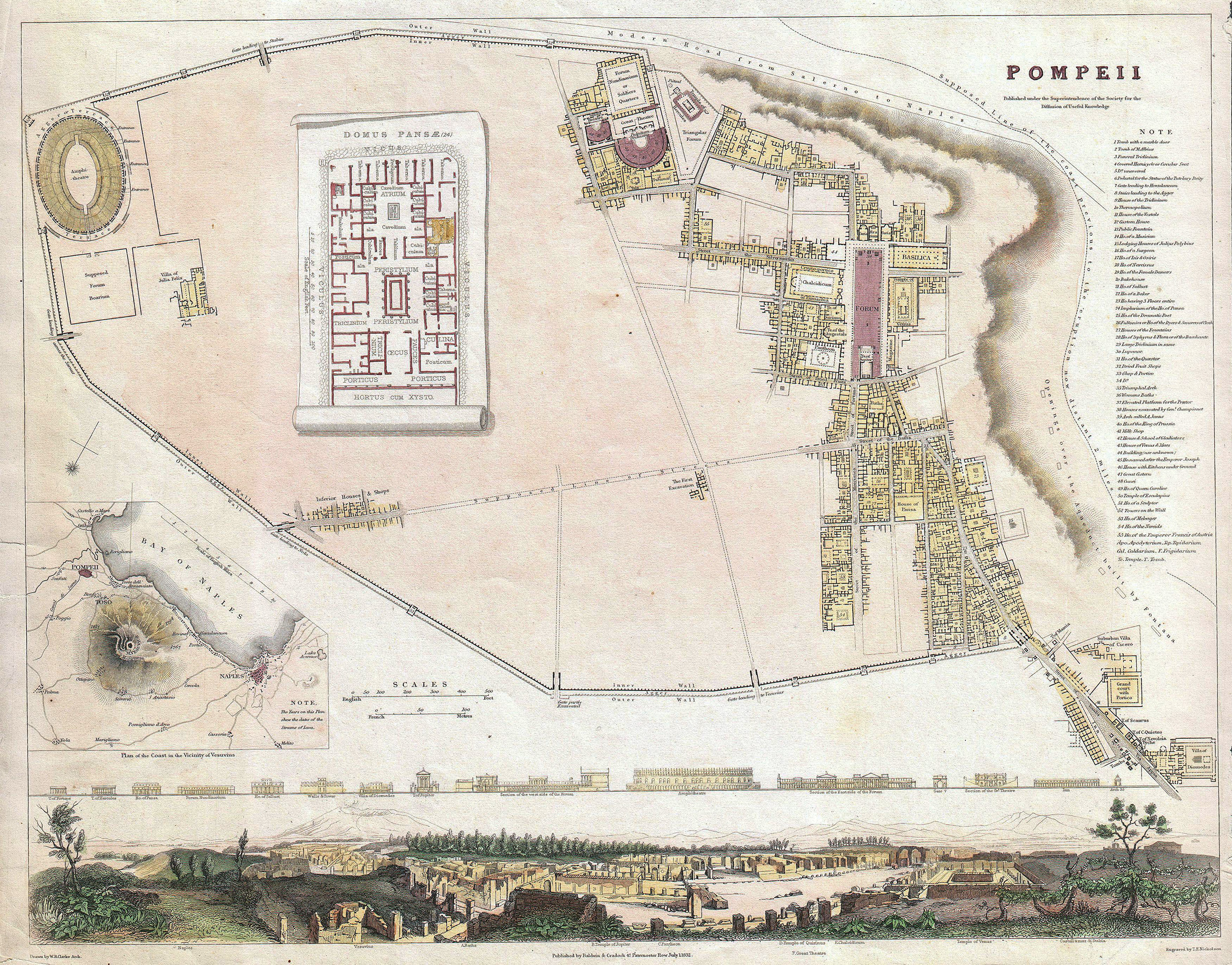
The possibility of having an autonomous residence away from the noise of the city has always traversed our history, as a desire for exclusivity and a display of power and well-being. Yet it was only from the Roman Empire onwards that a new model of dwelling emerged away from recognized centers of power, one that eschewed the city and its securities. For the first time, with the Roman suburban villa, we witness something unprecedented: the possibility of living safely away from the city walls and community. The villa was, in reality, an evolved agricultural residence at the center of its estates, often enclosed within defined boundaries, but effectively an autonomous and dominant dwelling. From this moment, the villa model asserted itself in all historical circumstances in which the sense of individual security outweighed protection offered by the city and its symbols.
The dispersed rural villa across the regions of the Roman Empire, the Renaissance and Baroque pleasure houses, the neoclassical townhouses in the English and North American countryside, and eventually the bourgeois cottage all correspond to the assertion of a familial individuality that proudly contrasted with the need to remain together, protected, within the urban circle. Over the centuries, the scale of the dwelling gradually changed, and proportionally, the surrounding land decreased—from the vast estate surrounding the Roman villa of the 2nd century AD, to the small garden proudly encircling the brianzola villa perched atop its little hill.
This type of dwelling would come to be considered one of the freest and most malleable grounds on which to work, becoming an extraordinary model of theoretical and formal reflection for Western architectural culture.
In its pursuit of uniqueness and freedom, the villa represented for architects and clients a powerful place in which to pour experimentation and assertions of principle, narrating, by synthesis, the world that inhabited it.
The Rotonda, namely Villa Almerico Capra Valmarana designed by Andrea Palladio after 1566 (fig. 3), is a theoretical and design manifesto of a new world, imagined as Roman amidst the gentle, pleasant hills surrounding Vicenza. The perfect symmetry and geometric rigor that govern this villa, bringing winds and the four cardinal points to meet under the dome commanding the absolute centre of this composition, transform the work into a manifesto, definitively crystallized in the Four Books of Architecture.
This work dominates a defined territory, a space for the pleasures of a household of new men, Roman in spirit, and at the same time it is a universal, absolute object capable of becoming a replicable model in the English countryside as well as among the plantations of Virginia.
The ghost of Palladio sails across the ocean with his Four Books, shaping the taste and gaze of America’s first great architect, President Thomas Jefferson, who in his Monticello villa and the early designs for the White House dreams of Italy and its gentle hills.
The villa continues to be the magnificent obsession of architects, for the compositional freedom and formal vitality it allows. With the proud and assertive rise of bourgeois culture, opportunities and clients multiplied. The Modern Movement and its heroes would have the chance to experiment within the villa’s infinite possibilities for new, healthy, open-air living, channelling into this typology a surprising creativity that exalted the full design individuality of its best practitioners. La Villa Savoye by Le Corbusier, solitary, white, dominant at the centre of a large lawn whose path guides you inside via ramps ascending toward the sky conquered by the roof garden. Frank Lloyd Wright’s Kaufmann House, on the other hand, appropriates the stone, which merges with the stream below. Water, the greenery of plants, rock, wood form a single organic living model. Villa Malaparte by the duo Libera/Malaparte celebrates Capri and the emperors who colonized it with gentle violence, clinging to the cliff overlooking the Faraglioni. Red earth and a white stroke on the terrace projecting toward the Mediterranean to infinity. Inside, the house merges with the surrounding landscape, yet never forgetting the fireplace, the sacred fire necessary to energize even the most extreme dwelling. Mies van der Rohe’s Farnsworth House, an absolute manifesto to transparency and the power of geometry, embodies form and content indifferent to the life it hosts.
The list could be endlessly long, so many are the villas built, dared, and dreamed by architects for a world of bourgeois clients, new masters of the global peri-metropolitan landscape, bringing us to the 1999 MoMA exhibition Un-private House, which consecrated the possibility of imagining the single-family dwelling as yet another experimental laboratory where the real model dematerializes in dialogue with emerging digital culture and its deconstructed imaginaries.
In reality, Terence Riley’s curated exhibition did not so much celebrate the consolidated model of the bourgeois private house as highlight its gradual conceptual demise, due to the slow yet relentless dematerialization of privacy, driven by the incursion of digital life into our daily routines. That closed door, which for two centuries separated the private house from the public street, is torn down by the silent yet inexorable power of Google, bringing the entire world, its gaze, and the uninterrupted flow of data directly into the bedroom, thus transforming our private dwellings into an involuntary stage where anyone can make their existence public and shared. The MoMA exhibition clearly addressed the issue of domestic design in the digital era, almost naively suggesting that the forms of our houses (and lives) would increasingly become liquid, curvilinear, soft, leading to an unprecedented fusion with the external environment and the flow of data that would embrace us.
If we look from 1999 to the present, it feels as if we have traversed multiple historical phases in a very short time: the trauma of September 11, 2001, the collapse of the markets in 2008, the COVID-19 pandemic, radical climate change, and a series of increasingly widespread and nearby regional conflicts that daily bring terror into our lives. The single-family villa has not dissolved into the digital flow, but this does not mean it is not undergoing a period of transformation that does not challenge its symbolic essence but, rather, conforms to a different era and a set of conditions that make its field of action interesting.
From this perspective, some European countries, including Switzerland, see projects and research by a new generation of architects and clients confronting different desires and imaginaries, interacting with a constructive realism and solid environmental sensitivity that allow the most interesting projects to express a strong design personality combined with a nearly contrasting desire to diminish the personality of the artifact itself. There is a quest for truth that leads designers and clients to search for primary, essential forms, at the edge of roughness, combined with the idea that the house, internally, is an even warmer, more protected heart, almost hidden from the world, reaffirming this housing model as the ultimate defense of a condition of privacy constantly threatened by the outside world.
This is combined with another condition influenced by the rising cost of building plots, as well as their gradual reduction, after a long century of land consumption without full awareness of its consequences on landscape. Not only have plots contracted or occupy liminal positions in an already heavily urbanized territory, but the practice of regeneration and recovery has also become another ground of design research, yielding increasingly promising results. The consequence of working on constrained plots is that the building mass is reduced, made essential in the distribution of internal cuts and choices, inevitably prompting designers to question the archaic, foundational matrices of the single-family dwelling idea. What once separated rooms into specific functions conditioned by habits and the binding presence of new appliances and fixtures has gradually dissolved, thanks to more fluid lifestyles, widespread connectivity, and a different relationship between function and its space. It feels like a return to a pre-modern phase of dwelling, where reciprocal, compressed spaces condensed daily actions and phases that would later be rigidly separated.
This condition merges with design research into the dimension of truth in the use of construction materials, their environmental performance, and their formal and expressive dimension. This domain clearly concerns single-family residences for a middle class increasingly in difficulty and impoverished compared to the golden era of the economic boom, materializing a suffering social stratum still proudly anchored to a residential tradition it does not fully wish to abandon. This condition still emerges in the clear separation between the day and night zones of the house, the latter more private, while at the same time, the hyper-functional specialization of spaces seems to have been entirely abandoned in favor of more fluid, generous areas capable of hosting different actions and tasks depending on the time of day, the inhabitants, and the seasons.
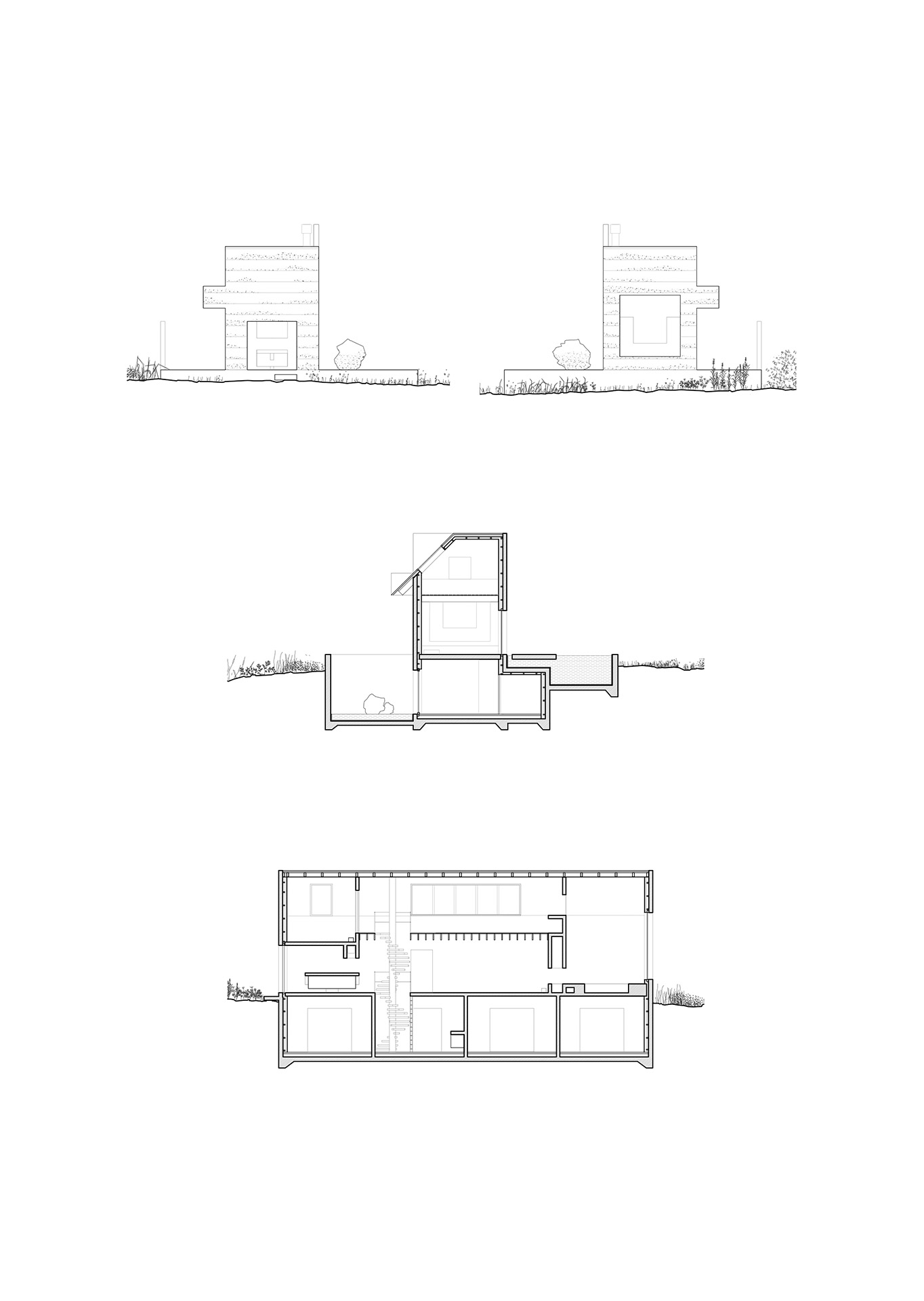
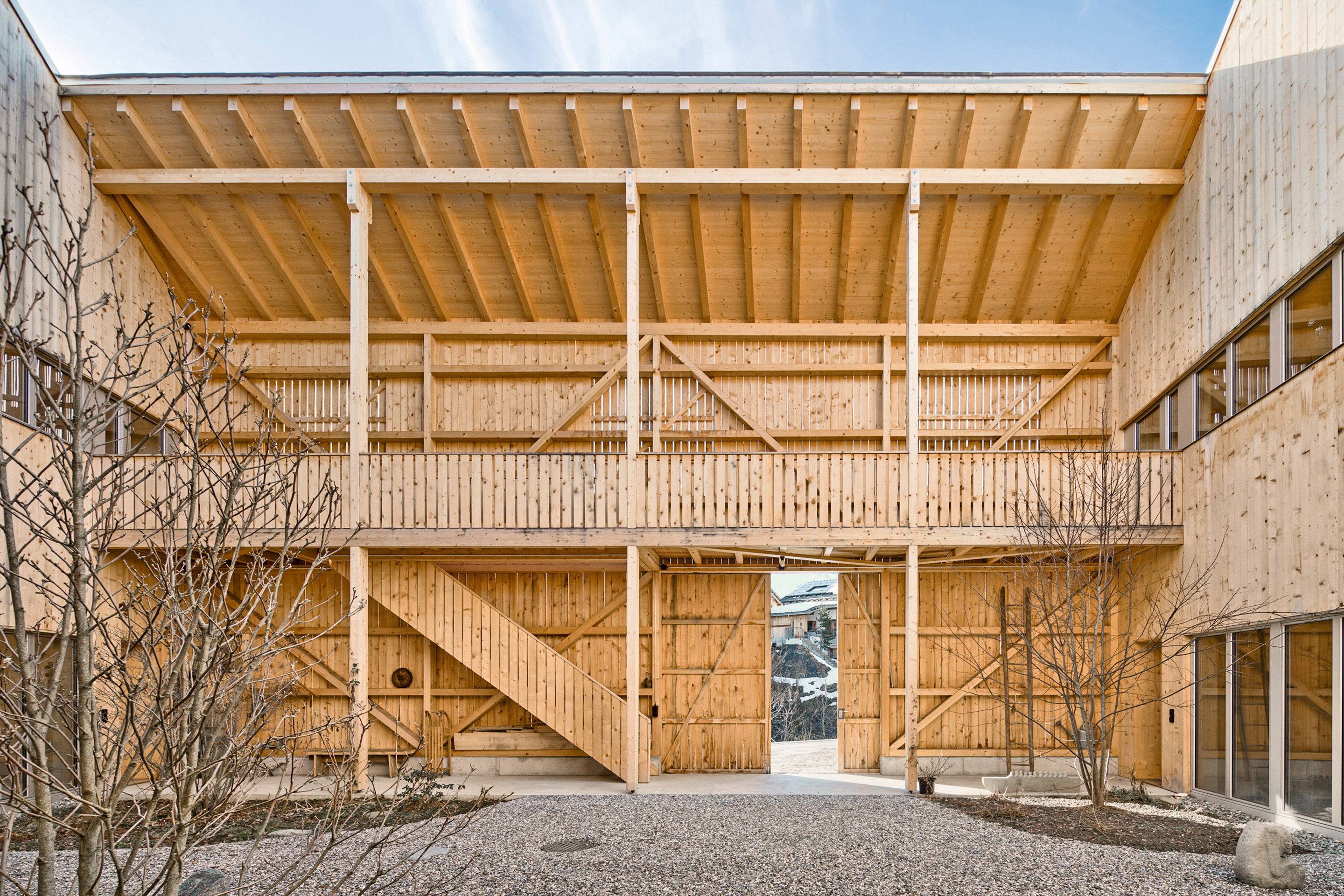
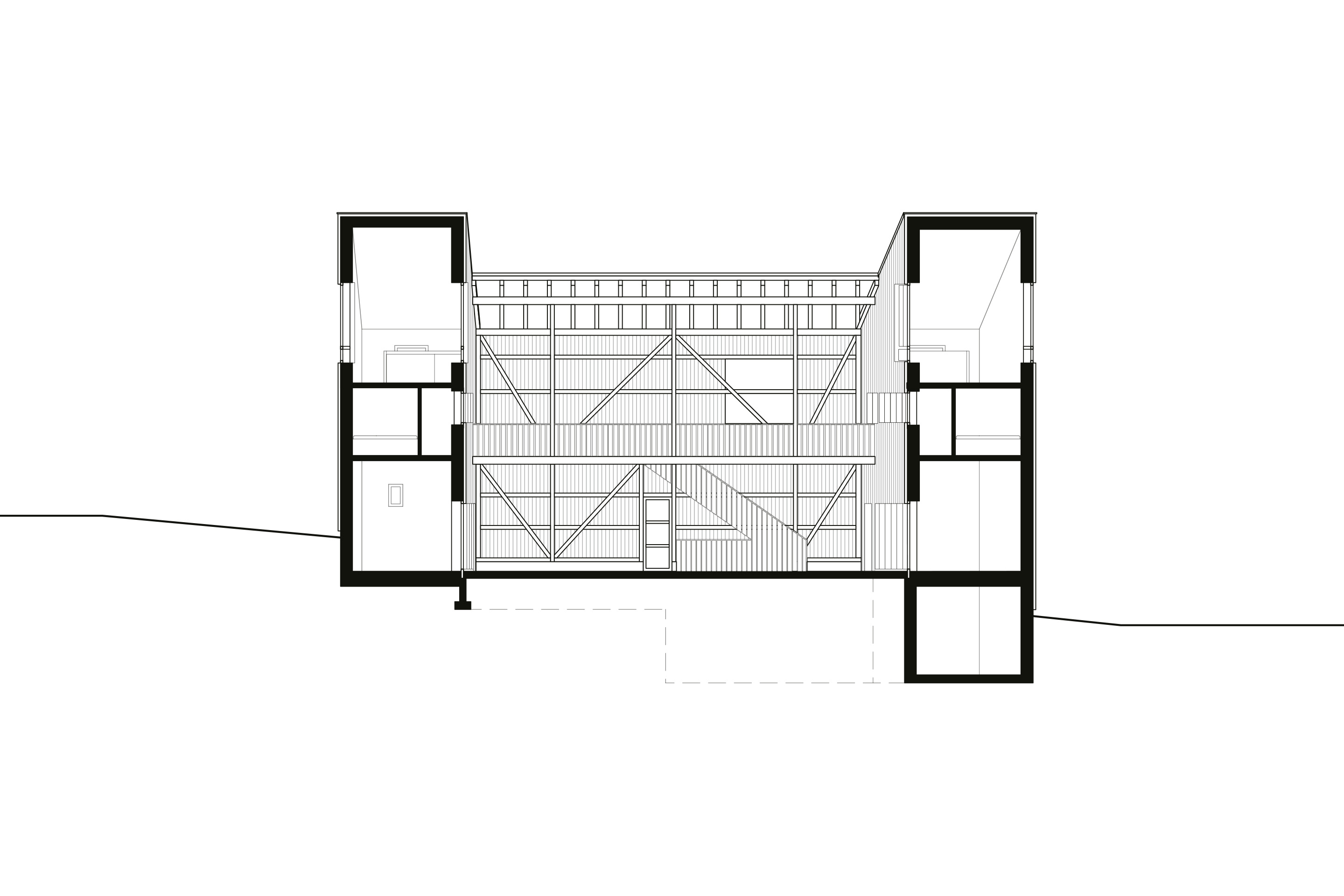
The new residential frugality is perfectly expressed by a generation of authors who have internalized this symbolic and formal condition as part of a worldview, evident in Leopold Banchini’s work with Villa Montasser, which works on the minimal reduction of elements and geometries used, strongly coherent with his most experimental research on the form of dwelling, developed at the 2023 Venice Biennale of Architecture. A cultural attitude, before being a design approach, also evident in Bearth & Deplazes Architects’ Casa Bula (cf. pp. 54-63), where the theme of the house is exalted by the essential simplicity of the dwelling’s design, along with a deliberately exaggerated wooden gabled roof, almost entirely protecting the upper floor sleeping area and casting a dramatic shadow over the absolute transparency of the ground floor. The same studio, in another residential project in Urmein (fig. 6), masterfully reinterprets the structural and figurative use of wood, with a dual building body connected by a dual system of galleries defining an internal courtyard, in which the wooden structure acquires expressive force, merging contemporary poetry with an acute and conscious reinterpretation of Alpine rural architecture.
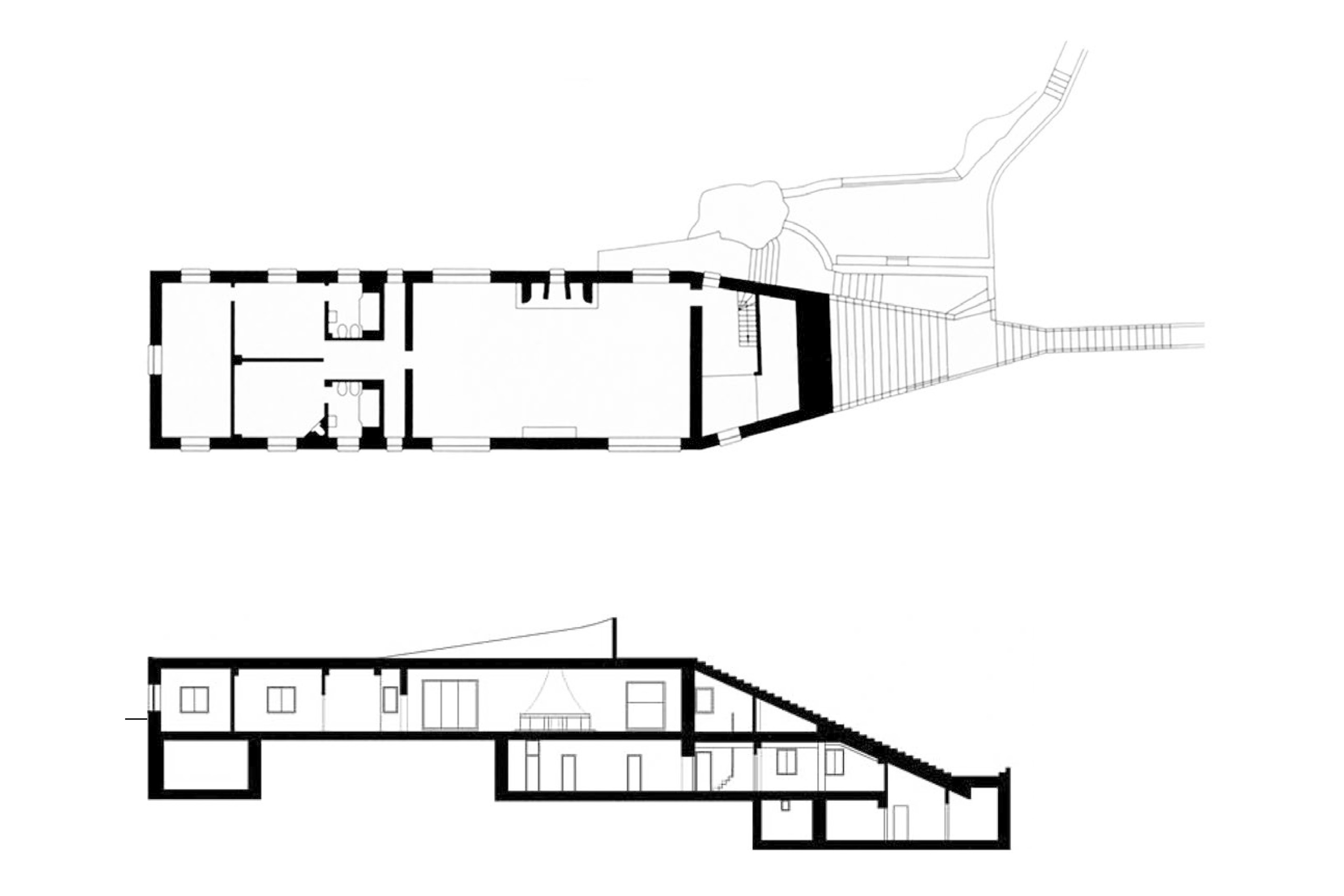
A constructive tradition reread not with the apparent nostalgia typical of Critical Regionalism, but as an attentive and projective form by those who regard places as vital resources to engage with, as seen in Bartke Pedrazzini’s Ca’ del Tero / Casa Cortile in Minusio (cf. pp. 44-53). Here, the opportunity to intervene on a traditional cluster of distinct residential units becomes a chance to reinvent the buildings themselves, preserving the original masonry and footprints while reconfiguring volumes, completing them with flat roofs and integrating upper floors clad in coarse, expressive mortars, necessarily contrasting with the existing structures. This strong materiality fully dematerializes inside, where deep window openings, both new and pre-existing, fade into diffuse whiteness, rendering domestic spaces almost abstract.
The principle of recomposition, demolition, and integration regards existing architecture as a living organism to engage with openly, also attempting to define a more recognizable urbanity in the arrangement of spaces closest to the street and the lot’s outer boundary.
We must not forget that the relationship between reinterpretation of construction traditions and modernist abstraction lives in an original experimental line recognizable in Swiss architectural culture, having reached a significant pivot decades ago in Herzog & de Meuron’s Stone House in Tavole, where the use of a primary building type in this small villa, with reinforced concrete embedded in local stone, indicated a return to reasoning on elementary architectural forms even in contemporary times, far beyond Minimalism.
Stone is also central to Wespi de Meuron Romeo’s work for the house in San Nazzaro (cfr. 34-43), where the elementary, pure volume of the dwelling is literally fitted into the lot’s perimeter, materialized through a significant dark mineral enclosure. The contrast between the transparent box at the lot’s heart and the boundary is almost jarring, continuing inside, treated with near-Franciscan emphasis, excavating two lower levels with spaces that overlook the adjacent slope toward the lake. This residence perfectly expresses the desire for protection and retreat from public life, always at the core of the single-family villa essence, once again playing on the contrast between rough exteriors and dematerialized inhabited interiors.
These projects indicate paths to pursue in a time that appears different and tensioned, yet simultaneously tells us that humans’ need to find peace, protection, and refuge in spaces necessarily separated from the urban environment will never dematerialize. Every project is also a product of the cultural and economic environment it represents, and every architecture is a living organism adapting under the pressure of its inhabitants. Each villa project thus becomes a fragment for understanding how our relationship with the idea of dwelling—alone and together—is changing in a world presenting major challenges for our future.