

Modellare il futuro | Shaping Tomorrow
espazium quaderni 2026 3
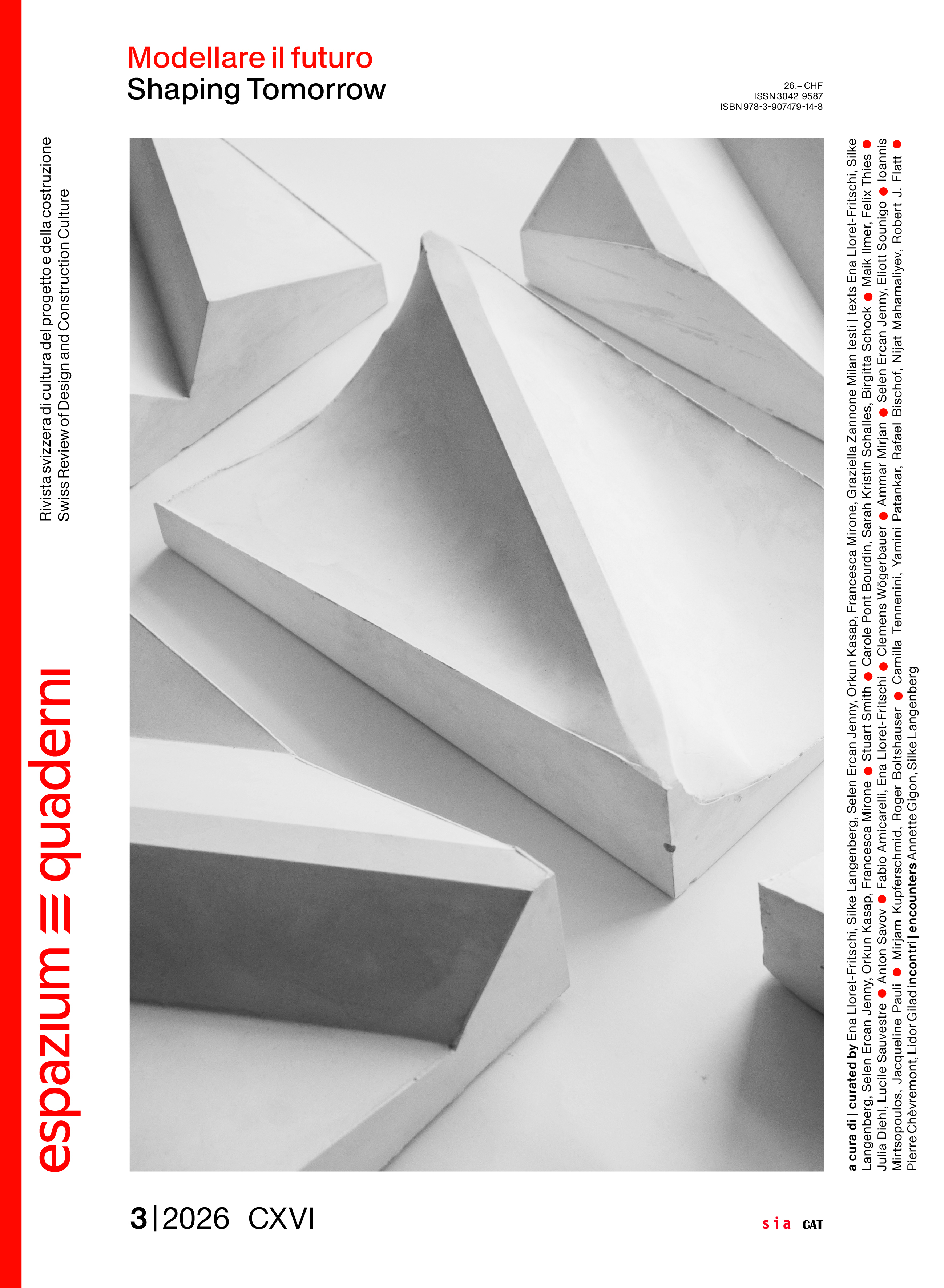
Modellare il futuro / Shaping Tomorrow, titolo dell’ultimo numero di espazium quaderni, affronta il tema del passato come risorsa attiva e strumento critico per comprendere e trasformare il presente. A partire dai contributi dei partecipanti alla terza edizione del convegno Making the Past Productive, svoltosi presso il Teatro dell’architettura dell’Accademia di architettura di Mendrisio, il numero amplia e rilancia il dibattito avviato nel novembre 2024, anticipando al contempo la quarta edizione del Future of Construction Symposium 2026, prevista presso ll’ETH di Zurigo dal 20 al 23 maggio 2026.
Muovendo dall’osservazione dello scenario contemporaneo, segnato da una crescente pressione ambientale e dalla necessità di ripensare radicalmente le pratiche costruttive, il numero riflette sul ruolo che il patrimonio materiale e culturale può assumere all’interno delle trasformazioni in corso. Come ricordano i co-direttori Stefano Milan e Andrea Nardi nell’editoriale: “L’industria delle costruzioni, con un’espressione ormai abusata, deve dimezzare le emissioni entro il 2030: solo in Svizzera movimenta ogni anno circa settanta milioni di tonnellate di materiali, e ne scarta una quantità analoga. A scala globale, entro metà secolo la domanda di nuovi alloggi supererà le centomila unità al giorno per tenere il passo con l’urbanizzazione. In questo scenario, la questione riguarda il modo in cui guardare al passato, senza ingenuità.”
I contributi raccolti delineano così un quadro nel quale circolarità, innovazione digitale e approcci centrati sull’uomo convergono nella ridefinizione delle modalità di progettare, collaborare e costruire in condizioni di crescente incertezza. Il passato emerge non come repertorio nostalgico, ma come campo operativo da cui apprendere strategie, processi e forme di adattamento utili ad affrontare le sfide contemporanee. Attraverso saggi teorici, ricerche e casi studio, il numero costruisce una riflessione articolata sulla trasformazione dell’ambiente costruito, con particolare attenzione ai temi della sostenibilità, della costruzione circolare e degli approcci rigenerativi.
Co-curato da Ena Lloret-Fritschi, Silke Langenberg, Selen Ercan Jenny, Orkun Kasap, Francesca Mirone, organizzatori dell’edizione 2024 di Future of Construction, e Graziella Zannone Milan, Modellare il futuro / Shaping Tomorrow si propone come uno spazio di riflessione collettiva sullo stato attuale del settore delle costruzioni, mettendo in discussione principi consolidati e modelli standardizzati per aprire nuove prospettive sul patrimonio costruito e sulle sue possibilità di trasformazione futura.
---
Modellare il futuro / Shaping Tomorrow, the latest issue of espazium quaderni, addresses the theme of the past as an active resource and critical tool for understanding and transforming the present. Drawing on contributions by participants in the third edition of the symposium Making the Past Productive, held at the Teatro dell’architettura of the Academy of Architecture in Mendrisio in November 2024, the journal expands and extends the discussion initiated during the conference, while also anticipating the fourth edition of the Future of Construction Symposium 2026, scheduled to take place at ETH Zurich from May 20–23, 2026.
Starting from an observation of the contemporary context, marked by increasing environmental pressure and the urgent need to radically rethink construction practices, the issue reflects on the role that material and cultural heritage can play within ongoing processes of transformation. As co-directors Stefano Milan and Andrea Nardi write in the editorial: “The construction industry, to use an already overused expression, must halve its emissions by 2030: in Switzerland alone, around seventy million tons of materials are processed every year, while a similar quantity is discarded. On a global scale, by the middle of the century the demand for new housing will exceed one hundred thousand units per day in order to keep pace with urbanization. In this scenario, the question concerns how to look at the past, without naivety.”
The contributions collected in the issue outline a framework in which circularity, digital innovation, and human-centered approaches converge in redefining the ways we design, collaborate, and build under conditions of growing uncertainty. The past emerges not as a nostalgic repository, but as an operational field from which to learn strategies, processes, and forms of adaptation capable of addressing contemporary challenges. Through theoretical essays, research projects, and case studies, the issue develops a broader reflection on the transformation of the built environment, with particular attention to sustainability, circular construction, and regenerative approaches.
Co-curated by Ena Lloret-Fritschi, Silke Langenberg, Selen Ercan Jenny, Orkun Kasap, Francesca Mirone — organizers of the 2024 edition of Future of Construction — together with Graziella Zannone Milan, Modellare il futuro / Shaping Tomorrow proposes a space for collective reflection on the current state of the construction sector, questioning established principles and standardized models in order to open up new perspectives on the built heritage and its potential for future transformation.
In questo numero | In this edition:
- Editoriale | Editorial: Tempo, memoria, materia | Time, Memory, Matter – Stefano Milan, Andrea Nardi
- Rendere produttivo il passato | Making the past productive – Ena Lloret-Fritschi, Silke Langenberg , Selen Ercan Jenny, Orkun Kasap, Francesca Mirone
- Sfide e soluzioni nell’ambiente costruito contemporaneo | Challenges and Solutions in the Modern Built Environment – Stuart Smith
- Progettare per l’ignoto | Planning For The Unknown – Carole Pont Bourdin, Sarah Kristin Schalles, Birgitta Schock
- Sul futuro della formazione in architettura | On the future of architectural education: Una conversazione con | In conversation with Annette Gigon, a cura di | edited by Silke Langenberg
- Trasformazione circolare a Müllerstrasse | Müllerstrasse: a Circular Transformation – Maik Ilmer, Felix Thies
- Pre-fabbricazione: verso un’architettura low-carbon scalabile | Pre-manufacturing: Key to scalable, low-carbon architecture – Julia Diehl, Lucile Sauvestre
- La costruzione del/i futuro/i | Construction of Future(s) – Anton Savov
- Casseri in carta per elementi in calcestruzzo | Paper Formwork for Concrete Elements – Fabio Amicarelli, Ena Lloret-Fritschi
- Girare in tondo … e adorarlo! | Turning in Circles … and Loving It! – Clemens Wögerbauer
- Decodificare l’armatura | Decoding Rebar – Ammar Mirjan
- Superfici smart, sostenibili ed efficienti | Smart, efficient and sustainable surfaces – Selen Ercan Jenny, Eliott Sounigo
- Saggezza dal passato, intelligenza dall’artificiale | Wisdom from the past, Intelligence from the artificial – Ioannis Mirtsopoulos, Jacqueline Pauli
- Pisé: la sua storia e il suo potenziale | Rammed Earth: Its history and potential – Mirjam Kupferschmid, Roger Boltshauser
- Patrimonio, tutela e AI-powered Conservation Co-pilots | AI-powered Conservation Co-pilots for BuilT Heritage – Camilla Tennenini, Yamini Patankar, Rafael Bischof, Nijat Mahamaliyev,
- Robert J. Flatt
- L’IA può rendere il passato produttivo? | Can AI Make the Past Productive? – Pierre Chèvremont, Lidor Gilad
- The Twelve Ideal Cities of Helvetica a cura di Klaus
- EUREKA a cura di Graziella Zannone Milan testo di Muck Petzet, Ferdinand Knecht, Irene Tassinari, Andrea Roscetti, Aramis Vincenzi