

Inhabiting the Elsewhere
Emergency is not an exception but a way space is produced and governed. Through refugee camps, reconstruction, mapping and participatory practices, this issue of espazium quaderni explores the relationship between architecture, power and justice beyond the rhetoric of crisis.
Testo in italiano al seguente link
In 1975, Michelangelo Pistoletto makes La conferenza: the gazes of a group of people converge on the speaker, photographing him simultaneously; his gaze gathers them into a single image, revealing the underlying geometry of power in which the one who speaks occupies the centre and the community remains an observing mass; it is the paradox of democracy, which, in the same year, with Raggi di persone, the artist overturns by altering the relations between people: the participants photograph one another, each sees and is seen, and only the collective gaze recomposes the scene. This pair of works anticipates an idea that Pistoletto would later condense in the word demopraxia: replacing cratòs, power, with praxis, doing. Not the people as an abstract figure, but individuals in the concreteness of gestures, knowledge and relations. Making, repairing, involving, sharing. Applied to architecture, demopraxia undermines the project as an absolute act, opening it instead to the transformations of those who inhabit and use it daily.
This issue of espazium quaderni starts from this premise: emergency is not only a condition to be managed, but one of the forms through which space is produced, administered and governed. To analyse it is not to neutralise it, but to assume that understanding the apparatuses that define it is already an act of responsibility. Emergency has its own grammar. It uses poor materials and technical words: shelter, camps, corridors, buffer zones, registrations, protocols, evacuation and reconstruction plans. It declares the provisional, yet generates duration. It prepares places meant to disappear and lets them settle into life-dense conglomerates: lives it protects while classifying them, cares for while regulating them, receives while holding them. Refugee camps are born under the sign of urgency; then time transforms them. They become cities without fully acquiring their rights, or remain camps even when the city has absorbed them.
Al Wehdat, in Amman, narrates the duration of emergency (see pp. 48-58). Born as a Palestinian camp, today it is a dense, commercial urban fragment, traversed by markets and infrastructure. The passage from shelter to sūq reveals an emergency that has become urban matter and human archive. The city incorporates the camp, but still does not resolve the history that produced it.
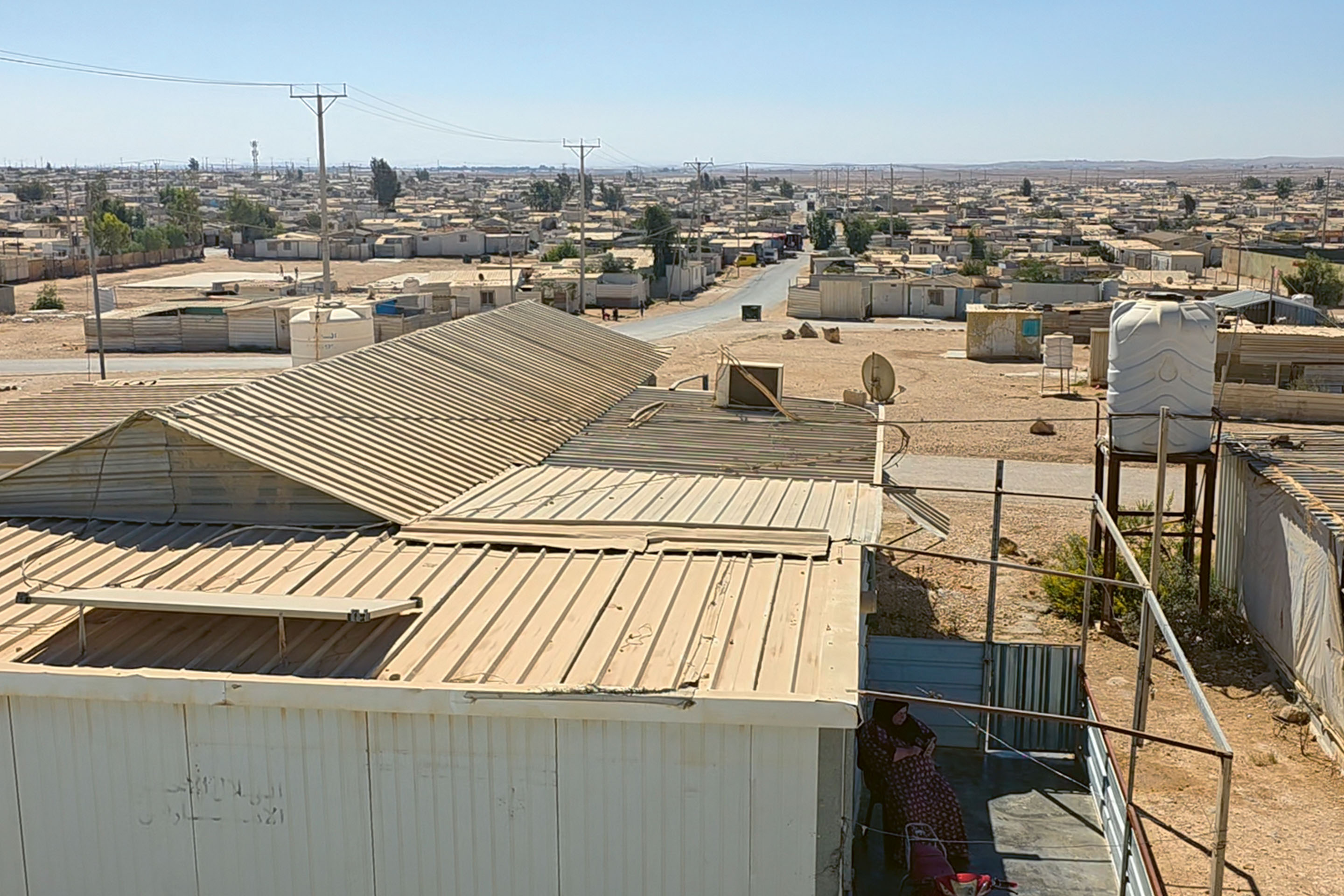
Zaatari instead narrates transformation (see pp. 38-47). Established to receive Syrian refugees, it shows how decisive human relations are in the making of the city. Housing units are adapted; tents and provisional additions recompose fragments of domesticity. The order of the grid is fractured by minimal gestures: privacy, care, proximity, economy, family relations. Streets become markets; imposed spaces are rewritten by inhabitation.
Gaza brings these questions into harsher territory (see pp. 28-37). Here, reconstruction is contested even before the conflict has ended. The plan precedes the rubble: and this is what makes Gaza irreducible to the other cases, forcing us not to separate space from the humanity that inhabits it – and will inhabit it. To reconstruct a devastated territory means interrogating the practices of a governance imposed from above. The polished images of reconstruction conceal essential questions: who may stay, who may return, who will have a voice, what traces, what rights and what futures will be made possible.
The issue, then, concerns the relationship between space and power: the point at which the project becomes an instrument of social justice or the continuation of violence by other means. Maps, cartographies, satellite images, data and forensic investigations make visible what power tends to disperse, deny or normalise. Yet in the abstract density of the map an entire territory is never found. The map selects, orders, isolates, exposes. It can erase, as it can bring traces to light (see pp. 24-27). A stroke of pencil, a click of the mouse. Architecture begins here too: when it establishes who and what counts in representation and who remains out of frame; when it decides how a space is named or interdicted.
Demopraxia, then, is not an external reference to the issue, but a possible criterion. It asks that reconstruction be shifted from delegation to participation, from the final image to the process, from the authority of the plan to the practice of those who will have to inhabit what is decided. In wounded territories, no project can claim neutrality. Every choice takes a position not only on the memories to be kept, on the relations to be recomposed, but also on the lives to be made possible. Architecture and urbanism can still do something if they relinquish the innocence of their tools. They can recognise that behind every destroyed building lies a geography of bonds, uses, domestic economies, childhoods, mourning, desires. They can place technical knowledge at the service of a radical question: under what conditions can a place become habitable again without being erased?
In the Tractatus politicus, Spinoza writes that he sought not to laugh at, not to lament, not to detest human actions, but to understand them. The point is not to soften judgement, but to make it more exacting. To understand means entering the weave of causes: seeing how a condition is produced, preserved and can be transformed. A difficult lesson, today. This issue seeks to understand how emergency takes form. Recognising how a space of violence is constructed is already the first step towards imagining how it might be undone.