

Decoding Rebar
While structural design has become largely digital, reinforcement assembly remains mostly manual. Mesh’s robotic technology bridges this gap, transforming 3D data into automated processes that are more efficient, safer, and more precise, while optimizing steel use and reducing material waste.
Testo in italiano al seguente link
Despite the rapid digitization of construction planning, the physical execution of reinforced concrete structures remains surprisingly analog. Switzerland consumes approximately 1 million tons of rebar annually; however, handling and assembly–both on-site and in prefabrication plants – remain largely manual. This disconnect between digital design and physical execution results in significant inefficiencies, safety risks, and lost potentials for material optimization. New robotic advancements bring flexibility and accessibility to the rebar industry
The Analog Bottleneck
Reinforced concrete is the dominant material in construction and the backbone of most infrastructure projects. However, the workflow for processing rebar has not evolved in parallel with digital design technology. While structural engineers and architects increasingly rely on 3D data models, the execution phase often reverts to 2D plans and manual interpretation. This reliance on manual labor creates several challenges. First, it is cost-intensive; in Switzerland, assembly labor costs typically hover around 0.5 CHF per kilogram.1 Second, the work is physically demanding and hazardous, contributing to a chronic shortage of skilled labor.
Cost pressure in this labor-intensive sector has also led to precarious working conditions. Recent investigations revealed systemic fraud and wage dumping within Switzerland’s manual rebar placement industry.2 These socio-economic factors, combined with the physical limitations of human labor, underscore the urgent need for a shift towards automated construction.
Closing the Digital Gap
The paradox is that the necessary data for automation already exists. Structural designs are typically generated in digital formats, including rebar data (such as IFC or BVBS files)3 that contain precise geometric information. In the traditional workflow, this rich 3D data is often «flattened» into 2D plans for manual assembly, effectively breaking the digital chain. To reach robotic standards in construction, this digital thread must remain unbroken. The digital data models can directly drive physical production directly, eliminating the need for manual translation and reducing the potential for human error.
Mesh: A Software-First Approach to Robotic Rebar Construction
Addressing this challenge requires more than industrial hardware; it requires an intelligent software layer capable of interpreting construction data. Mesh, a spin-off from Swiss Federal Institute of Technology in Zurich (ETHZ)4 has developed a technology specifically designed to bridge the gap between digital planning and robotic execution.
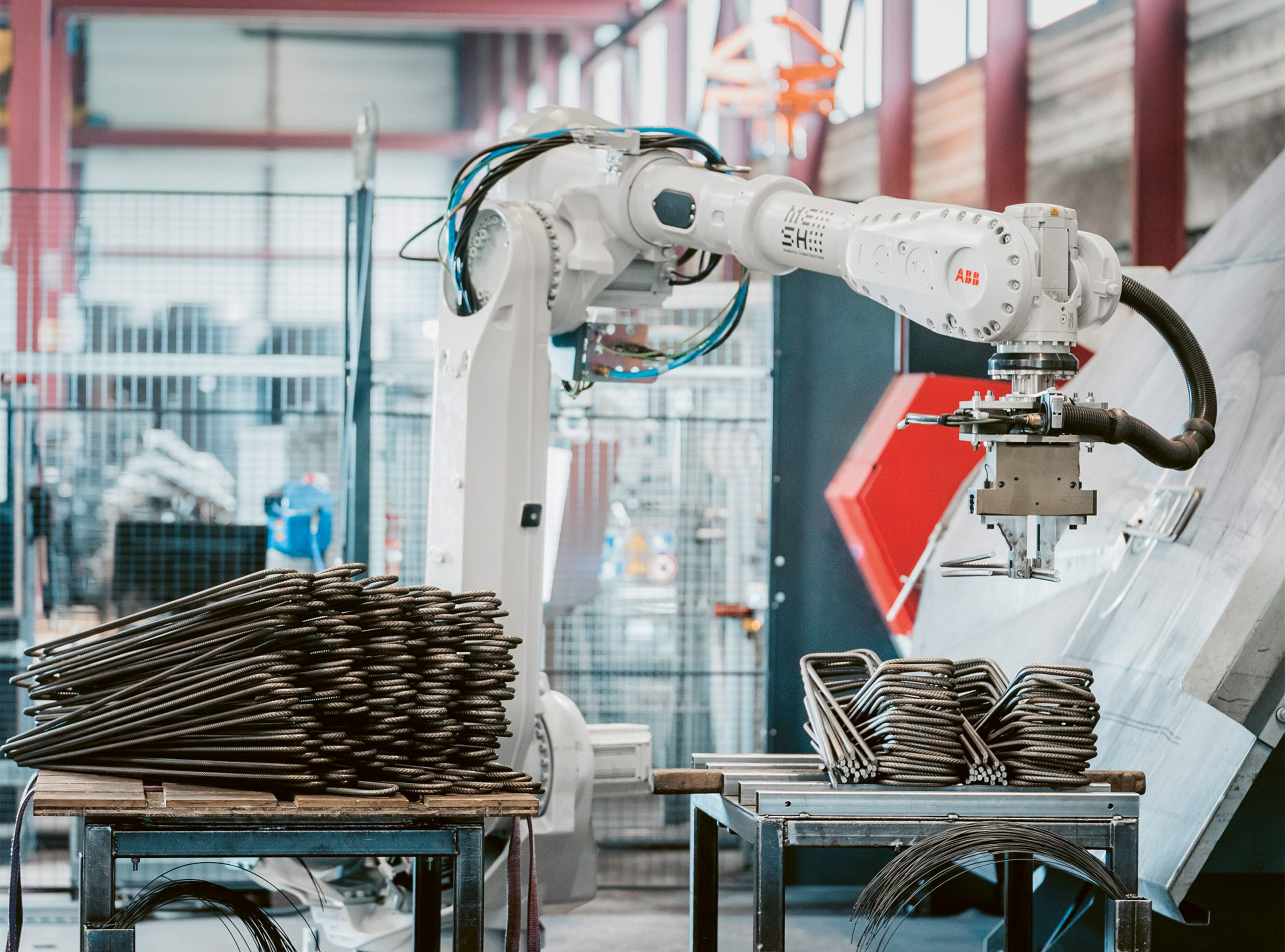
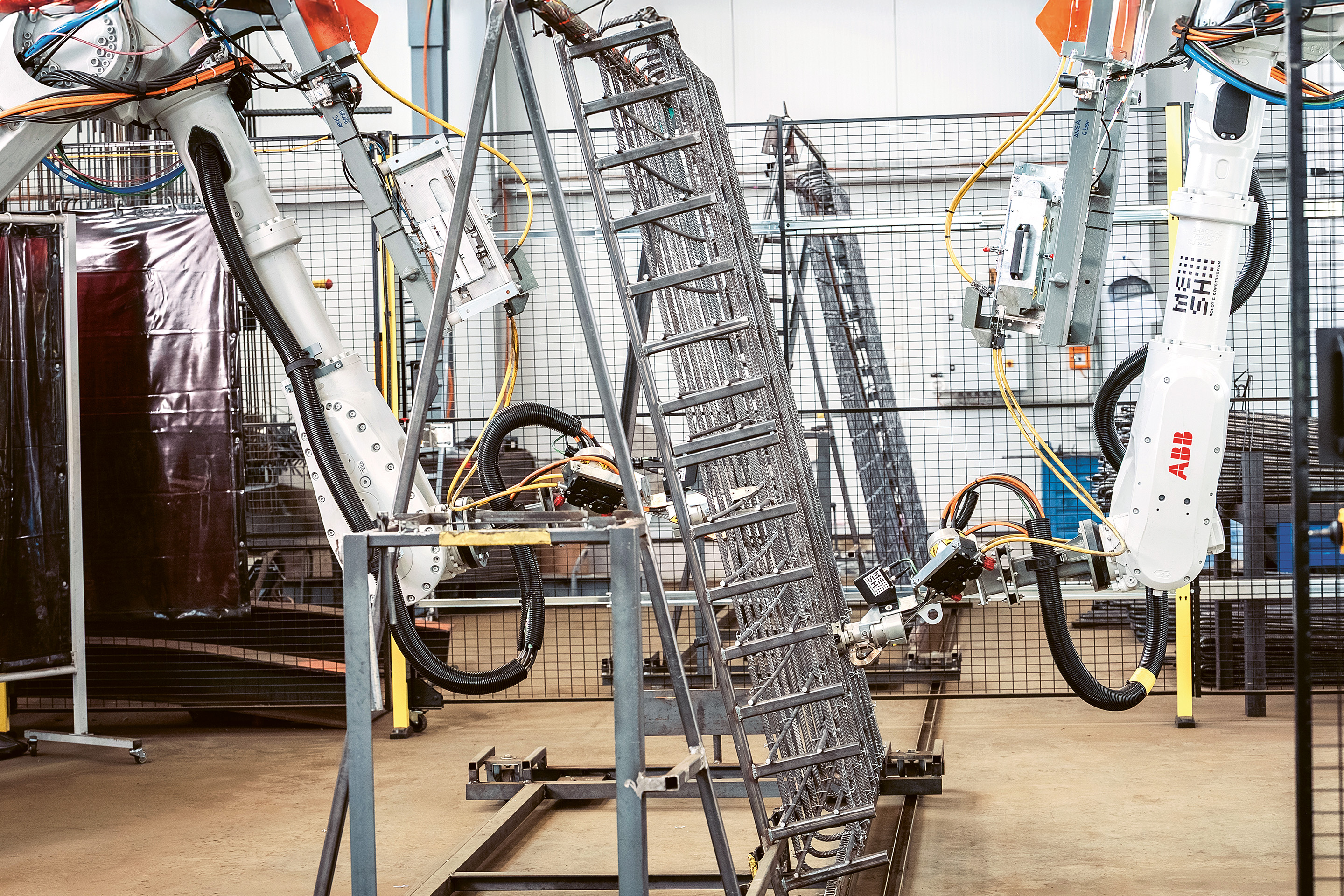
Unlike traditional, rigid automation lines used in the automotive industry, construction demands high flexibility to handle unique geometries and varying batch sizes. Mesh achieves this by licensing its software technology to the rebar industry, enabling standard industrial robots to autonomously handle, place, and join rebar.
The core innovation lies in the software’s interface and adaptability. By utilizing a «no-programming» interface, the system allows operators to control complex robotic movements without requiring specialized coding knowledge. This accessibility is complemented by high operational flexibility, enabling production lines to switch between different cage designs and rebar geometries at the push of a button. Crucially, the system integrates computer vision and sensor feedback to monitor production in real-time. This facilitates the adaptive handling of construction tolerances – a vital capability for managing the material imperfections inherent in steel rebar.
Specificity
A key advantage of this robotic flexibility is the potential for material efficiency. In traditional manual construction, reinforcement is often over-dimensioned or simplified into standard grids to make manual assembly feasible. In contrast, robotic precision allows for the fabrication of complex, optimized reinforcement structures that place steel only where it is structurally necessary. This can significantly reduce the material footprint of concrete structures without compromising stability.
This capability also challenges growing assumption that construction efficiency requires the standardization of building components. Mesh’s technology proves the opposite: robotic technology enables the efficient production of small batch sizes. This technological capability is particularly relevant to the Swiss construction landscape. Rather than forcing the construction industry to suit mass-production constraints, digital solutions and robotics allow this specificity – even as wages rise and labor becomes scarcer.
Industrial Deployment
This robotic approach has moved beyond the prototype stage and is currently employed in industrial settings. In 2025 alone, robots powered by this software handled or joined more than 1 million rebar elements in Switzerland. Mesh technology is currently used to tie reinforcement bars for prefabricated concrete elements for the new Gotthard tunnel and in cut and bend shops to handle and stack rebar from stirrup bending machines. For Tor Alva, a 3D-concrete-printed tower (cfr. Archi 2/2025), Mesh robots placed rebar for the structural core, allowing for the integration of reinforcement into the 3D printing process.
By linking planning data and robotic systems through intuitive software, the rebar industry can move away from physically strenuous and problematic manual labor models. The result is a production process that is not only more efficient and precise but also capable of supporting a multitude of construction futures.
Notes
- Derived from the standard productivity benchmark of approximately 10.5 man–hours per tonne for reinforcement installation (NPK 241) and the average all-in labor rate for Swiss concrete workers of CHF 55–65/h. See Schweizerischer Baumeisterverband (SBV), Lohnstatistik 2024: Hoch- und Tiefbau (Zürich: SBV, 2024).
- «Neue Daten zeigen Ausmass von Betrug bei Eisenlegern», Zentralplus, 2024, https://www.zentralplus.ch/justiz/neue-daten-zeigen-ausmass-von-betrug-bei-eisenlegern-2780850/
- Industry Foundation Classes (IFC) and Bundesverband Bausoftware (BVBS) are the standard neutral data formats for BIM-to-bar exchange and digital reinforcement fabrication. See buildingSMART International, IFC Specifications Database, e Bundesverband Bausoftware e.V., BVBS-Schnittstelle Bewehrungsdaten.
- «ETH Spin-off Mesh Automates Reinforcement Work», ETH Zurich News, 2025, https://ethz.ch/en/news-and-events/eth-news/news/2025/06/eth-spin-off-mesh-automates-reinforcement-work.html