

A tool to guide interventions on the existing building stock
In the context of the climate transition, the way we intervene in existing buildings is becoming increasingly central. Should a building be demolished, renovated or simply continue to be used? What are the environmental consequences of these choices? How much embodied energy and how many resources are already incorporated in the existing building stock? And how significant are the emissions associated with the use of buildings over time?
Testo in italiano al seguente link
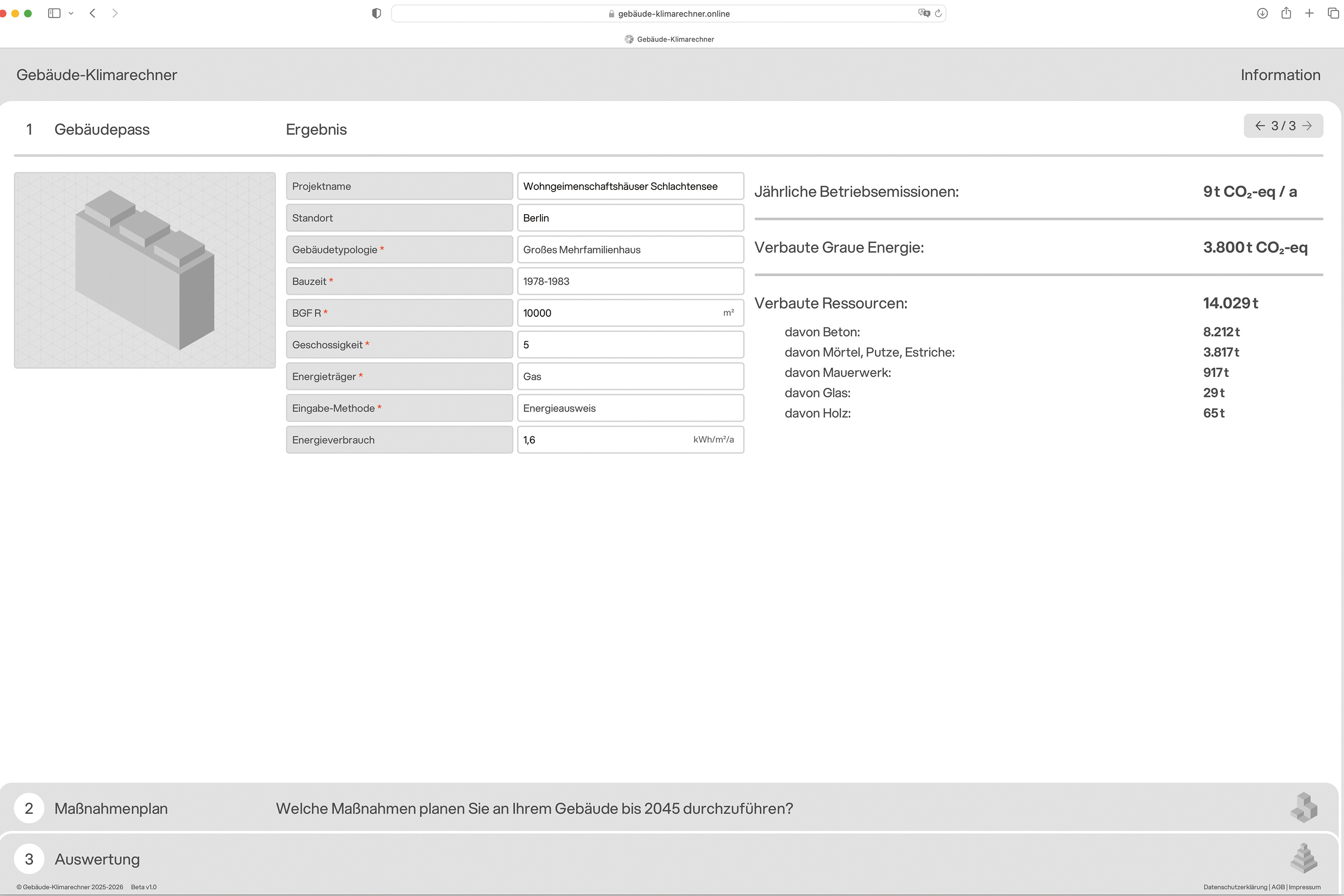
The Building Climate Calculator (Gebäude-Klimarechner, G-Kr) was developed to provide an initial response to these questions. It is a tool that enables property owners and project managers to estimate the climate impacts associated with different intervention scenarios for a building by using only a small amount of readily available data. The system allows users to compare alternatives, such as maintaining the existing building, renovating it or replacing it with a more efficient new construction, relating the emissions generated across the life cycle.
The project is supported by the Bundesinstitut für Bau-, Stadt- und Raumforschung (BBSR – Federal institute for Research on Building, Urban Affairs and Spatial Development) as part of the research program Zukunft Bau and is led by Muck Petzet Architekten / Prof. Muck Petzet (Sustainable Design USI-ARC). The calculation system and data foundations were developed in collaboration with the Accademia di architettura at USI in Mendrisio, b+ee bauphysik + energieeffizienz, and Madaster. Project partners also include the Bund Deutscher Architektinnen und Architekten and the Greyfield Group. The scientific advisory board includes Elisabeth Endres (TU Braunschweig), Thomas Auer (TU München) and Timm Sassen (Greyfield Group).
The aim of the project is to make the evaluation of the environmental impact of design decisions on existing buildings more understandable and accessible. The methodologies currently available are often complex and difficult to apply during the early stages of decision-making. Therefore, the calculator proposes a simplified approach that integrates several environmental aspects into a single reading, particularly operational emissions and those associated with the implementation of interventions.
The G-Kr is conceived as a free, non-commercial tool for knowledge dissemination. To ensure its long-term management and updating, the platform is operated by the association ReduceReuseRecycleArchitecture Association e.V., which is committed to promoting public interest objectives in the field of sustainable architecture.
The system is based on detailed analyses of the effects of different building strategies applied to buildings from various construction periods and typologies. In this way, the calculator offers a reading of environmental impact that goes beyond energy efficiency alone, considering together operational emissions, production emissions and resource use. The criterion for evaluating the different scenarios is the lowest overall CO2 emissions impact by 2045, in line with the objectives of the German Climate Protection Act (Klimaschutzgesetz).
The calculator is not intended to replace a detailed life cycle analysis (LCA), but rather to provide a preliminary, indicative assessment that helps to understand the potential environmental consequences of design decisions.
A first beta version, dedicated to residential buildings, was made available online in January 2026. The aim is to progressively improve the model through user input and feedback, and in the future to extend the system to other building types, such as educational or administrative buildings.
The data entered are recorded exclusively in anonymous form for statistical analysis and cannot be traced back to individual users. For this reason, the system does not require the creation of user accounts, and results can be downloaded directly by the user at the end of the calculation process.
The foundations of the project
According to climate policy objectives, Germany aims to achieve climate neutrality by 2045. This means that CO₂ equivalent emissions generated by economic and social activities will need to be balanced by natural or technological carbon removal processes. This commitment is aligned with the goals of the Paris Agreement and the effort to limit global temperature increase to 1.5 °C.
The construction sector plays a particularly significant role in this context. In Germany it is responsible for approximately 40 % of CO2 emissions and more than half of all waste generated. For this reason, public policies in recent years have introduced regulations and incentive programs primarily aimed at improving the energy efficiency of buildings.
Alongside these policies, however, there is a growing need to consider more broadly the environmental effects of transforming the existing building stock. Interventions such as deep renovations or new construction do not only bring long-term energy benefits; they also involve emissions and resource consumption related to material production, construction processes, and demolition.
The calculation tool was developed precisely to make this relationship between operational emissions, production emissions and resource use more understandable, thereby supporting a more informed evaluation of intervention strategies for the existing building stock.
In particular, the research project seeks to address several key questions:
– What is the most appropriate way to intervene in an existing building in relation to climate objectives?
– Is it possible to develop simple evaluation tools that support decision-making in the early stages of design?
– How can statistical data on the building stock be used to represent buildings of different typologies and construction periods in a comparable way?
– How can the overall environmental impact of different strategies be assessed while considering operational energy, production energy and resource consumption together?
By entering a small number of easily available data, the calculator provides an estimate of the environmental effects of different scenarios and a first indicative suggestion regarding possible intervention strategies.
The guiding principle of the system is to achieve maximum benefit with minimal environmental impact, taking into account not only the energy savings obtained during the building’s use, but also the emissions and resources required to implement the interventions.
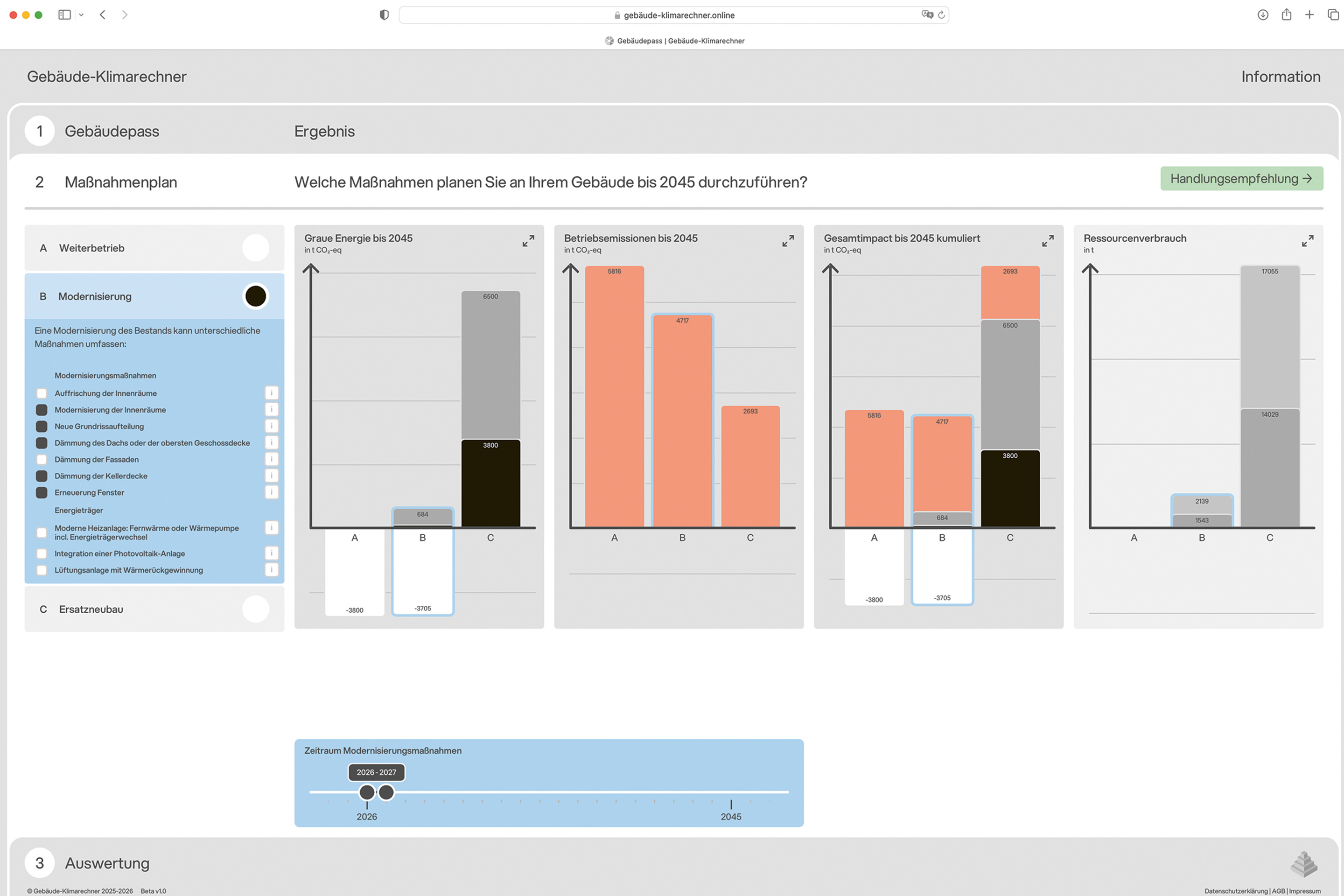
A simple example helps clarify this approach. Replacing windows, for instance, generates waste from the removal of existing elements and requires energy and materials for the production, transport and installation of the new components. These initial impacts must be offset over time by the energy savings achieved during the building’s operation. Considering the goal of climate neutrality by 2045, such benefits should occur within a relatively limited time frame. The beta version of the calculator is currently limited to residential buildings. During the testing phase, the model will be further refined and gradually extended to additional building typologies.
An integrated methodological approach
The project is based on the conviction that achieving climate goals requires increasingly integrated analytical tools capable of considering the entire life cycle of buildings.
Regarding the evaluation of operational emissions, the system proposes complementing traditional estimates of energy demand with greater attention to actual energy consumption, where such data are available. Numerous studies show that, in existing buildings, significant differences can emerge between theoretical values and real performance. Considering both perspectives can help improve the quality of assessments. Similarly, the project encourages the inclusion of production emissions associated with building interventions in the analysis. In conventional evaluations, these components are sometimes considered only partially or distributed over standardized time periods. The calculator instead seeks to represent more explicitly the moment when such emissions are actually generated, while also highlighting the potential for reuse of the embodied energy already contained in existing buildings.
In the calculation model, operational and production emissions are therefore considered together and combined into an overall climate impact, expressed in CO2 equivalent (CO2eq). The reference time horizon is 2045, consistent with climate neutrality objectives. The system also considers the expected evolution of energy carriers, considering the gradual increase in the share of renewable energy within energy supply systems.
In evaluating different scenarios, whether maintaining the building, modernizing it or demolishing and replacing it with a new construction, the preferred solution is the one that produces the lowest total emissions by 2045. Alongside this indicator, the calculator also presents the volume of waste generated and the resources consumed. The tool compares three main scenarios:
- Continued use of the building without significant interventions
- Renovation of the existing building
- Demolition and replacement with a new construction
For reasons of simplicity, the free online version does not include more complex intermediate scenarios such as partial demolitions, vertical extensions or enlargements.
Interpreting the results
The results provided by the calculator are based on the association of statistical values related to building typology, construction period and building size. Consequently, the level of precision is necessarily indicative. The system does not replace a detailed life cycle analysis but allows different scenarios to be compared and the general tendencies of their environmental impacts to be identified. At the end of the process, the results can be downloaded as a PDF and used, for example, as a basis for discussion among owners, designers and other decision-makers.
Naturally, decisions regarding the transformation of a building also depend on many other factors, such as economic aspects, the architectural value of the existing structure, structural conditions, or spatial characteristics. The calculator nevertheless introduces an additional level of evaluation, related to the environmental consequences of different strategies.
For further investigation and more detailed analyses, the support of design offices or research institutions experienced in LCA and overall impact assessments is recommended. Ultimately, the sustainable transformation of the existing building stock requires not only calculation tools, but also the design sensitivity, technical expertise and interpretative capacity of architects experienced in working with existing buildings.
This publication was financed by the Swiss National Science Foundation (SNSF) as part of the National Research Programme NRP 81 “Baukultur” grant nr. 226622.