

A Loggia Too Many... But for Whom?
In Gelterkinden, the Hofmatt primary school project has become a battleground: between the rhetoric of “luxury” and the reality of public process, opposing visions of quality, cost, and responsibility collide. What is at stake is not just a building, but the very value of architecture as a common good.
Testo in italiano al seguente link
There is a way to make anything that costs more than the bare minimum look like waste. Just call it luxury. Luxury needs no proof: it evokes excess, privilege, money squandered by those who don't understand its real value. Gorgias of Leontini, the great master of Sophist rhetoric, knew this well — words do not describe reality, they construct it.
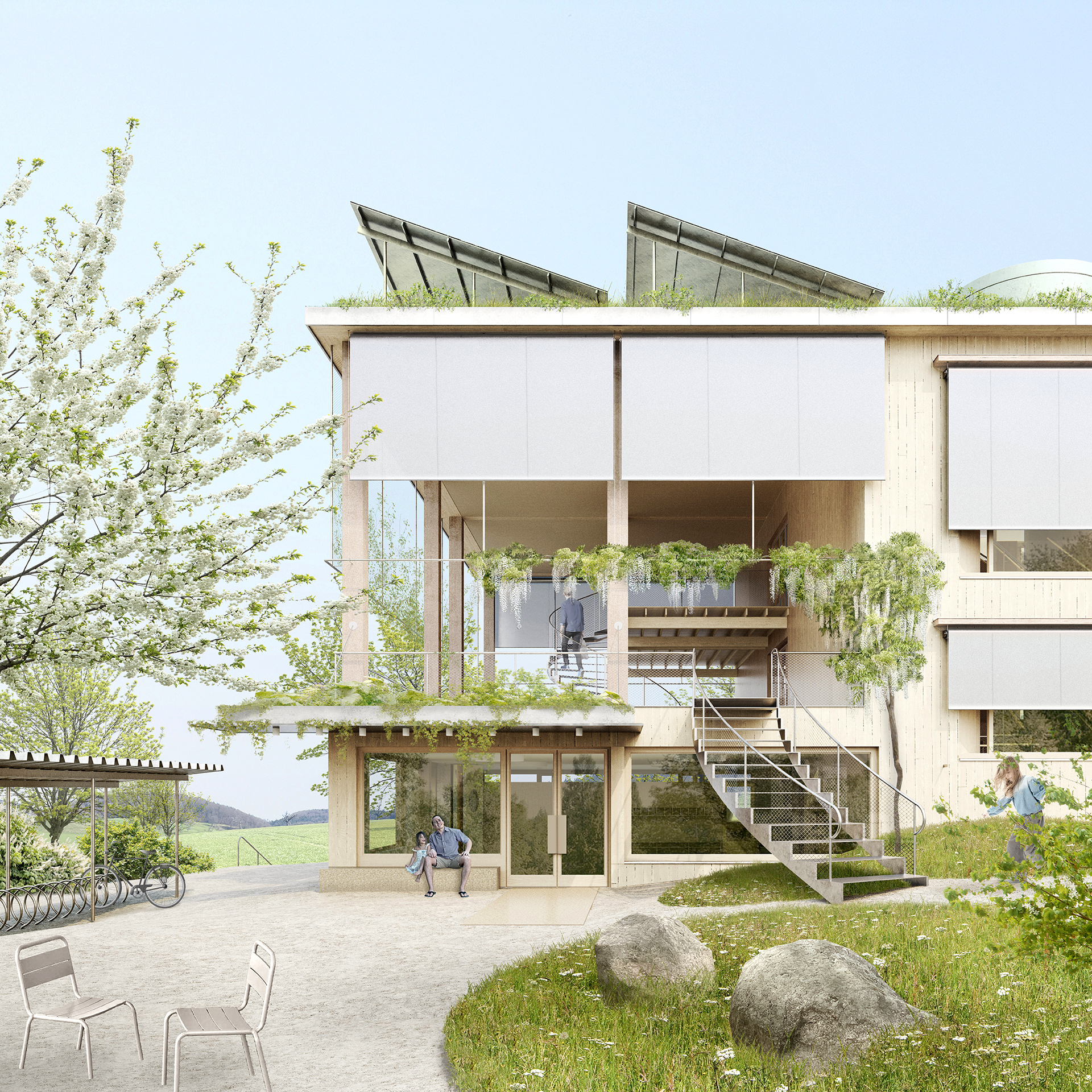
In Gelterkinden, in the canton of Basel-Landschaft, this strategy has been unfolding for months. On 26 April, residents will vote on the planning credit for the Hofmatt primary school. The referendum committee that swiftly formed has draped a gaudy, glittering veneer over a timber building of quiet, gentle bearing — a building whose principal offence was to imagine a loggia for children, open to the green of the school grounds. They called it "Luxus-Schulbau": luxury school.
The financial concerns of residents are understandable. The committee cites a financial plan suggesting that municipal debt could rise from the current 31.3 million to 61.1 million francs by 2030. Whatever the precise figure, a community asked to approve a school project of considerable economic weight has every right to ask whether public money is being well spent. It is a legitimate question, and it deserves a serious answer.
The serious answer, however, is not the "Ratio" proposal. Developed in six weeks by a group of former councillors, local entrepreneurs and a civil engineer — no architect among them — it was drawn up after the competition had closed, with the stated aim of overturning its outcome. Its cost estimate of 6.7 million francs is offered with a tolerance of ±10%. Campus Loggia, the winning project, is estimated at 10.8 million with a tolerance of ±25%.
The difference in precision is not a marginal detail. The accuracy of a cost estimate is a direct indicator of how far a project has been developed. A tolerance of ±25% is typical of a competition entry not yet worked up to execution stage — honest and appropriate at that point. A tolerance of ±10% presupposes a bill of quantities, detailed drawings, an executive specification. But is that really what exists here? On what basis is such categorical precision being claimed?
There is a still more fundamental objection. "Ratio" takes the winning project, strips it of every architectural quality and reduces it to a bare distribution diagram, sacrificing every spatial decision on the altar of a notional functionalist efficiency. A richer and more rigorous concept might serve better here: Suffizienz — a German term that resists easy translation, but captures something closer to measured adequacy than mere sobriety. It does not mean doing less in quantitative terms, but doing what is necessary in a way that holds up over time. Avoiding waste not only of immediate resources, but of future adaptation, corrective maintenance, forced transformation. An open loggia, a threshold space, a spatial quality that appears to be "extra" may, over the long term, reduce the need for additional floor area, improve daily use and extend the social life of the building. Read across time rather than fixed to the initial estimate, Suffizienz leads to the opposite conclusion from the committee's: not the elimination of every apparent excess, but the construction of an equilibrium between cost, use and duration.
It leaves a bitter taste to see professional work challenged with the confidence of those who believe they know better — those who draw an absurd equivalence between six weeks of voluntary effort and three years of qualified process. The Gelterkinden competition was no aesthetic caprice: it was an open procedure under SIA standards, with twenty-three participating teams, an independent jury and a unanimous recommendation. To claim that "Ratio" is an equivalent alternative is not only to diminish an entire chain of professional work — it is to appoint oneself the final judge of a verdict already reached. Are we to understand, then, that architects, specialists and the public authority itself are wholly incapable? The clarity of the winning project, which carried its central proposal in its very name, suggests otherwise.
It should also be noted that a No vote on 26 April does not deliver "Ratio". The authors themselves were subsequently compelled to clarify that their proposal "should not be understood as a direct counter-project currently put to the vote." And yet it remained online, complete with renderings, floor plans and a detailed timeline — not to be built, but to be seen, to sustain a certain ambiguity. What a No vote delivers, instead, is the cancellation of all work completed to date, a new mandatory public procurement procedure — Swiss procurement law does not permit the direct award of a commission of this scale without a tender — and an unavoidable restart cost, compounded by construction inflation in the interim. The concrete result would be years without the building: and for something that will not be built, a great deal has already been spent — in money, and in democratic process. This is not an architectural argument. It is arithmetic.
What is happening in Gelterkinden is not an isolated case. It is a pattern. In the same period, in Schaffhausen, the SVP tabled a motion calling for the abandonment of SIA architectural competitions, on the grounds that they are costly, elitist and slow. In Gelterkinden the attack is on a single project. In Schaffhausen on the instrument itself. But the direction is the same: to progressively narrow the space in which quality can be independently measured, before it becomes binding on public expenditure.
And this is not the only open front. In Ticino too, several referendums have cut short public projects of genuine utility — and the question always arises: why do these objections surface only after the award, never before?
What the committee contests is not only this project, but the very principle that a municipality should invest in quality school buildings. The rhetoric of "luxury" implies that any school exceeding the bare minimum is a waste. That is a legitimate position in a democracy — but it should be recognised for what it is: an explicit choice to reduce the ambition of public education infrastructure, and to diminish the value that collective buildings acquire when they become common goods. A public competition is a democratic guarantee: the mechanism by which a community ensures that collective decisions are not delegated to the cheapest option or the mood of the moment, but to a process that is verifiable, open and independent. To abandon it — or to delegitimise it after the fact — is not a saving. It is a retreat.
The competition, to borrow from Winston Churchill's celebrated judgement on democracy, is the worst form of project selection — except for all the others that have been tried.
Primary school Hofmatt, Gelterkinden
Client: Comune di Gelterkinden
Team partecipants: 23
Procedure: open design procedure for architecture and landscape architecture
Technical jury: Andreas Galli (presidente), Jan Krarup, Anna Jessen, Pascal Gysin, Céderic Bachelard (supplente)
Client's jury: Martin Rüegg, municipal councillor (education, culture/associations, sports, library); Doris Hunziker, vice principal of the Gelterkinden primary school; Christoph Belser, municipal councillor (public buildings), Gelterkinden; Pascal Bürgin, technical office (alternate)
Evaluation: June – July 2023
1° rank / 1° prize: Atelier Amont, Basilea
Relazione della giuria su competitions.espazioum.ch: Projektwettbewerb Primarschule Hofmatt Gelterkindenerb
2° rank / 2° prize: Atelier Schloo, Zurigo
3° rank / 3° prize: Morger Partner Architekten, Basilea
4° rank / 1° purchase: op-arch, Zurigo
5° rank / 4° prize: Alessandro Luraschi Architekten, Zurigo