

Rammed Earth: potential of the history
From historic earthen architecture to contemporary experimentation, rammed earth is re-emerging as a low-carbon, circular building material. Studio Boltshauser explores how innovation, prefabrication, and new construction methods can redefine its role in the architecture of the future.

Testo in italiano al seguente link
Earth as a building material is available almost everywhere in the world and is also easily mouldable. Humans have built structures with earth for thousands of years, in regions ranging from South America and Africa to South-East Asia and even Australia.1 Earth construction has a rich history in Europe too. The research project «Terra [In]cognita»2 discovered a variety of earth construction techniques in almost every European country. Studio Boltshauser’s investigations at the Swiss Federal Institute of Technology in Zurich (ETHZ) into earth construction are driven by what the remarkable durability of historic examples in Central and Western Europe as well as Morocco can teach us about construction today.
Traditional rammed earth construction
In the 17th century, merchant families involved in the linen trade relocated their production from St. Gallen to rural villages in eastern Switzerland, where they were not restricted by the regulations that governed the weaver’s guild in the nearby city. They built residential buildings and manufactories, some of them were built with rammed earth. Subsequently, the village of Hauptwil and its surroundings became a hub for earth construction, with many schools, residential buildings and factories being built with the same technique. It is not recorded why they chose this method, but at that time it offered clear advantages in terms of cost and fire resistance. The merchant families most likely learned about it through their business relations in southern France,3 where, in the Rhône-Alpes region, many rural buildings were built with rammed earth, with the oldest
examples dating back to the 13th century. In the 18th century, rammed earth pioneer François Cointeraux sparked wider interest in both the material and what he termed
«the art of rural construction». Writings from that period show how important and widely used rammed earth construction was at the time: agricultural buildings, factories, residential buildings and even churches or castles were constructed from it. The tradition only declined at the end of the 20th century, due to a loss of knowledge during the two world wars and the widespread adoption of cement in construction.4
The south of France shares its rich history of earthen construction with the Iberian Peninsula: earthen techniques spread across national borders and show how the material and method can be adapted to different geographic and climatic characteristics. In Spain, for example, it was common to combine earth with additional materials – adding lime or gypsum to the mixture to stabilise it – with the choice of additives depending on regional availability.
Alongside rural buildings, the Iberian Peninsula has a rich history of military buildings constructed in rammed earth,5 whose history is closely linked to the arrival of the first Moors in the early 8th century. They disseminated their knowledge of rammed earth construction through written works and manuals, as well as through the citadels and watchtowers they built. Earth construction remained relevant long after the Christian conquest of the Moorish territories, and only in the 19th century was it replaced by brick construction.6
The history of rammed earth on the Iberian Peninsula led us to follow its traces back to North Africa. On seminar trips to Morocco, we visited Kasbahs and Ksur in the Atlas: these residential houses and settlements are well adapted to the local climate, with earth serving as a thermal storage for excess heat. Morocco, however, has a rich history of earth construction beyond these well-known and often visited buildings. The origins of the technique can be traced back to antiquity and the Middle Ages, when city walls were built with rammed earth. In cities, collective granaries were built as multilevel, vaulted spaces to hold grain and assure market stability in lean times, based on
rural forerunners constructed from local material in the Atlas to hold grain and other valuables.7
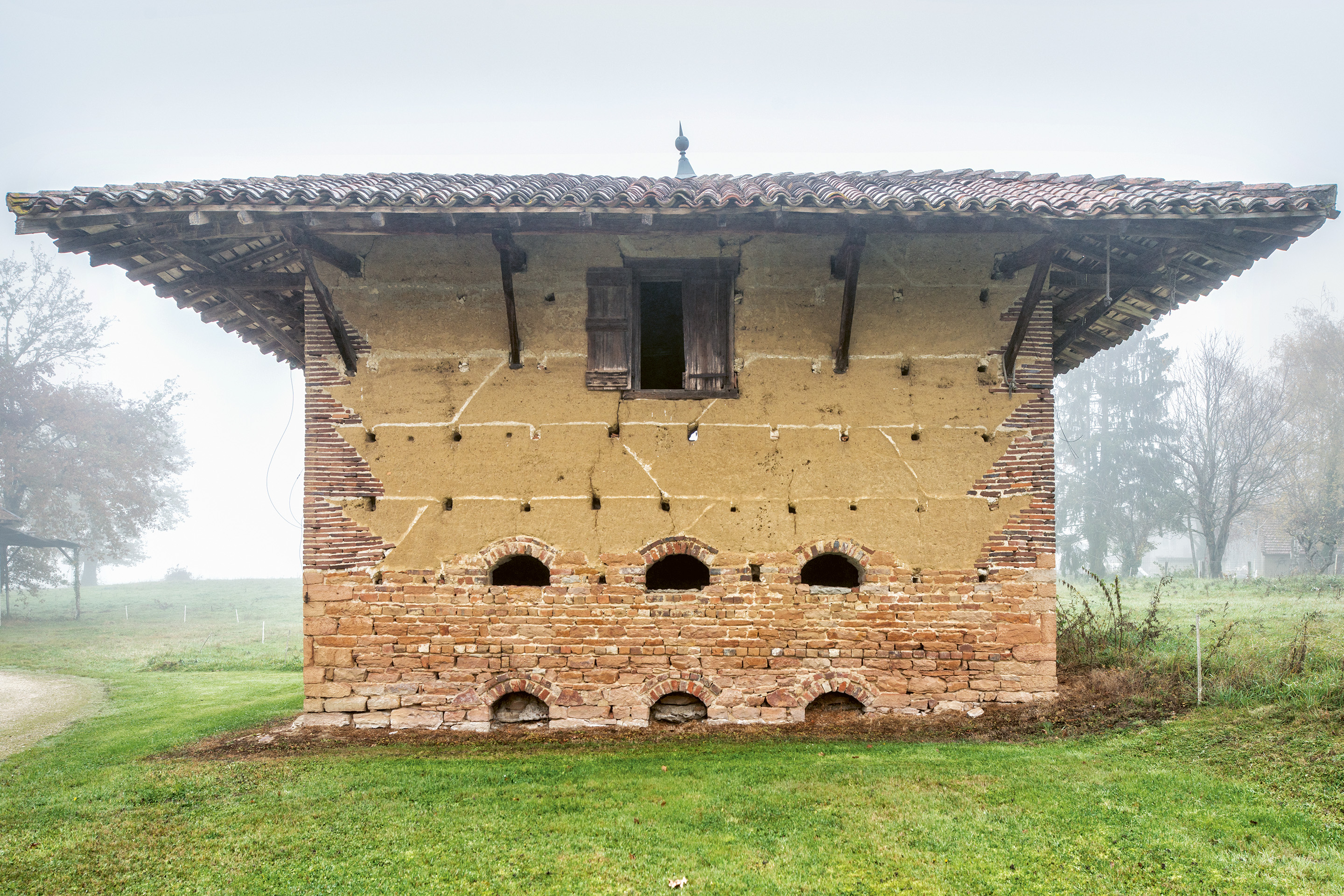
These structures teach us several lessons, regardless of geographic and climatic conditions. Those that have survived for decades or even centuries share common protective measures designed to prevent the earth construction from coming into contact with water, thus avoiding erosion or deterioration. This can be observed particularly well in the Coissat cattle shed, built in France in 1844 (fig. 2): its large, overhanging roof protects the structure from rain; the stone plinth prevents water from seeping into the rammed earth and helps to keep it stable; clinker stones protect the corners from wear and tear; and the lime between the layers of rammed earth prevents moisture from entering while also acting as an «erosion brake», slowing down the flow of any water that reaches the wall. Similar measures – slightly simpler owing to the warmer climate – can be observed in rammed earth buildings in Morocco. On the Iberian Peninsula, protecting the rammed earth led to various techniques, such as gypsum waves or clinker inlays. Thanks to these measures, rammed earth structures have an exceptionally long lifespan and, at the end of their service life, can be easily recycled: the material can be broken up and reused in other structures, or simply returned to the soil without polluting the environmen
Challenges in adopting rammed earth in today’s construction
Although we can learn a great deal from historical buildings, it is often challenging to apply these lessons to current construction practices. Rammed earth is still processed in essentially the same way as in traditional construction methods: the mixing ratios, the labour-intensive ramming and the long drying duration have barely changed. These techniques need to be developed further to achieve wider adoption, as there is tremendous potential – in Switzerland, for instance, excavated soil is available in abundance, yet today it is often transported over long distances only to end up in landfills. Improving current processes to prepare earth quickly and easily for reuse is therefore a pressing necessity.8 Many of the barriers to implementing earth construction are not specific to earth buildings: missing fiscal incentives, a lack of professional training or experience, and insufficient scientific data are challenges common to other sustainable building materials as well. Those specific to earth construction include the variability and unpredictability of the raw material, as well as its comparatively low material strength and reduced durability when exposed to moisture.9
From tradition to the Ofenturm project
A contemporary project that explores the potential of earth construction is the Ofenturm, the Kiln Tower, in Cham
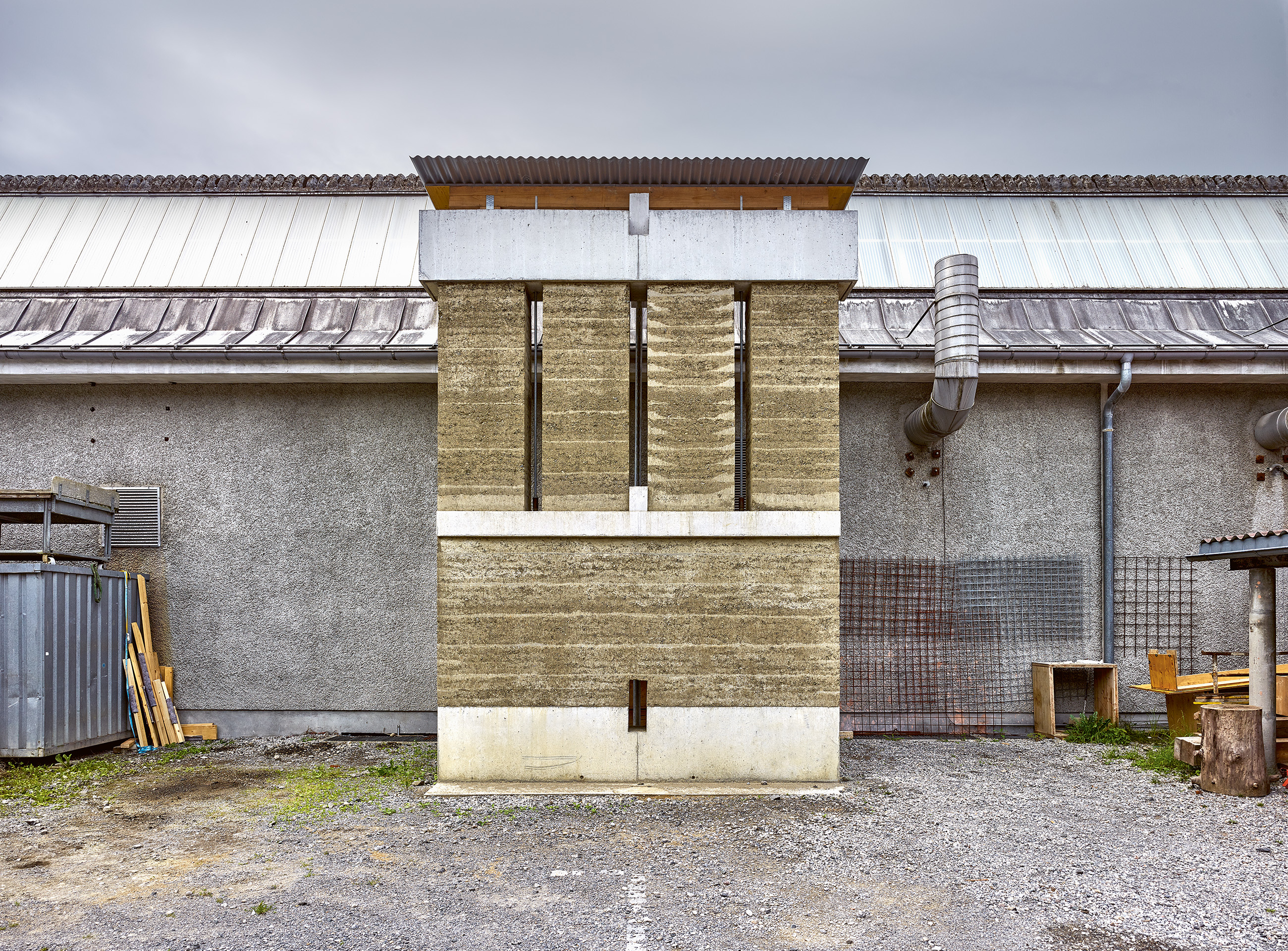
(fig. 4). Its conception began during Roger Boltshauser’s guest professorship at the École Polytechnique Fédérale de Lausanne (EPFL), where design students explored ways of translating the findings of historical research into contemporary design and building processes. From the outset, the focus was on developing hybrid constructions and exploring their architectural potential, with prefabrication always in mind. The students designed an exhibition pavilion for the Stiftung Sitterwerk in St. Gallen, one of which was selected for realisation. The design by Yannick Claessens and Mattia Pretolani consisted of rammed earth elements framed by horizontal concrete elements, making it possible to post-tension the structure. During a summer school in 2017, students built a mock-up of the façade in place (fig. 3).
The mock-up helped clarify how rammed earth can be post-tensioned. Two threaded rods, positioned between the horizontal earth elements, transmitted the post-tensioning force to the rammed earth, while the behaviour of the wall sections was monitored to gain comparative reference values of material properties such as compressive strength and shrinkage. The aim was also to test the practicability of post-tensioning rammed earth: calculations and tests showed that, compared to a non-post-tensioned equivalent, the mock-up could absorb 70 per cent higher wind loads.
In the autumn semester of 2017, Studio Boltshauser taught at the Technical University of Munich (TUM), with the aim of building on the knowledge gained from the
Sitterwerk mock-up. Students designed viewing towers for the Brickworks Museum in Cham, with a key design task being to minimise impact on the museum site and the surrounding protected landscape. Following the semester, three student projects were selected and further developed into a single building project. Robert Gentner and Regina Pötzinger proposed a long, slender tower made of rammed earth elements with an internal timber structure to hold them in place; their idea was combined with the kiln proposed by Miklós Doma and Philipp Lanthaler and the careful placement in the landscape suggested by Sophia Brellenthin and Moritz Penker. The architecture office Boltshauser Architekten in Zurich subsequently adapted and further developed the project to meet building regulations.
In the summer of 2019, the building elements were prefabricated within six weeks. The earth construction company Lehmag produced the elements with the help of students from ETHZ, TUM and other universities,
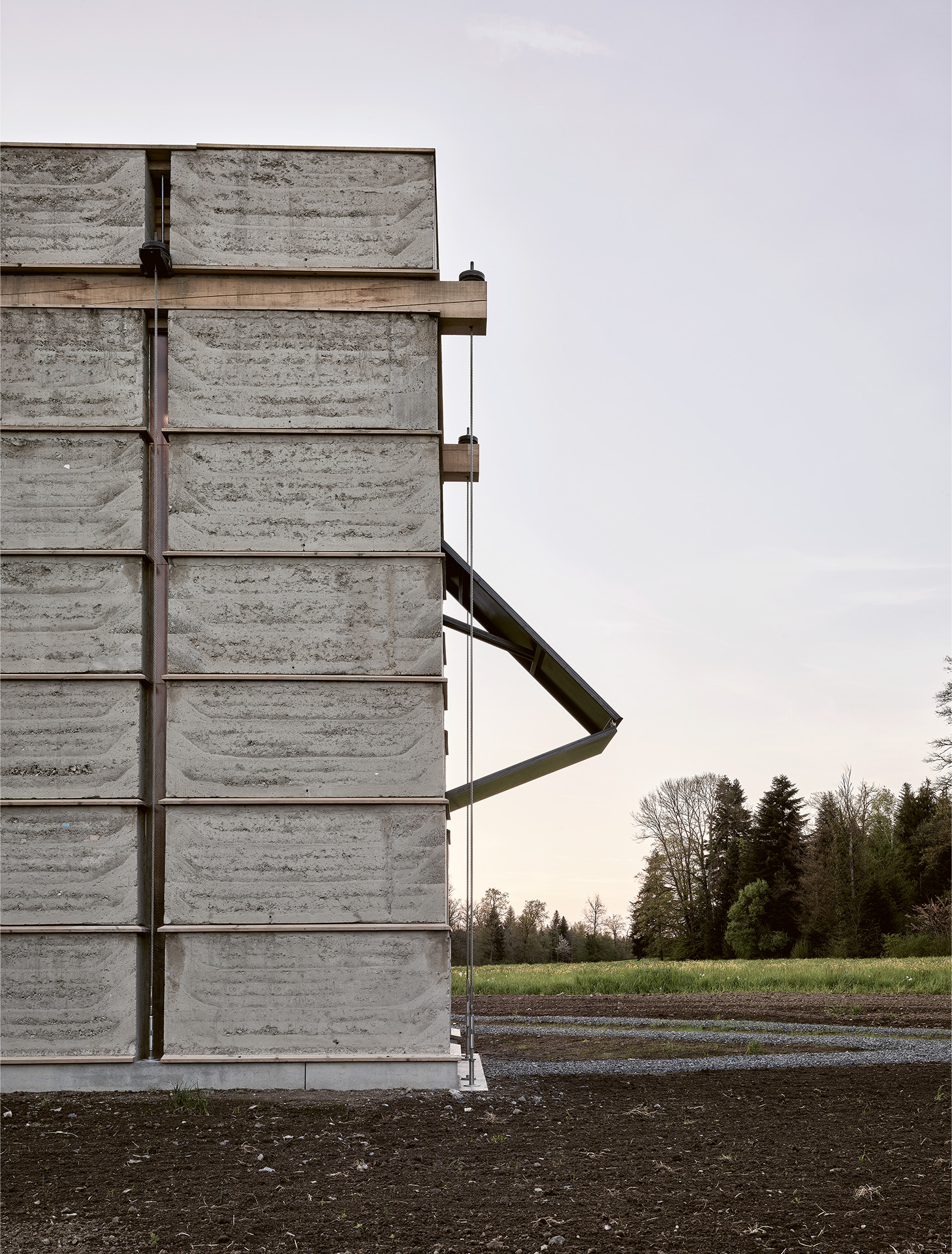
who, working in three teams, manufactured 91 elements in total. One particular innovation illustrates how technical advancements in production can help create a new architectural language. While building with prefabricated earth elements is not a new concept, the joints between the blocks are usually closed and retouched manually, eliminating all visible traces of the individual elements. Here, however, they become the focus of a new architectural expression: the elements were rammed onto timber base plates which, though normally used only to produce, store and transport the elements, were integrated into the final wall. A weather drip was installed on the plates to protect the earth from erosion (fig. 4).
A wooden roof forms a rigid structure that distributes tension forces evenly to the wall, while at the base of the building, structural steel elements anchor the ropes directly into the prefabricated concrete plinth. Shortly before completion in spring 2021, the post-tensioning was set to 40 kN as calculated by the Seforb engineering office. Since then, integrated load cells have recorded the post-tensioning forces: initially they dropped sharply due to creep, but after around 100 days the post-tensioning stabilised at approximately 25 kN, subsequently dropping to around half of the originally applied load. Thereafter, the building settled very slowly and the post-tensioning force took permanent effect. In April 2024, all tension ropes were readjusted to around 50 kN, and measurements taken from that point onwards aim to investigate the impact of re-tensioning on the structure.
The idea of circularity was also critical to the design. The strip footings and base plates are prefabricated reinforced concrete components that are merely screwed together, and the separately built-in post-tensioning system can be easily removed, allowing the rammed earth elements to be dismantled. Essentially, the kiln tower’s entire load-bearing structure will be possible to reuse.
Further research
The ideas explored in the Kiln Tower represent only some of the many possibilities that hold great potential, but which also require further research. Current research at Studio Boltshauser focuses on the horizontal reinforcement of rammed earth: eight synthetic reinforcement grids, as well as a bamboo grid, were tested in small sample cubes, with four cubes produced for each material. Each cube consisted of two layers of rammed earth, with the bottom layer reinforced with a grid, and the dried samples were then subjected to a compression test. First results show that most reinforcement grids increase the compressive strength of the earth cubes, with grids featuring thicker meshes and thinner fabric tending to have the greatest impact. In addition to validating these results through further tests, the research currently focuses on large-scale testing to assess how reinforcement influences material strength at a greater scale (fig. 1).10
Studio Boltshauser is also a research partner within the «Think Earth» Regenerative Construction Innosuisse Flagship Project, which aims to improve our understanding of earth-based building materials and to combine earth with wood in hybrid building components. The project covers the entire process: excavation, mixing, placing and removing the formwork, drying, transporting to the site, and finishing – with the goal of establishing a streamlined working model for earth-based building materials.11 The entire process must become much faster, more efficient and financially feasible to enable a true leap in scale.
Notes
- Hilgert, Felix. Bauen mit Stampflehm. Detail Praxis, 2025, 24.
- Il progetto di ricerca è stato sostenuto dal Programma Cultura 2007-2013 dell’Unione Europea. Il risultato è una pubblicazione che ha riunito autori provenienti da 27 paesi europei. Correia, Mariana, Letizia Dipasquale, & Saverio Mecca. Terra Europae. Earthen Architecture in the European Union. ETS, 2011 file:///Users/online/Downloads/C10_2011TERRAEUROPAE.pdf
- Menolfi, Ernest, & Janina Flückiger. «Rammed Earth Construction in German-speaking Switzerland». In Pisé – Rammed Earth. Tradition and Potential, Boltshauser, Roger, Nadja Maillard, & Cyril Veillon, Triest, 2019., 100–151.
- Witry, Marlène, & Hubert Guillaud. «Rammed earth construction in the Rhône-Alps region». In Pisé – Rammed Earth. Tradition and Potential, Boltshauser, Roger, Nadja Maillard & Cyril Veillon, Triest, 2019, 18–81.
- Correia, Mariana, Jacob Merten, Fernando Vegas, Camilla Mileto, & Valentina Cristini. «Earthen architecture in Southwestern Europe: Portugal, Spain and Southern France». In Terra Europae. Earthen Architecture in the European Union. ETS, 2011, 71-75.
- Vegas, Fernando, & Camilla Mileto. «Earth construction in the Iberian Peninsula». In Pisé – Hybrid Constructions. Tradition and Potential. Boltshauser, Roger, Mirjam Kupferschmid, Janina Flückiger, & Marlène Witry, Triest, 2026, 72-105.
- Naji, Salima. «The history of earth construction in Morocco». In Pisé – Hybrid Constructions. Tradition and Potential. Boltshauser, Roger, Mirjam Kupferschmid, Janina Flückiger, & Marlène Witry, Triest, 2026, 28-47.
- Hilgert, Bauen mit Stampflehm, 14-15.
- Morel, Jean-Claude, & Rabia Charef. «What are the barriers affecting the use of earth as a modern construction material in the context of circular economy?» IOP Conference Series: Earth and Environmental Sciences 225, (2019): 012053 https://doi.org/10.1088/1755-1315/225/1/012053
- Jourdan, Rémi, Lukas Vögeli, Gregory Bianchi, Felix Hilgert, & Roger Boltshauser. «Rammed Earth: Improvements in Material Strength Through Mixture Reliability and Reinforcement Grids». In Sustainable Built Environment Conference 2025 Zurich – Extended Abstracts (2025) https://doi.org/10.3929/ethz-c-000785715
- «Think Earth» Regenerative Construction – Innosuisse Flagship Project, https://thinkearth.ethz.ch/en/the-project.html, retrieved, 2025.