

Construction of Future(s)
How is the architecture, engineering and construction sector being transformed by its convergence with artificial intelligence, extended reality and robotics? Beyond technological innovation, the future of the built environment emerges from the interaction between data, resources, processes and human needs.
Testo in italiano al seguente link
Architecture, engineering, and construction (AEC) are shaped by more than technological innovation alone: housing needs, labour and demographics, economic pressures, regulation, culture, and identity set the real constraints and aspirations of the built environment. Yet technology remains vital – not to drive the agenda, but to augment our agency to materialize these aspirations.
The Future of Construction symposium was created to examine this relationship between changing capabilities and the forces that give them meaning. Initiated in 20221 at the Swiss Federal Institute of Technology in Zurich (ETHZ) by members of the National Centre of Competence in Research Digital Fabrication (NCCR DFAB)2 and the Center for Augmented Computational Design in Architecture, Engineering and Construction (Design++),3 it continued expanding this discourse in Munich (2023)4 and Mendrisio (2024).5 In 2026, the symposium returns to Zurich under the theme Construction of Future(s)6 – a deliberate plural that rejects a single, linear storyline and embraces the plurality of factors and methods that shape what we build.
This trajectory reflects a broader shift at ETHZ. Over 12 years, NCCR DFAB explored the transformative potential of digital fabrication and robotics in construction, while recently Design++ has extended the lens to how artificial intelligence, data, and immersive media augment design thinking and collaboration. In that context, the convergence of AI, extended reality (XR), and robotics marks a threshold moment: continuous loops across thinking, perceiving, and making begin to connect design, construction, and operation. When this works well, technology becomes less a spectacle and more a quiet enabler, making room for human priorities to lead. The symposium frames this shift with four questions.
Why does technological convergence matter?
Creating the built environment is often fragmented: design intent, structural reasoning, and construction execution live in separate tools and documents. The convergence of AI, XR, and robotics helps experts bridge these gaps. An example of this is Semiramis,7 where designers define performance goals – rainfall capture and sun exposure – and the algorithm generates spatial arrangements for robotic fabrication. Design alternatives can be explored in an immersive, augmented-reality setup, while four robot arms assemble the hanging garden. The same convergence applies not only to building the new, but also to caring for what already exists. Heritage++ develops an «immersive co-pilot» for Lausanne Cathedral that overlays a 3D model with structural and material information – down to the age, composition, and damage state of individual stones –to guide inspection and decision for repair.8 Together, these projects point to a mode of practice in which perception, analysis, and material action are coordinated within a single workspace.
Why collaborate with machines?
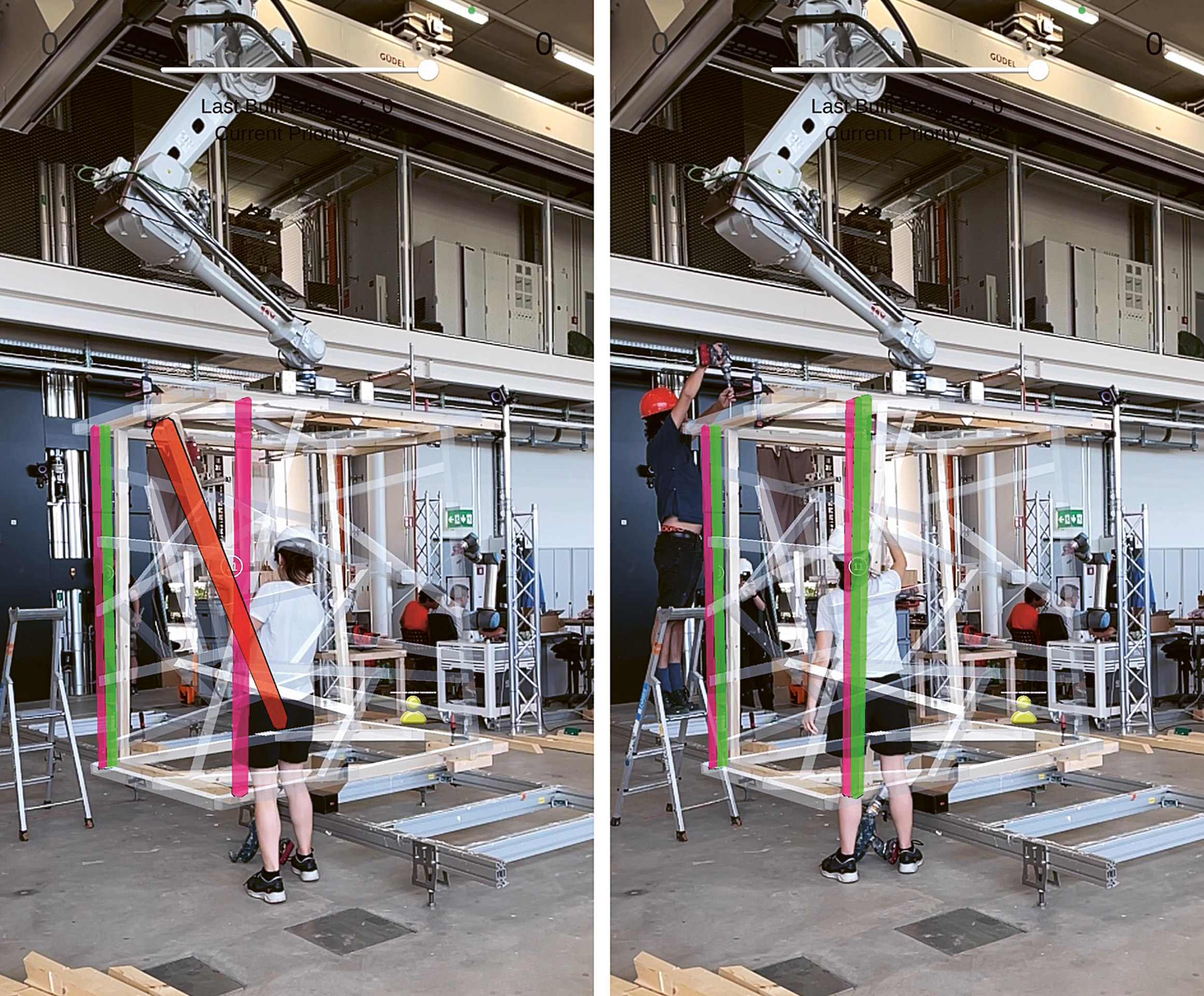
While AI manages computational complexity, XR bridges the gap between machine precision and human intuition. The project Interactive Digital Twins9 exemplifies this by integrating motion capture with XR during complex timber assembly. Rather than following static drawings, workers receive real-time, holographic guidance that adapts to their movements and the specific timber elements in hand (fig. 1 and 2). This coupling helps them navigate material irregularities, reducing errors and accelerating the learning of demanding tasks.10 Collaborating with machines helps human agency move from strictly following instructions to steering goals, values, and trade-offs in real time.
What, where, and how to build in a resource-limited world?
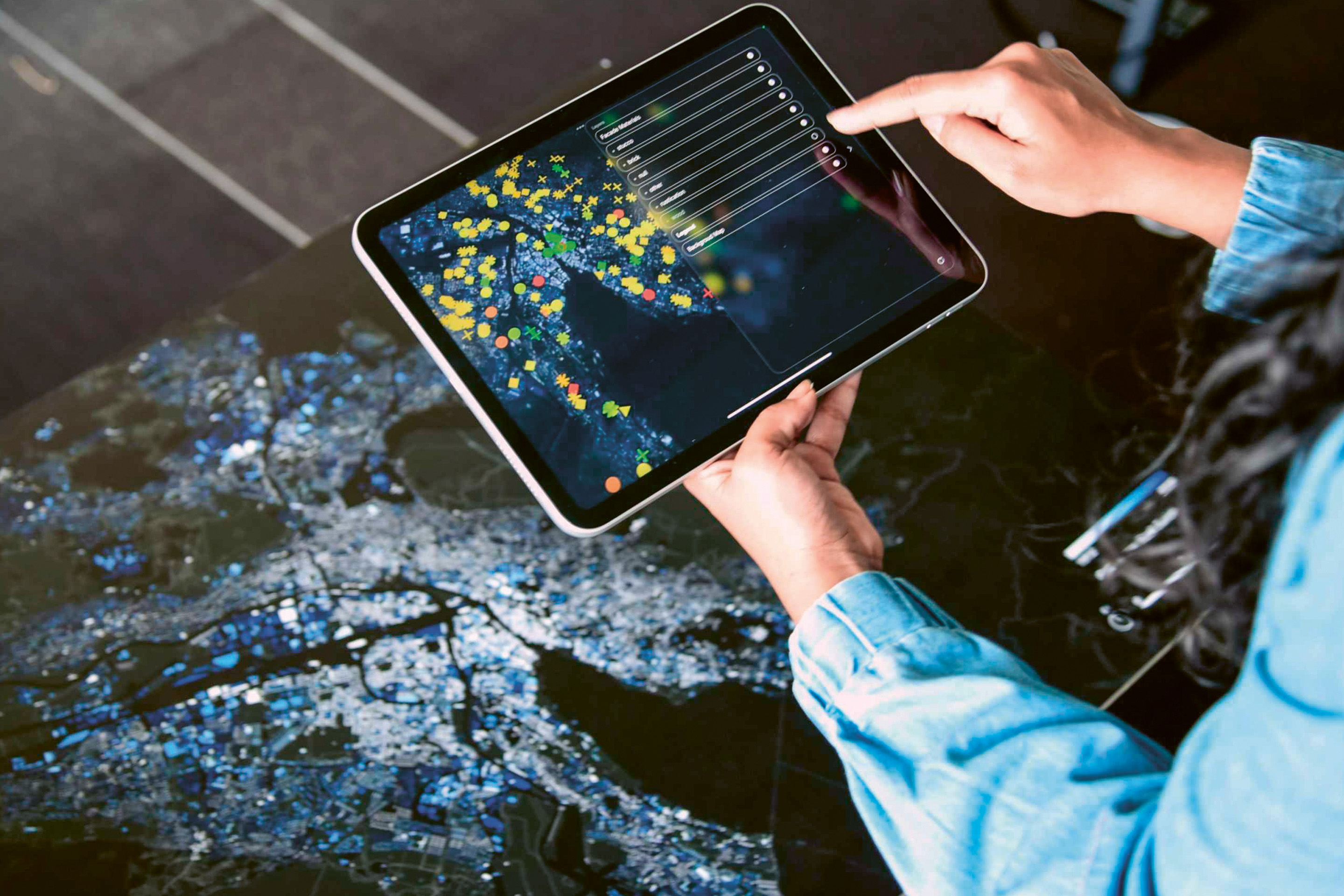
Resource scarcity is pushing construction from extractive, «new-build» optimization toward circular, stock-aware strategies. Research on Global Material Cadastres for Circular Construction11 enables this by re-envisioning the city as a materials depot (fig. 3). Using street-view imagery and computer vision, these tools detect and classify facade materials at the urban scale, creating a resource cadastre — a spatial inventory of potentially reusable components prior to demolition. Complementing this, the 7DayHouse framework shows how to design for urban densification within such constraints.12 It uses graph-based evolutionary algorithms13 and generative AI for layout planning14 to generate thousands of modular floor plans optimized not just for space, but for specific, limited material kits. These approaches expand the unit of design from the solitary object to dynamic systems of availability, reuse, and supply chain integration.
Why change how we practice?
Current practices in AEC are trapped in disconnected silos that fragment data and liability and stifle systemic innovation.15 The convergence of AI, XR, and robotics makes those separations increasingly artificial. Once the same evidence can travel across phases, we need workflows and responsibilities that can travel with it.
Research on robotic perception at the construction site demonstrates this shift. Using robust on-site localization, mobile robots can now navigate dynamic environments and align «as-built» conditions with «as-planned» BIM-based digital twins.16 This replaces static handovers with a synchronized state of truth, so teams can act on deviations while change is still possible. Accountability shifts from defending deliverables to owning evidence-based decisions – reducing the liability friction that often blocks cross-phase innovation. This matters because circular reuse, low-carbon substitutions, climate-resilience upgrades, or new business models only work when decisions and responsibilities can be coordinated across phases.
Conclusion
Across the four questions, the convergence of AI, XR, and robotics is transitioning AEC from blueprint-driven, fragmented workflows to adaptive, data-rich practices. This shift establishes a feedback loop between thinking, perceiving, and making, where technology augments humans rather than dictates solutions. Ultimately, this allows cultural, socio-economic, and ecological aspirations – rather than technical limitations – to guide the construction of diverse, resilient futures.
Notes
- «Future of Construction 2022», https://2022.futureofconstruction.net
- «NCCR Digital Fabrication», https://dfab.ch/
- «Design++», https://designplusplus.ethz.ch/
- «The Future of Construction 2023 symposium», https://2023.futureofconstruction.net
- «Future of Construction 2024», https://2024.futureofconstruction.net/
- «Construction of Future(s)» Future of Construction 2026, futureofconstruction.ethz.ch/theme.html
- Salamanca, Luis, Aleksandra Anna Apolinarska, Fernando Pérez-Cruz, & Matthias Kohler. «Augmented Intelligence for Architectural Design with Conditional Autoencoders: Semiramis Case Study». In Towards Radical Regeneration, Gengnagel, Christoph, Olivier Baverel, Giovanni Betti, Mariana Popescu, Mette Ramsgaard Thomsen, & Jan Wurm. Springer International Publishing, 2023 https://doi.ormoveg/10.1007/978-3-031-13249-0_10;
«Robots Build New Hanging Gardens», ETH Zurich, 2021, https://ethz.ch/en/news-and-events/eth-news/news/2021/11/robots-build-new-hanging-gardens.html- Patankar, Yamini, & al. «Heritage ++, a Spatial Computing Approach to Heritage Conservation», RILEM Technical Letters 9 (2025): 50–60 https://doi.org/10.21809/rilemtechlett.2024.202.;
Maia Avelino, Ricardo, Wenqian Yang, Anjo Weichbrodt, John Ochsendorf, & Robert J. Flatt. «Augmented Reality for Structural Inspection of Historic Monuments: The Case of Lausanne Cathedral» International Journal of Architectural Heritage 0, no. 0 (2025): 1–16, https://doi.org/10.1080/15583058.2025.2578318;
Vogel, Benedikt. «AI and Extended Reality Help to Preserve Built Cultural Heritage» ETH Zurich, (2025) https://ethz.ch/en/news-and-events/eth-news/news/2025/11/ai-and-extended-reality-help-to-preserve-built-cultural-heritage.html- Moisi, Alexandra, & al. «Interactive Digital Twins: Integrating XR and Motion Capture for Timber Assembly». Proceedings of the ACM Symposium on Computational Fabrication, New York, USA, SCF ’25, 2025, 1–18 https://doi.org/10.1145/3745778.3766661
- Moisi, Alexandra, & al. «Interactive Digital Twins: Integrating XR and Motion Capture for Timber Assembly». Proceedings of the ACM Symposium on Computational Fabrication, New York, USA, SCF ’25, 2025, 1–18 https://doi.org/10.1145/3745778.3766661
- Raghu, Deepika, Martin Juan José Bucher, & Catherine De Wolf. «Towards a ‘Resource Cadastre’ for a Circular Economy – Urban-Scale Building Material Detection Using Street View Imagery and Computer Vision» Resources, Conservation and Recycling 198 (2023): 107140 https://doi.org/10.1016/j.resconrec.2023.107140 ;
Armeni, Iro, Deepika Raghu, & Catherine De Wolf. «Artificial Intelligence for Predicting Reuse Patterns». In A Circular Built Environment in the Digital Age, De Wolf, Catherine, Sultan Çetin, & Nancy M. P. Bocken. Springer International Publishing (2024) https://doi.org/10.1007/978-3-031-39675-5_4- Savov, Anton. «7DayHouse: Fabrication aware Generative Design». In Back to Bauhaus: Praxisreport 2022, Achammer, Christoph & Iva Kovacic, with TU Wien, 2023 https://repositum.tuwien.at/handle/20.500.12708/177479
- Cao, Jianpeng, Hisham Said, Anton Savov, & Daniel Hall. «Graph-Based Evolutionary Search for Optimal Hybrid Modularization of Building Construction Projects», Journal of Construction Engineering and Management 150, no. 8 (2024): 04024098, https://doi.org/10.1061/JCEMD4.COENG-14687
- Zhang, Hang, Anton Savov, & Benjamin Dillenburger. «MaskPLAN: Masked Generative Layout Planning from Partial Input», Proceedings of the IEEE/CVF Conference on Computer Vision and Pattern Recognition (CVPR), 2024: 8964-8973 https://doi.org/10.1109/CVPR52733.2024.00856
- Hall, Daniel, Afroz Algiers, Teemu Lehtinen, Raymond E. Levitt, Christine Li, & Prithvi Padachuri. «The Role of Integrated Project Delivery Elements in Adoption of Integral Innovations». In Engineering Project Organization Conference 2014, Devil’s Thumb Ranch, Colorado, July 29-31, 2014. Chan, Paul, & Robert Leicht (Engineering Project Organization Society EPOS, 2014).
Hall, Daniel M., Afroz Algiers, & Raymond E. Levitt. «Identifying the Role of Supply Chain Integration Practices in the Adoption of Systemic Innovations» Journal of Management in Engineering 34, no. 6 (2018): 04018030 https://doi.org/10.1061/(ASCE)ME.1943-5479.0000640- Krummenacher, Benjamin, Jonas Frey, Turcan Tuna, Olga Vysotska, & Marco Hutter. «Diffusion Based Robust LiDAR Place Recognition» (2025) IEEE International Conference on Robotics and Automation ICRA, (2025), 9053–59, https://doi.org/10.1109/ICRA55743.2025.11127534;
Vysotska, Olga, Igor Bogoslavskyi, Marco Hutter, & al. «Adaptive Thresholding for Sequence-Based Place Recognition» 2025 IEEE International Conference on Robotics and Automation ICRA, (2025), 2219–25 https://doi.org/10.1109/ICRA55743.2025.11128422