

Pre-manufacturing: Key to scalable, low- carbon architecture
From excavated earth to prefabricated floor slabs: combining timber and rammed earth demonstrates how local materials, automation, and industrial production can drastically reduce construction-related emissions, turning a traditional building method into a scalable low-carbon solution.
Testo in italiano al seguente link
In the construction industry, the discussion on decarbonization is moving beyond operational energy to the embodied carbon in materials and logistics. The United Nations Environment Programme (UNEP) calls for an Avoid-Shift-Improve approach: avoid unnecessary extraction and production, shift to regenerative materials, and improve the carbon footprint of conventional ones.1 Yet despite these clear strategies, the sector remains off track, highlighting both the challenge and the urgency of transforming how we build.
Local and natural materials hold immense sustainability potential, yet their benefits are often limited by on-site variability, labour intensity, and logistical inefficiencies.
In this context, pre-manufacturing in the construction industry is becoming central in solving one of the most pressing challenges of the construction industry: delivering low-carbon, high-performance buildings at scale.
At first glance, timber appears to be an ideal construction material, as it is renewable, locally available, and structurally reliable. It further benefits from prefabrication processes that accelerate construction timelines, reduce material waste, and ensure consistent and repeatable performance. However, timber alone is insufficient to meet the full performance requirements of residential and office buildings. Its inherent limitations, particularly low thermal mass and susceptibility to vibration, constrain its ability to satisfy comprehensive building physics and occupant comfort standards. Adequate thermal and acoustic mass is therefore essential, as it plays a critical role in regulating heating, ventilation, and cooling efficiency, as well as ensuring indoor thermal stability and acoustic comfort.
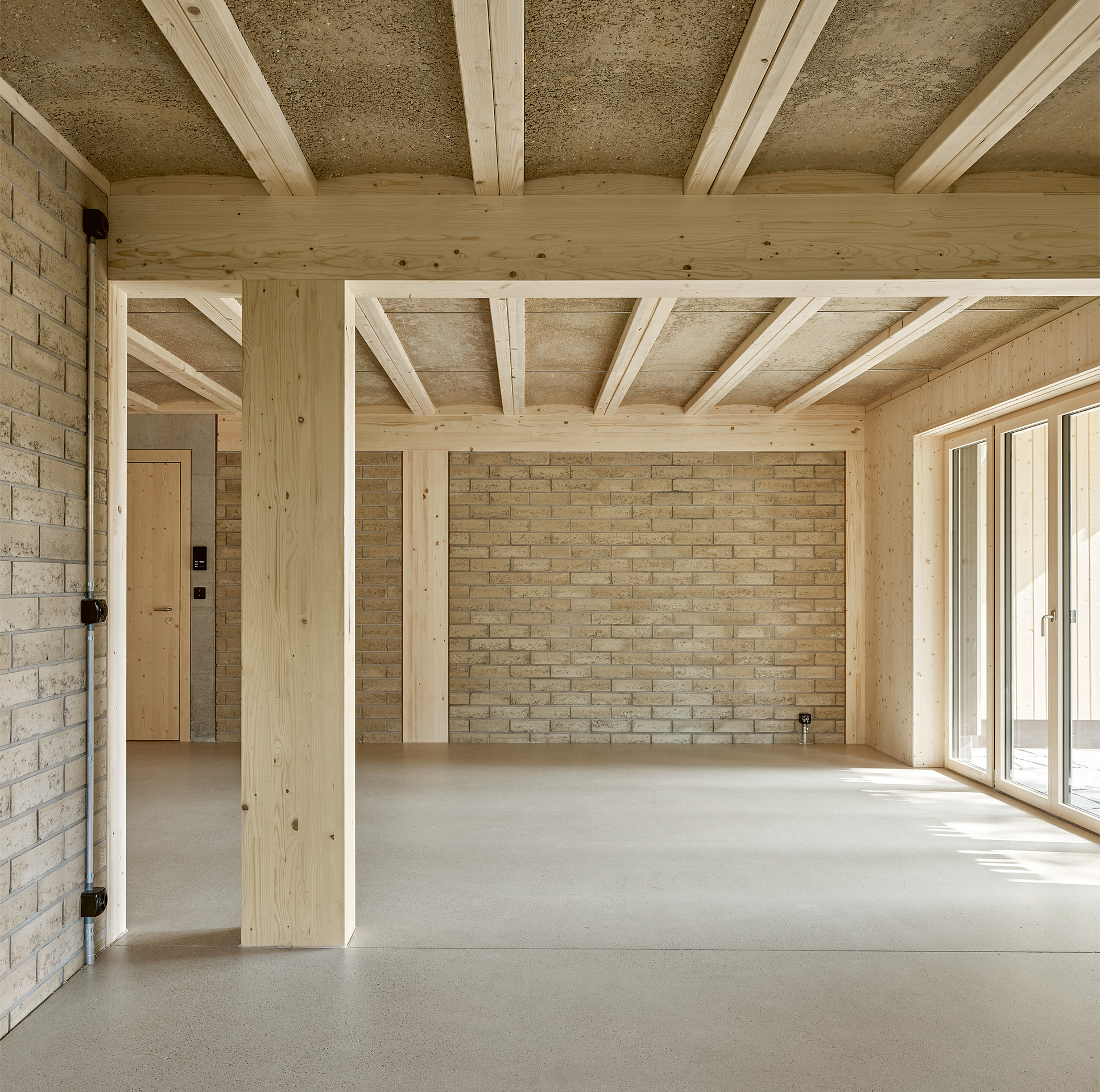
Conversely, rammed earth highlights the dual nature of this transition, presenting both significant challenges and promising opportunities. The material itself possesses valuable properties, including high thermal and acoustic mass, hygrothermal buffering, fire resistance, and exceptionally low embodied energy. Ongoing research and practical applications for example from the Technical University of Munich (TUM)2 and the Swiss Federal Institute of Technology in Zurich (ETHZ)3 demonstrate that timber and earth can work in strong synergy. Combined, these materials complement each other in ways that enhance overall performance while reducing both material consumption and carbon footprint.
Rather than ending up in landfills, excavated earth can be repurposed as slab infill, offering a sustainable alternative. The main challenge, however, lies in scalability. Rammed earth construction remains labor-intensive, and the material is sourced from diverse geological contexts, leading to widely varying properties. This natural variability makes full product standardization difficult to achieve. Rematter demonstrates the feasibility of large-scale structural earth construction without the use of cement stabilizers. The system consists of a prefabricated hybrid slab in which timber beams and panels provide the primary structural framework, while earth is robotically compacted directly into the assembly. This integrated process eliminates the need for disposable formwork and reduces compaction time by approximately 75 %. Experimental testing indicates dry densities exceeding 2100 kg/m³ and compressive strengths greater than 2.0 N/mm², confirming that the achieved level of compaction is sufficient to meet structural performance requirements.4
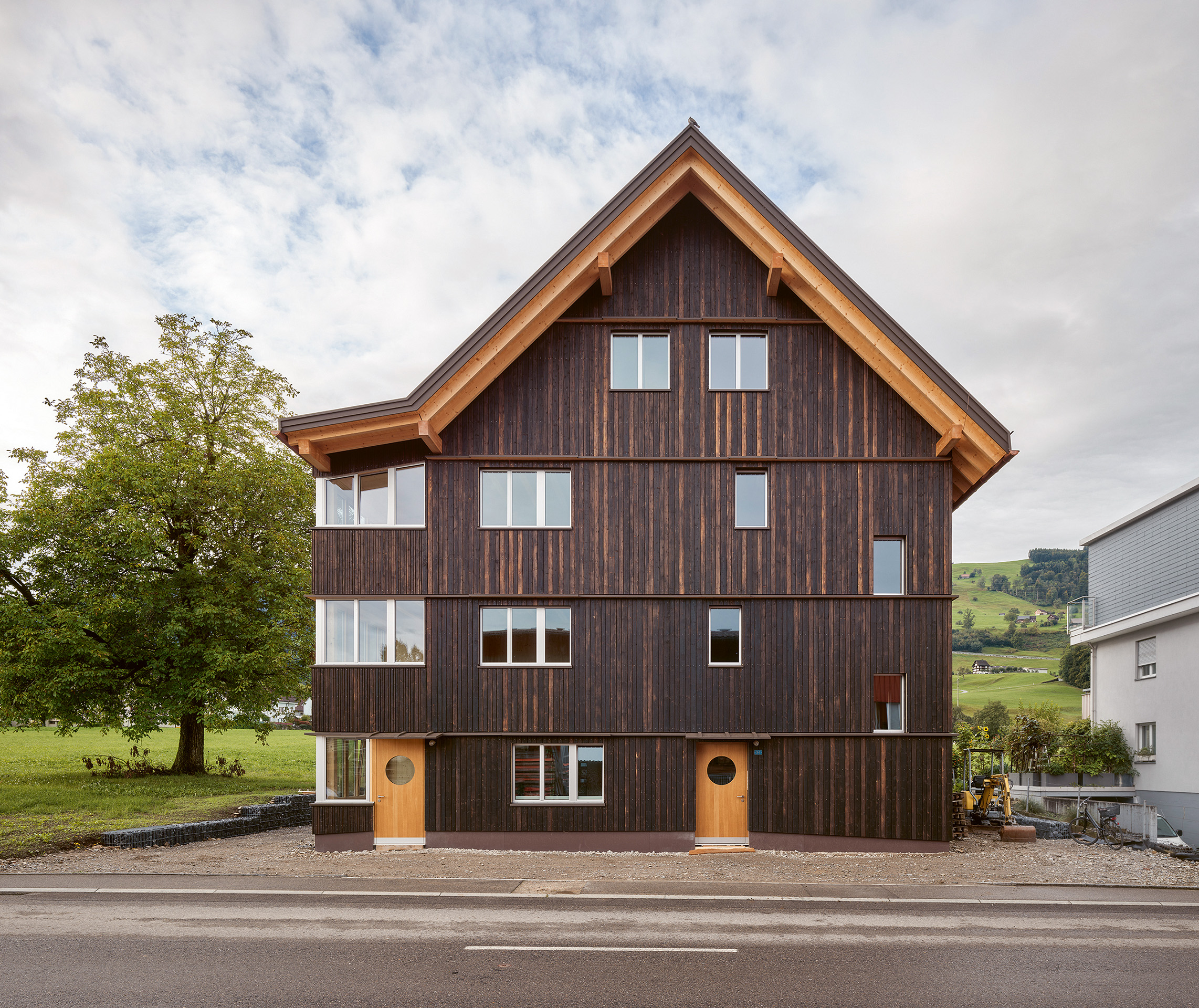
The architecture firm Salathé Architekten demonstrates this approach in collaboration with Rematter. Hybrid earth-timber slabs were manufactured at Rematter’s production facility in Aargau for an office project in Basel commissioned by Zoo Basel. By using earth sourced within a 50-kilometre radius, the system achieves a carbon footprint of approximately 20 % compared to conventional concrete slabs with equivalent load-bearing capacity. This project exemplifies how industrialized production can integrate local materials into high-performance construction at scale.
Without a doubt, industrializing earth-timber systems is not just a technical ambition; it is a systemic challenge that spans material science, logistics, and regulation. Variability remains the first hurdle: earth is inherently heterogeneous, with differences in clay mineralogy, granulometry, and more. Robotics and automation can standardize density and geometry, but source variability still requires rigorous mix of specifications and traceability. Earth demands its own performance metrics: compressive strength, moisture windows, and hygrothermal behavior, validated through extensive testing.
In construction, particularly for residential housing projects, effective sound insulation is a critical concern. According to SIA 181 regulations, impact sound levels must be below 58 dB for minimum requirements, 53 dB for medium, and 48 dB for increased performance standards. Early measurements show that with conventional floor structure the hybrid earth-timber slab can fulfill the increased requirements for impact sound level at a value of 42 dB. Further, the Hybrid floor slabs has a positive impact on vibration behaviour, often underestimated by existing calculation models.5 Without recalibrated standards, designers risk oversizing or adding overly conservative detailing.
Fire safety is another critical consideration, particularly in timber construction. The natural non-flammability of earth provides effective protection for timber and, when properly designed, allows structures to achieve REI60 ratings (R – load-bearing capacity, E – integrity against fire and smoke, I – thermal insulation for 60 minutes of fire exposure).6 REI60 has been successfully demonstrated, with REI90 now within reach for structural components. In addition, the system offers significant carbon savings, as noted previously, up to 80% compared to conventional concrete slabs, although these figures require confirmation through comprehensive life-cycle assessments that account for logistics and end-of-life reuse.
Regulations need to catch up. Lagging norms and standards remain one of the main barriers to market entry for novel and alternative construction materials. Initiatives such as the Innosuisse Flagship project Think Earth aim to address this. The goal of the project is to drive systemic change in the construction industry by developing and testing innovative construction techniques using earth and timber at a large scale. The focus is particularly on interdisciplinary collaboration between academia and over 50 industry partners to enable rapid transfer between research and practical application.
This is not nostalgia. By combining local resources, robotic fabrication, and emerging certification frameworks, earth and timber can be transformed from traditional craft materials into high-performance, low-carbon solutions. The ground beneath us and the technical know-how are ready.
It is time to use them at scale.
Notes
- UNEP. «Building Materials and the Climate: Constructing a New Future». United Nations Environment Programme (2023) https://www.unep.org/resources/report/building-materials-and-climate-constructing-new-future
- Trummer, Julian, & al. «Digital Design and Fabrication Strategy of a Hybrid Timber-Earth Floor Slab», IOP Conference Series: Earth and Environmental Science 1078, no. 1 (2023), https://doi.org/10.1088/1755-1315/1078/1/012062.
- «Think Earth: Regenerative Construction – Innosuisse Flagship Project, Projektbeschreibung», ETH Zürich, https://thinkearth.ethz.ch/.
- Bonwetsch, Tobias, & Linus P. Schmitz. «Automated roduction of Hybrid Earth–Timber Floor Slabs – Scaling up Sustainable Construction», IOP Conference Series: Earth and Environmental Science 1554, no. 1 (2024) https://doi.org/10.1088/1755-1315/1554/1/012067
- Bonwetsch, Tobias, & Linus P. Schmitz. «Automated roduction of Hybrid Earth–Timber Floor Slabs – Scaling up Sustainable Construction», IOP Conference Series: Earth and Environmental Science 1554, no. 1 (2024) https://doi.org/10.1088/1755-1315/1554/1/012067
- SIA 183:1996 – Brandschutz im Hochbau