

nuar, Possible versions of sustainability
Founded in Zurich in 2024, Nuar is a collective of five architects who explore sustainability as a process rather than a slogan. Combining reuse, material memory, and academic research, their projects transform constraints, resources, and identities into an experimental, critical, and deeply contemporary practice.
Testo in italiano al seguente link
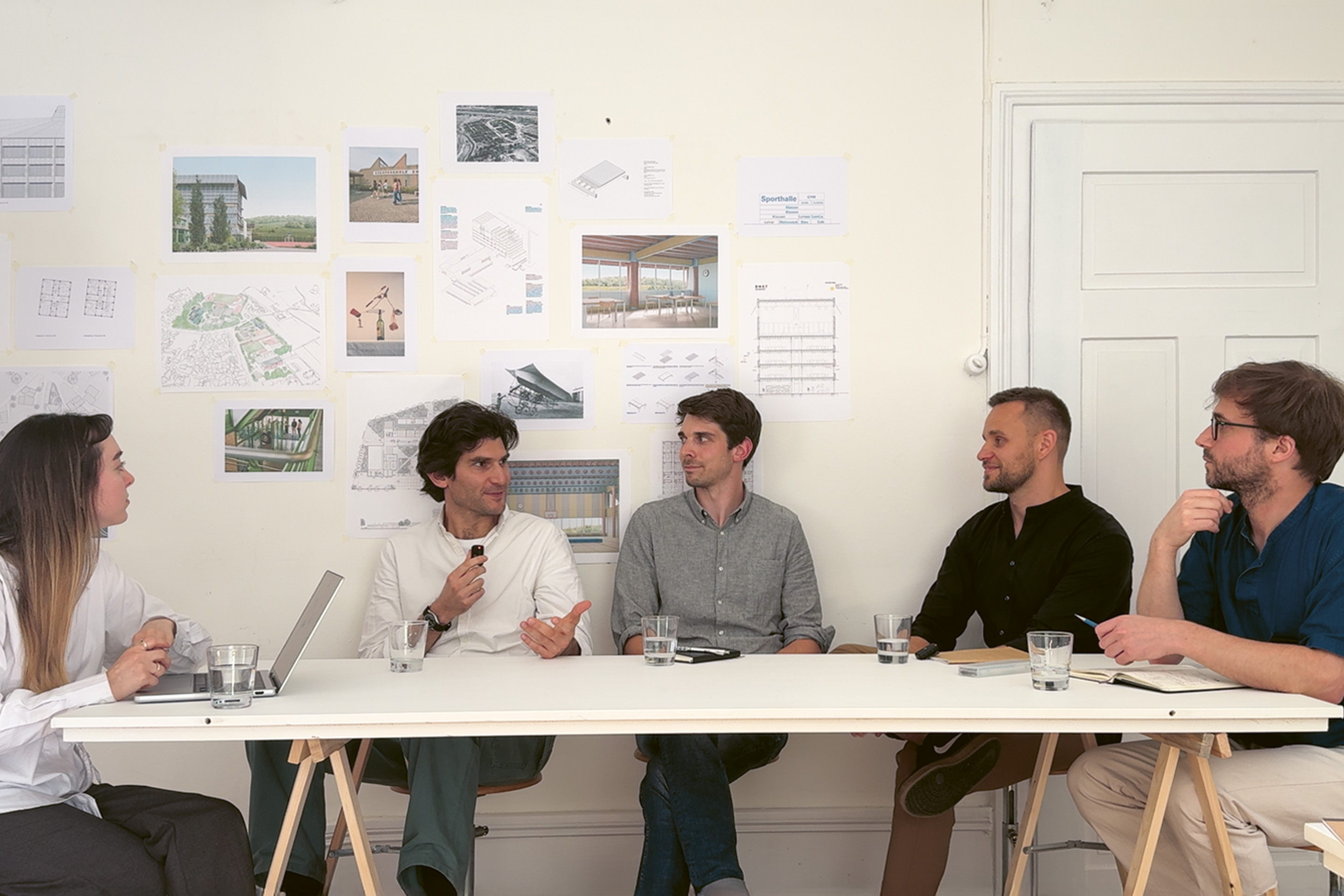
The architectural firm Nuar is based in Zurich, founded in 2024 by Adrian Kiesel, Guido Brandi, Stefan Hausherr, Marco Guerra, and Iso Tambornino. It brings together five architects from diverse educational backgrounds, spanning the ZHAW in Winterthur, the Accademia di Architettura di Mendrisio, and other academic experiences both within Switzerland and abroad. The firm is characterized by an experimental and interdisciplinary approach, coupled with a particular focus on reuse and circularity. Their practice is complemented by active engagement in university teaching and research. In 2025, the studio’s early promise was formally recognized by a nomination for Hochparterre’s Wilde Karte, marking Nuar as one of the most compelling emerging young practices in Switzerland.
On the meaning of «sustainability»
Some words expand until they lose shape. «Sustainability» is one such word: overloaded with meaning, it has become difficult to define today. In its etymology, sustinēre («to hold up», «to support»; cf. Treccani, entry «sostenere»), there is a concrete gesture, an idea of balance and endurance. Yet, in contemporary usage, the word has shifted in density: it often becomes a brand, a slogan, a promise rather than a lived practice. And yet, within it, there remains the potential for a deeper sense. For Nuar, addressing sustainability means accepting that there is no single definition, but rather a field of forces: materials and maintenance, reuse and logistics, urban density and land, costs and life cycles, the identity of places and communities. It is not an attribute to be appended at the end; it is a way of designing that determines what can change and what must endure.
During our encounter, it was natural to ask what «sustainability» truly means today. This question did not yield an immediate answer but became evident in the way the studio works and conceives architecture.
The grammar of the project
The conversation with Nuar begins with a book resting on a desk in their studio: Mein Name sei Gantenbein
by Max Frisch, a novel that often surfaces in their discussions and, in the case of the Bülach vocational school – a major competition they won in 2025 – served almost as a design reference. In that story of invented identities and parallel versions of the self, there is something that resonates profoundly with the studio’s working method. Frisch writes of a man imagining multiple lives, who does not choose a single truth but continues to test many until one begins to function.
When discussing the Bülach intervention, they explained that the book helped shape their understanding of process. Nuar approaches projects as a series of «reality variants», in which each building not only proposes a possible response but, as they explain, transforms contemporary questions ‒ urban densification, the cost of housing and energy, resource scarcity ‒ into architecture, gradually refining the initial inquiry.
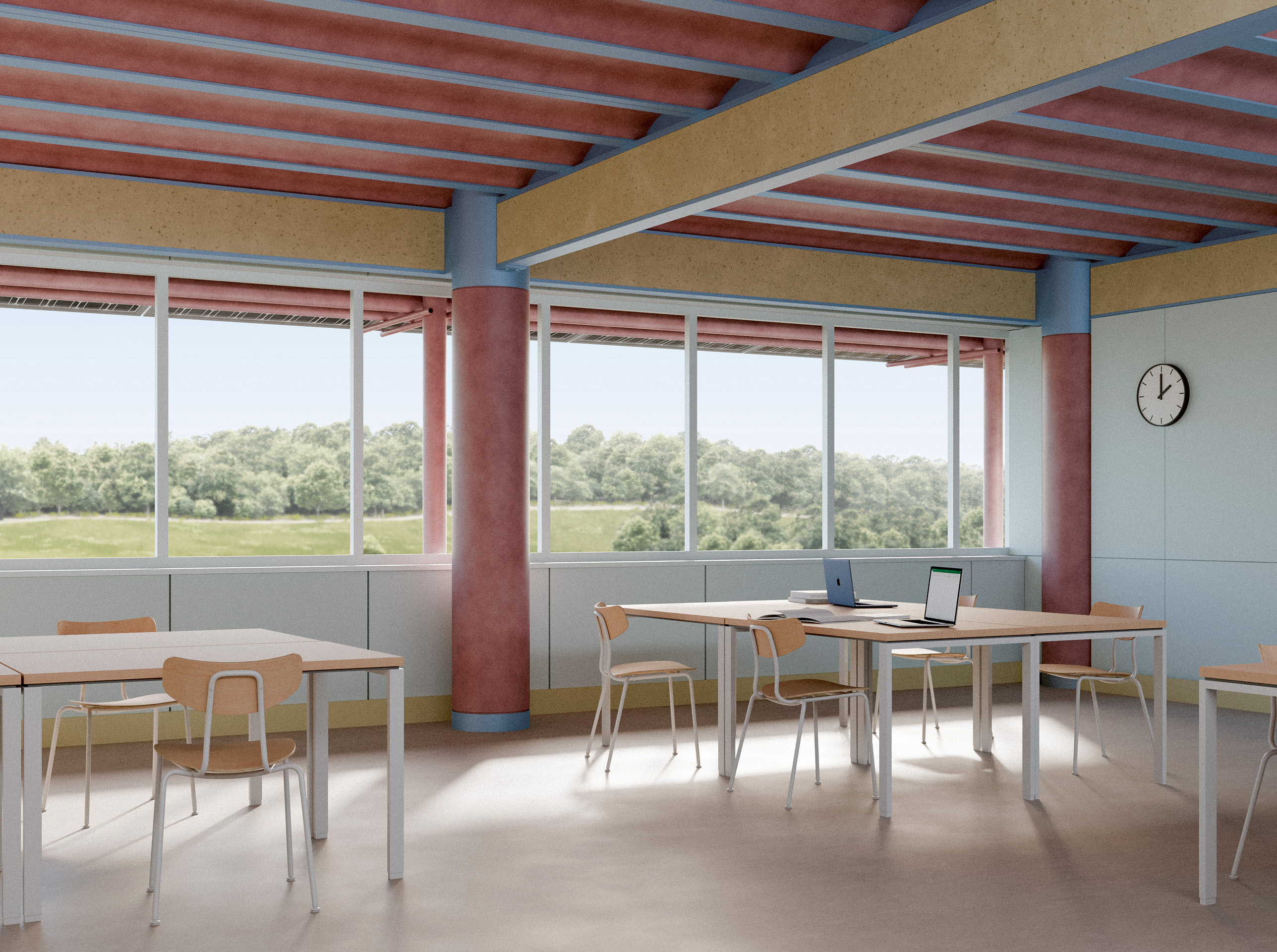
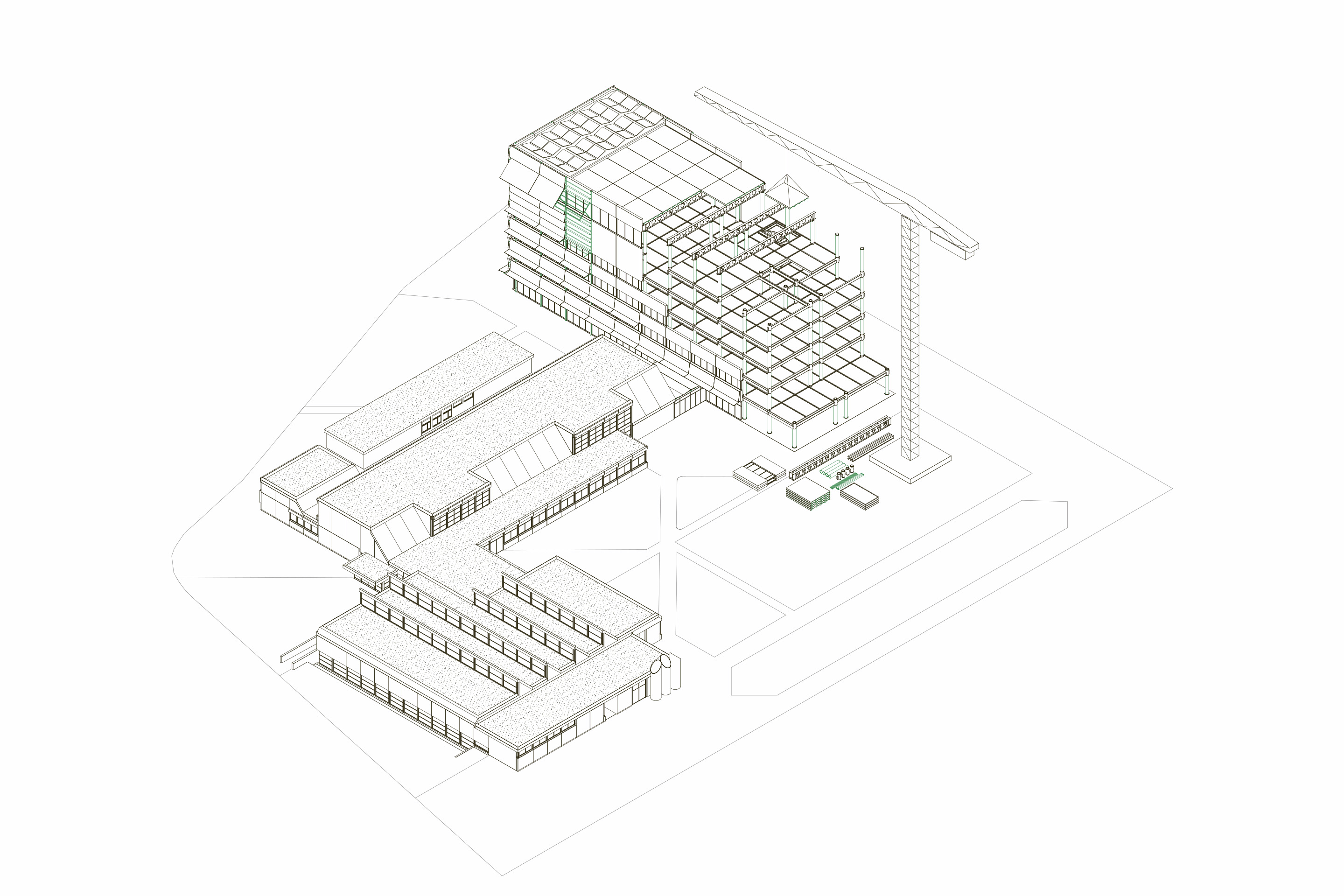
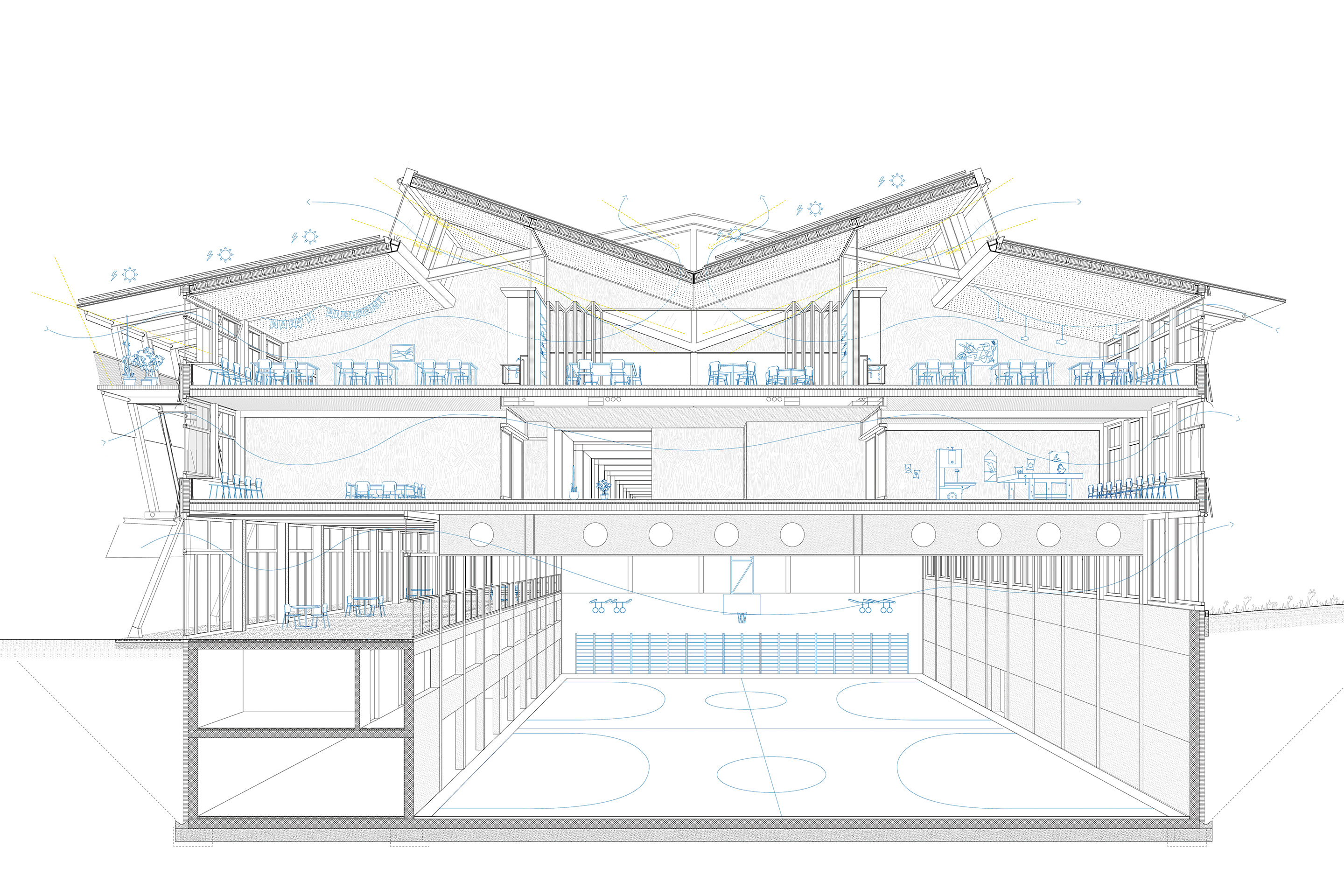
The competition called for the expansion of the school while preserving the existing building, designed in the 1970s by Claude Paillard and Peter Leemann, one of the few examples of high-tech architecture in the Canton of Zurich. With a metal frame and exposed systems, it is now protected as a building of supra-municipal interest. The brief, promoted by the Canton of Zurich’s Public Works Department on behalf of the Real Estate Office and the Education Directorate, demanded an intervention capable of engaging with this legacy, preserving the urban and spatial quality of the ensemble, while orienting it toward the future through durable and recyclable materials, prefabrication, cost and construction time reduction, CO₂ emissions minimization, and the integration of photovoltaic systems.
The founders of Nuar recount that they decided to participate as soon as they read the brief: they recognized a site suitable for their skills and sensibilities. Schools, they explain, offer an ideal context for experimentation: the clarity of programs, the scale of classrooms, and the necessity of collective spaces allow for a deeper exploration of the relationship between structure and construction, in a way that differs from residential design.
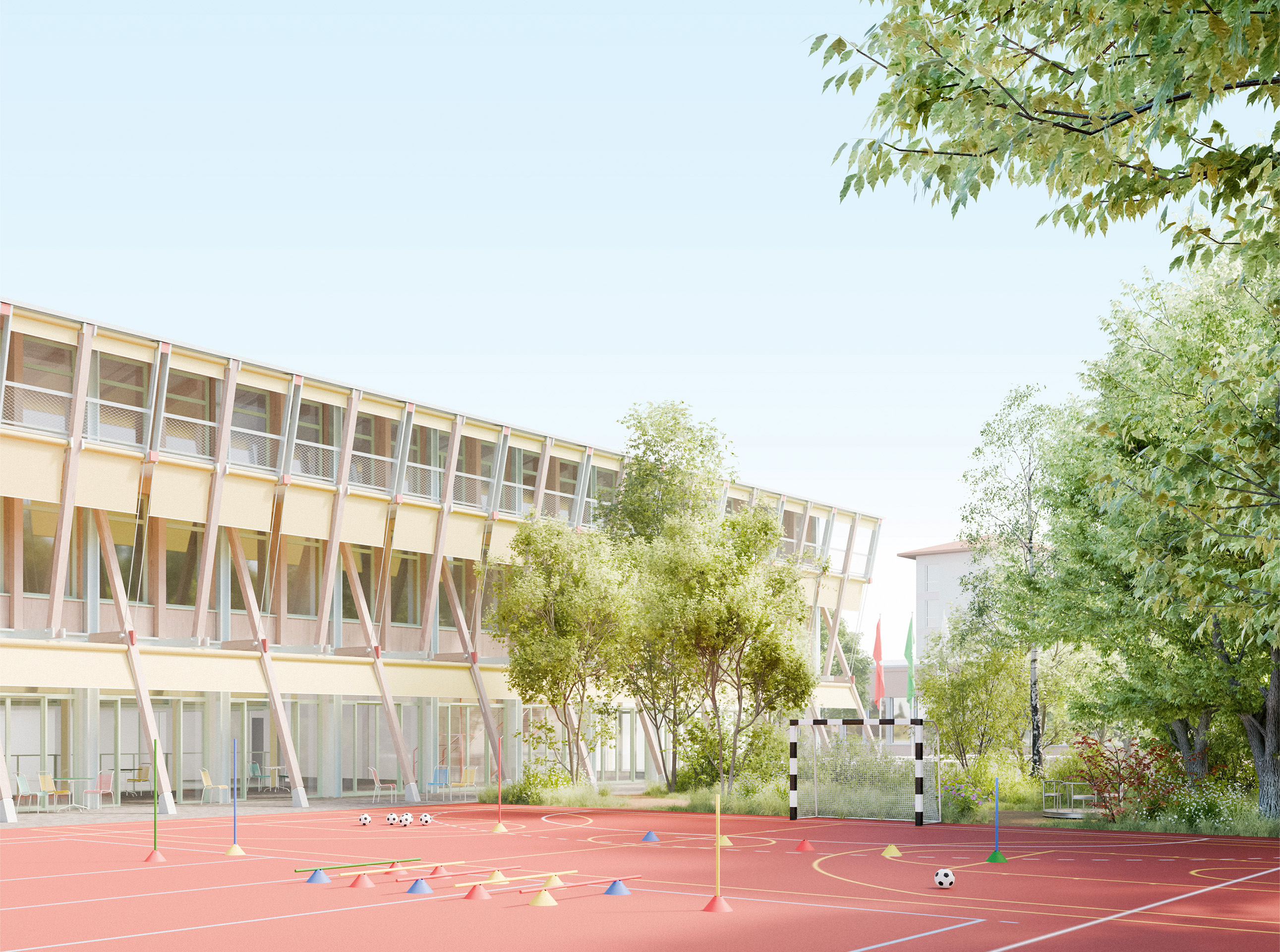
The winning project, under the motto Eine runde Sache (roughly translated «Well-Rounded»), encapsulates this approach: constructing a compact and efficient organism in which every part contributes to the balance of the whole. The new volume is inserted to the east of the existing building, transforming the horizontal spread of the complex into a denser and measured verticality. This gesture frees land and redefines the relationship with the site’s morphology. They were aware this was a risky choice, as a taller building could initially appear at odds with the horizontal character of the existing structure, yet this long-discussed decision was ultimately welcomed by the jury. They recount that, to understand the logic of Paillard and Leemann’s building, they spent extensive time redrawing it in 3D, piece by piece ‒ not to mimic it, but to discern its internal coherence. From this understanding arose the intent to use reclaimed metal elements, industrial conduit pipes, and decommissioned rails, transforming them into structure and façade: thus, alongside the desire for reuse, they found a way to restore character to the materials and honour their historical memory. This choice is linked both to ecological concerns and identity: the metal, with its traces and patina, becomes a narrative language.
The decision crystallized during a visit to the school, when the director, a former student of the same institution, recalled the smell of welding gas and molten metal in those spaces – a physical and olfactory memory that Nuar sought to preserve. In conversation, it emerges that this attitude is a constant in their method. The studio tends to build a narrative around each project: a story that intertwines the technical and human dimensions, matter and context.
However, this process does not always work, nor does it always lead to the desired outcomes. As they recount, designing means navigating a complex system, where every decision is a mediation between client demands, regulations, juries, material availability, and time. Even when briefs explicitly mention sustainability, the most coherent solutions are not always understood or accepted; at other times, pursuing it fully entails design risks or difficult-to-accept choices. It is in this margin of uncertainty ‒ between what one desires and what is possible – that the studio recognizes the most vibrant and simultaneously fragile part of its work.
The origin of an identity
The discourse on identity, intertwined at Bülach with material memory, finds its origin in the previous project for the school in Zuoz, Upper Engadine. It all begins there: the first competition the five participated in together, and the moment their design methodology took shape.
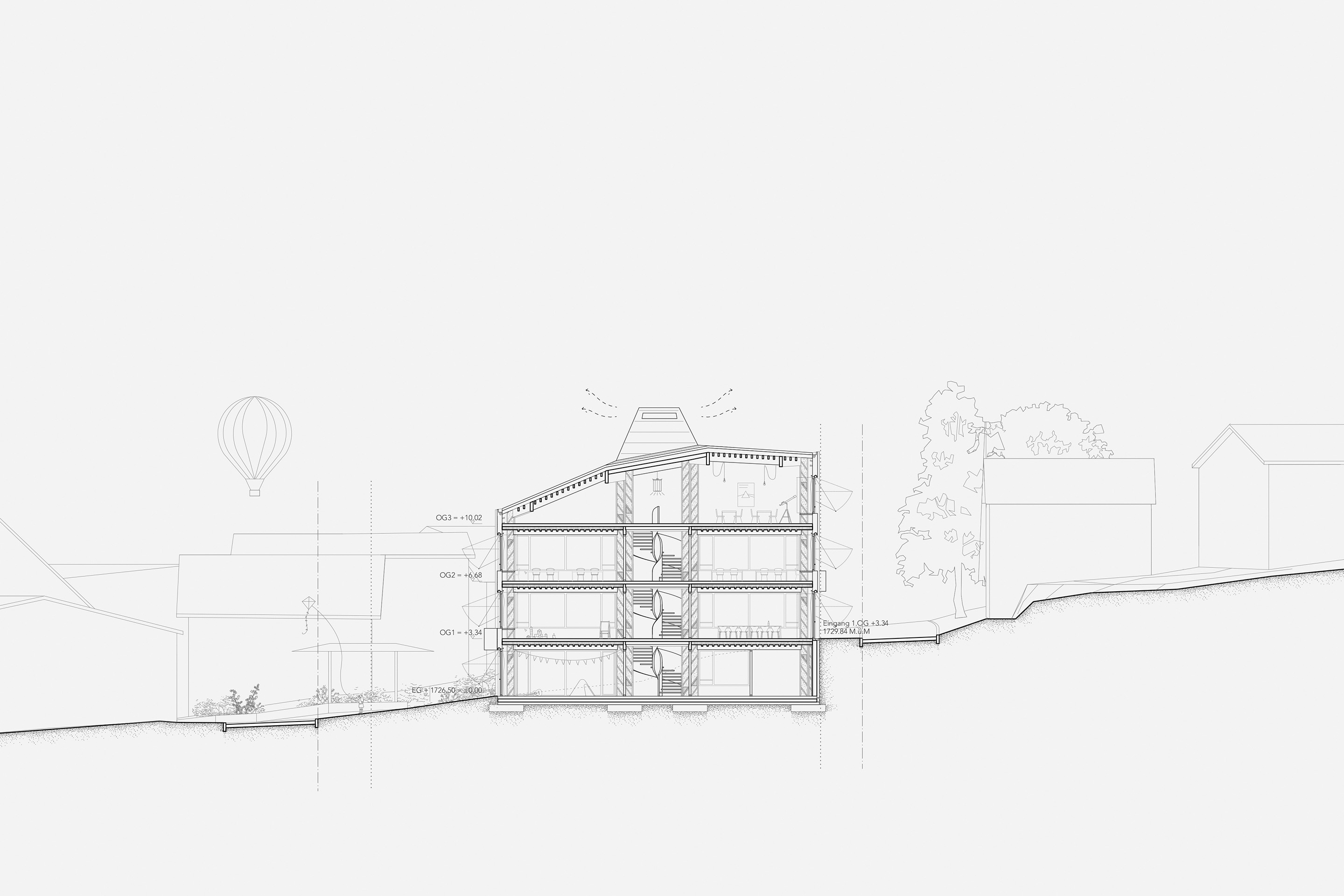
The brief, published in 2024, called for the construction of a new elementary school with a kindergarten, cafeteria, and spaces for extracurricular activities in the village centre, among houses, courtyards, and barns
The objective was a building that integrated seamlessly into the valley’s compact, stratified fabric, respecting its character and scale. Sustainability was not mentioned, but a sober, contextual, and durable architecture was sought. The architects chose to read this absence as an opportunity to experiment, bringing the ecological dimension once again to the level of process rather than image: a matter of method, construction, and material responsibility.
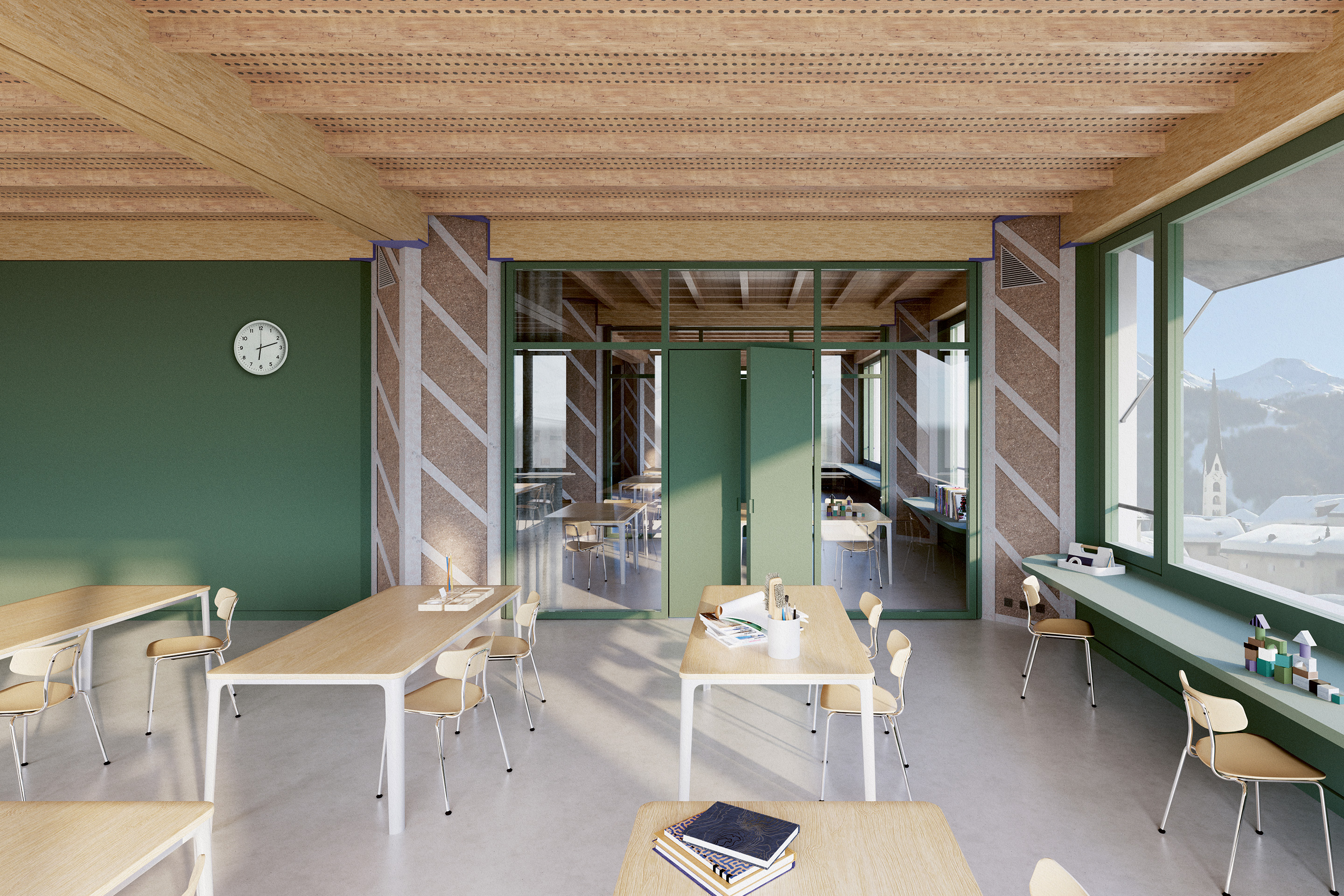
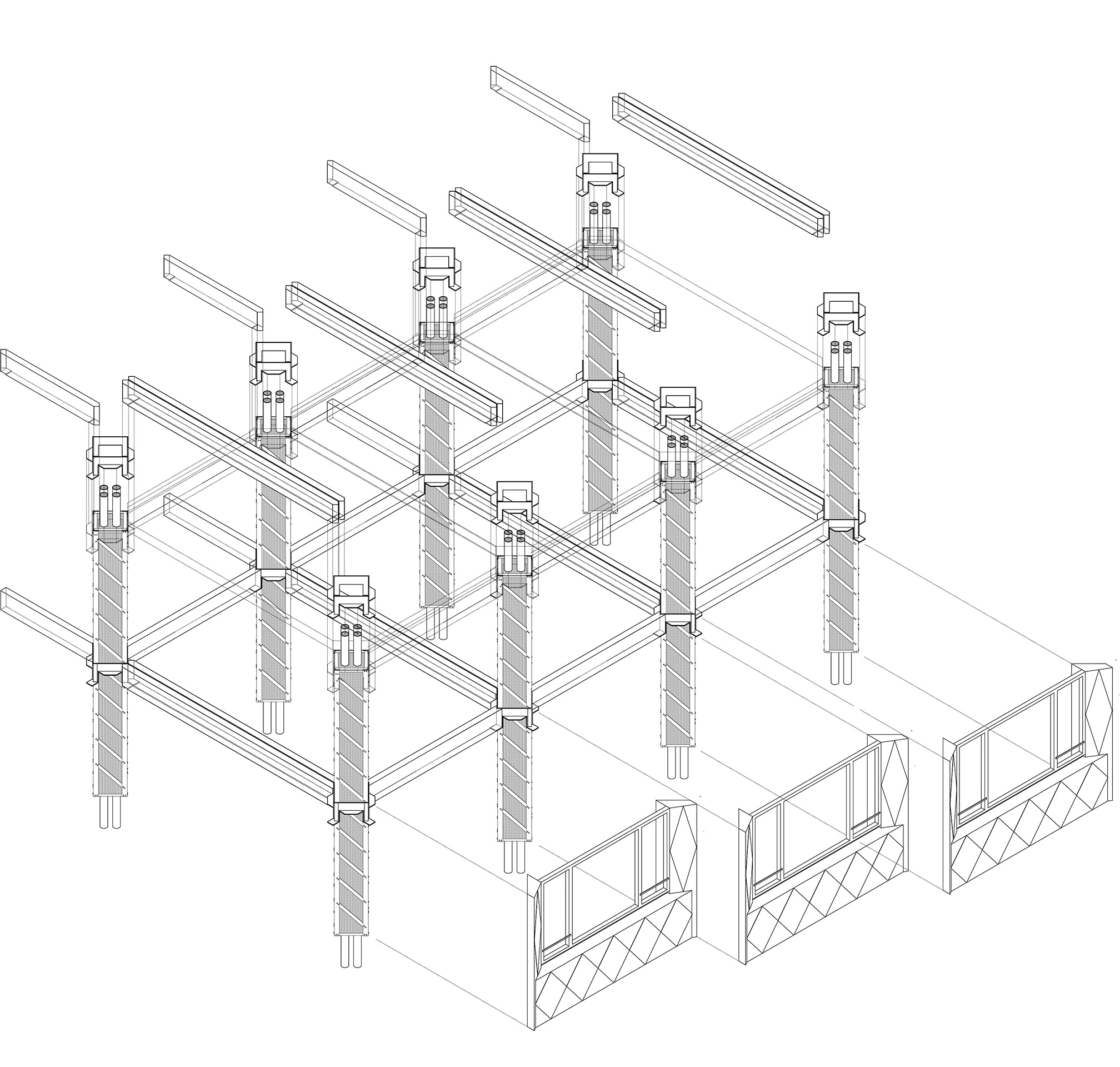
The winning project, titled Après Ski, is a compact volume set into the slope, resolving a complex topography with minimal impact on the ground. The four-story layout limits land consumption while maintaining great flexibility of use.
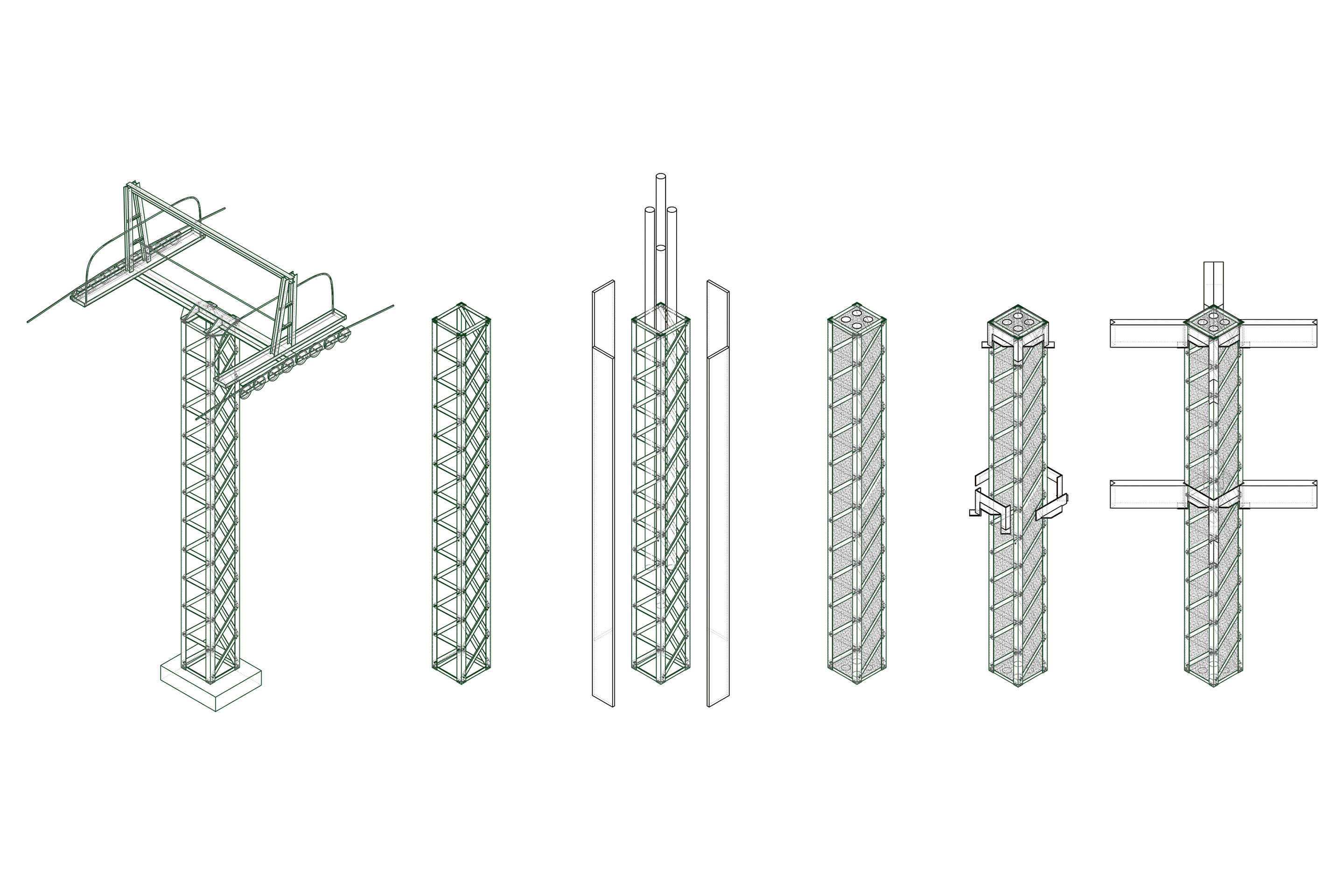
From this rational framework arose the decision to reuse metal elements from decommissioned ski lift systems, fragments of an industrial landscape now obsolete but still part of the collective memory of the Engadine. The result is twenty-four lattice truss columns embedded in the ground, rotated forty-five degrees relative to the façade line, supporting the glued laminated timber structure. The ski lift installations become the material of a new narrative, where the logic of reuse intertwines with the theme of heritage. The jury, in its final report, described the project as possessing «a quiet strength, capable of linking tradition and innovation without strain».
In the founders’ account, Après Ski marks the beginning of a method: the awareness that every building can thoughtfully interpret a set of established principles in a new and concrete way.
Between theory and practice
The academic dimension is not, for Nuar, a parallel chapter to design activity: it is integral to their working method. All studio members are active in teaching and research, and this constant dialogue between theory and practice generates a continuous movement. At the ZHAW in Winterthur, where topics related to circular construction, digitalization, and material reuse are explored, as well as at the Accademia di Architettura di Mendrisio, where relationships between structure, space, and inhabitation are examined, academic research becomes a shared experimentation platform. Reflections originating in classrooms or research labs often find application in competitions and studio projects, and vice versa: what arises in daily work returns to the university as a field of critical inquiry. This feature, common to all members, positions them as a generation of hybrid architects, capable of transforming continuous research into operational innovation.
A practice in construction
Nuar operates as a collective, privileging collaboration and rotating responsibilities. Projects are followed in pairs but always discussed by all members. If an idea does not convince the entire group, it is suspended or reformulated. This is a form of quality control but also a means to maintain an active internal critical tension. As they put it, every project must be able to represent each of the five members; otherwise, it is not yet adequate and must be reconsidered.
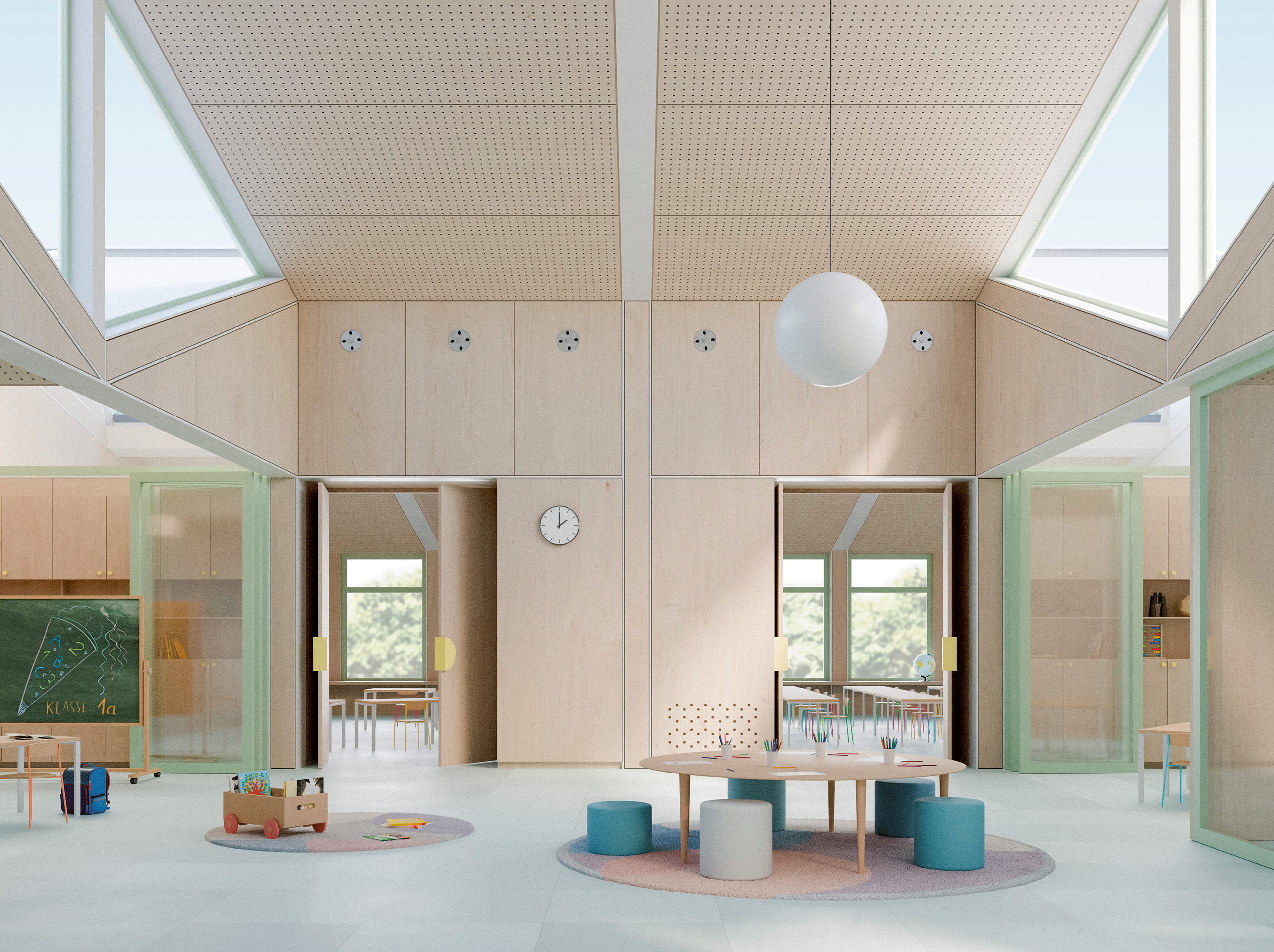
Looking ahead, they reflect on how to maintain the free and experimental spirit of their early competitions, when they felt they had nothing to lose. The challenge is to sustain this approach economically and organizationally: to build a studio that can grow without losing its elasticity, capable of preserving mutual trust and the joy of collective work. Rather than expanding rapidly, they aim to consolidate an open and inclusive approach that allows new members to join without transforming the practice into a hierarchical system. In the weeks following our conversation, Nuar won the selective competition for the new school complex at Schillerstrasse in Wil, with the project Webstuhl, securing the commission for the development phase. The project was recognized for the clarity of its layout, the quality of collective spaces, and the flexibility of use ‒ from the central foyer as a place of identity and community to the versatility of rooms ‒ demonstrating how sustainability in their work translates, first and foremost, into greater intensity and quality of daily experience.
At the end of the conversation, we lingered on the usefulness of the interview itself, its value as an exercise in awareness. They noted that thinking aloud about their work and the methodologies that support it helps them organize their thoughts and shape, once again, a shared narrative. It is a way to verify that their method remains alive and that curiosity does not wane. Ultimately, perhaps, this is their most concrete form of sustainability: continuing to ask questions, to discuss, to collectively search for the version that works, worthy of the questions of our time.
video interview at this link
Nuar: Guido Brandi, arch. MSc USI AAM, ETH MAS MTEC; Marco Guerra, arch. MSc USI AAM; Stefan
Hausherr, arch. MA. ZFH; Adrian Kiesel, arch. MA. ZFH; Iso Tambornino arch. MA. ZFH