

Circularity in future-ready design
For a sustainable built environment
Building for the future means designing buildings and infrastructure that can adapt to change without wasting resources. Future-ready and circular design reduce environmental impact, promote reuse and durability, transforming construction into a resilient and sustainable process.
Testo in italiano al seguente link
Construction and infrastructure are designed to last for decades. While this longevity is often desirable, it also exposes them to the inevitable challenge of uncertainty about how they will be used in the future. Shifts in societal needs (e.g., the growing adoption of remote work), technological advancements (e.g., the rise of e-commerce over physical retail), urban dynamics (e.g., the potential but uncertain impact of autonomous vehicles on traffic patterns), and environmental conditions (e.g., climate change) can render a construction project’s original function obsolete or inadequate over time.
This inherent uncertainty frequently leads to the need for adaptation through modifications, repurposing, or even partial demolition and reconstruction. However, any intervention in the built environment tends to have significant implications across all dimensions of sustainability: economic, social, and environmental. Costs can be substantial, impacts on communities may be considerable, and environmental impacts, such as material consumption, waste generation, and greenhouse gas (GHG) emissions, can be severe. The Swiss building industry is responsible for about one third of national GHG emissions1 and the construction and demolition is responsible for 80% of the waste in Switzerland.2
One of the key challenges in developing a sustainable built environment is that, despite operating in evolving and uncertain contexts, the adaptability of construction and infrastructure is largely determined during the design phase. This makes designing for an uncertain future a high-risk endeavour, often resulting in myopic solutions, i.e., assets that respond precisely to current conditions but fail to perform under changing circumstances.3
To address this, a twofold strategy is essential. First, construction and infrastructure should be designed to minimize the need for interventions throughout their lifespan. Second, when adaptations are required, they should be implemented in ways that limit economic costs, reduce social disruption, and minimize environmental impact.
To support these goals, two prominent and complementary research streams have recently emerged in the construction industry. The first is future-ready design (also known as strategic engineering), which explores how to optimize the initial design of long-lasting assets to reduce the effort and impact of potential future interventions, while maximizing the long-term net benefits for all stakeholders. The second is circularity, which focuses on reducing the environmental burden of interventions by promoting reuse, adaptability, and material efficiency throughout the lifecycle of the built environment.4
In fact, future-ready design and circularity integrate conceptually. Both aim to ensure that built assets remain valuable and functional for as long as possible while minimizing waste and emissions. The difference lies mainly in focus and scope: future-ready design emphasizes adaptability to external changes such as technological, climatic, or societal shifts, while circularity focuses on slowing, narrowing, closing, and regenerating material loops to extend the physical lifespan of resources within the built environment 5 Future-ready design can be seen as a strategic enabler of circularity, as designing assets that can evolve and avoid premature demolition is inherently aligned with circular thinking in the development of a sustainable built environment. In the following sections, we present an overview of recent research contributions in both fields, illustrating practical examples and outlining key directions for future investigation.
Future-ready design
Future-ready design is an emerging research domain within architecture and civil engineering that focuses on developing and evaluating design alternatives in the context of long-term uncertainty and its impact on stakeholders.
This approach involves modelling the services a construction or infrastructure must provide to all involved stakeholders and identifying and characterizing exogenous uncertainties, i.e., factors external to the asset that cannot be reliably predicted or averaged over time (such as the demographic dynamics, the price of energy or the development of new technologies). A set of design candidates are then generated to cope with these uncertainties. These design alternatives are then assessed through scenario-based simulations to evaluate their performance across a range of possible futures. The goal is to identify which design solution ensures the best performance for all stakeholders, despite the inherent uncertainty of the future. A brief overview of the key steps involved is provided below.
The process begins with modelling the service. This is a foundational step as it sets the metrics for evaluating any design proposal and it involves gaining a comprehensive understanding of how the assets is intended to function over the investigated time period. A static model of the system is then developed. This model takes the form of an objective function, i.e., a mathematical formulation of the objective of all involved stakeholders, designed to reflect how the construction or infrastructure delivers its services. The function is structured around a defined cost hierarchy and is based on utilitarian principles, capturing all economic, environmental, and social consequences of any service reduction using a common unit of measurement. This approach allows for the identification of an optimal balance between costs and benefits, while avoiding the need for weighting between different types of impacts.
The next step is the identification and characterization of exogenous uncertainties. This involves determining which parameters within the objective function could significantly influence service delivery if they were to change. These potential changes are assessed in relation to the underlying processes that may drive them. Historical data is analyzed to identify trends and detect shifts in behavior, providing a basis for exploring possible future scenarios and their likelihood. Where data is limited or inconclusive, expert judgment is used to complement and enhance the available information. Probabilistic models are then developed to estimate future values of key parameters, and these models are validated by evaluating their ability to reproduce historical outcomes (fig. 1).
With a clear understanding of the uncertainties, the focus shifts to generating design candidates. This includes defining a range of initial designs that address future readiness in different ways. These designs may be resilient, i.e., unlikely to require changes since they are designed to withstand foreseeable changes in demand (also referred to as robust); flexible, i.e., likely to need future adaptations but relatively inexpensive and easy to adjust; or responsive, i.e., able to adjust dynamically and autonomously as conditions change. Myopic designs may also be considered. While these last are optimized only for current conditions and may underperform in the long term, they offer the clear advantage of lower upfront costs. An example set of design candidate for a highway expansion is shown in figure 2.
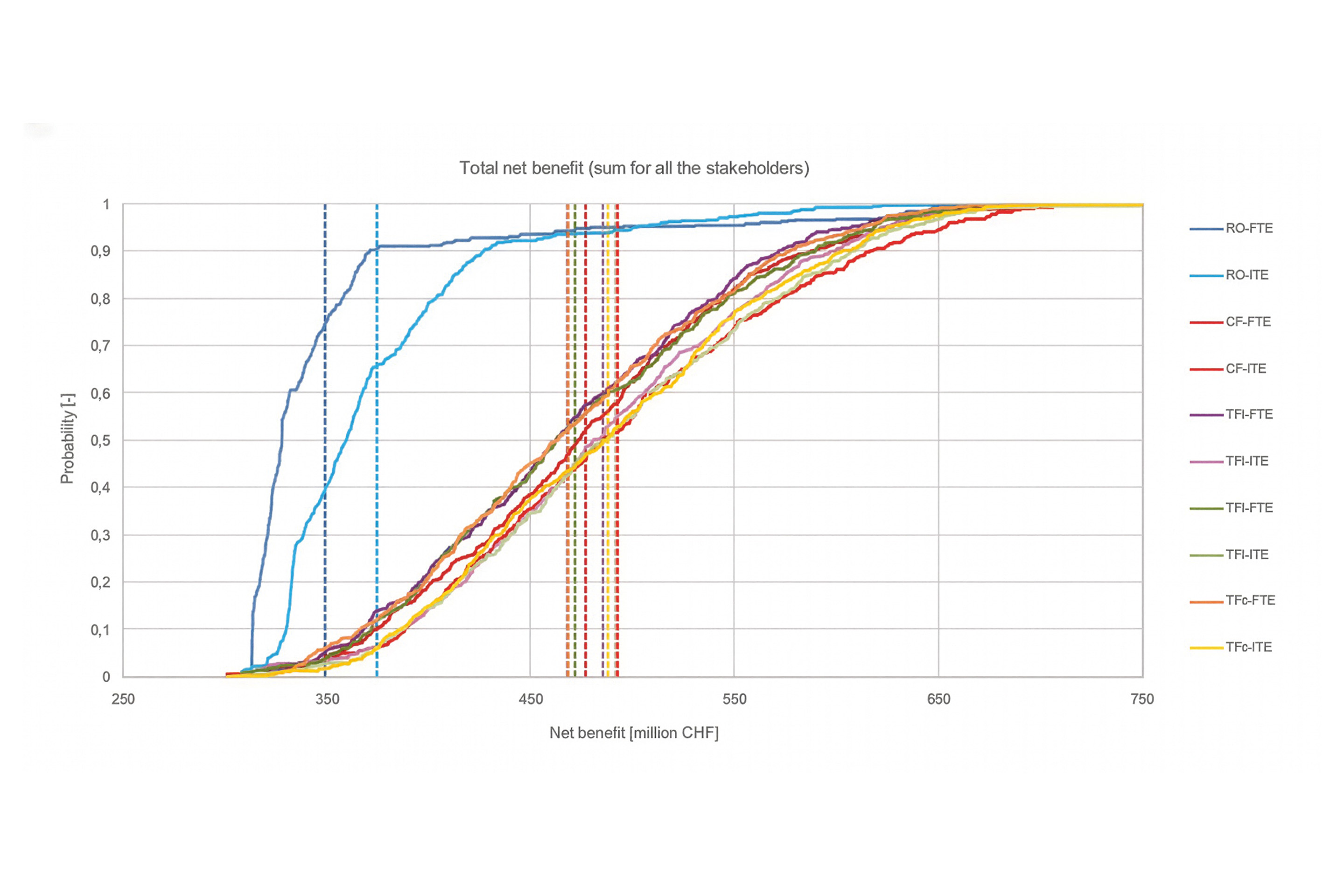
The final step is to assess these candidate designs in order to support optimal long-term decision-making for intervention on the build environment. At this stage, the static model is extended to incorporate the uncertainty modelled on the key variable parameters, taking into account their interactions and influence on the overall system. This is achieved by simulating all parameters stochastically, based on the specific uncertainties identified for each, and integrating them into a set of coherent scenarios. This approach avoids relying solely on the average or «most probable» outcome, which would risk overlooking real variations, a mistake that can lead to significant value loss in infrastructure projects.6 Within this scenario-based framework, each design alternative is evaluated to determine which provides the highest net-benefit for all stakeholders across a wide range of plausible future conditions (fig. 3).
Over the past two decades, significant efforts have been made to apply future-ready design thinking to various construction and infrastructure projects. A curated collection of notable examples is available on the Strategic Engineering website.7 This includes work on optimizing flexibility and resilience in hospitals to cope with uncertain future needs;8 in office buildings, considering potential future changes in gas and electricity prices, heating and cooling loads, and system performance,9 as well as variations in occupancy requirements.10 Similar approaches have been applied to traffic infrastructure, accounting for uncertainty in future traffic levels;11 on office buildings under uncertain future space demand;12 and on water supply systems, considering the uncertainty on water usage and availability.13 Responsiveness has also been explored in healthcare settings, such as hospitals dealing with the constant variability of patient flow,14 and in train stations, where traffic volumesfluctuates significantly between peak and off-peak hours.15
These initiatives have demonstrated considerable potential in optimizing construction and infrastructure demand in the long-term. However, few limitations still hinder the use of future-ready design principles for the optimization of designs under future uncertainty:
- Limited design alternatives from human-driven processes. Currently, the generation of design candidates relies heavily on human creativity, which inherently limits the number and diversity of possible solutions. This bottleneck can be overcome through the use of generative AI, which offers the potential to automatically generate a much larger and more targeted set of design alternatives tailored to the specific optimization problems at hand.
- Material and techniques alternatives are limited to these available form the linear economy. Evaluations of both initial designs and future adaptations are typically conducted assuming a linear logic, i.e. using new materials and components coming from productions while disposing of demolition waste. There is substantial room for improvement by integrating circular economy principles into the design process. Accounting for the long-term, system-wide benefits of these circular practices could significantly enhance the societal value of built infrastructure.
The research community is actively working to address the following key challenges. In particular the work done and under development in the domain of Circular Engineering for Architecture offers a significant contribution to cover these gaps.
Circular Engineering for Architecture
Circularity represents a renewed way of thinking about how buildings and infrastructure are conceived, designed, and managed, recalling practices that were once common before the rise of the linear, resource-intensive construction economy. Instead of treating buildings and infrastructure as static objects that eventually become waste, circular thinking views the built environment as a continuous flow of resources that can be maintained, reused, and regenerated. The goal is to move from a linear model of «take, make, use, dispose» to one that slows, narrows, closes, and regenerates resource loops.16
Circular engineering in architecture acknowledges that resources are finite, urban land is limited, and future needs are uncertain. Each design decision should therefore balance current performance with future opportunities for reuse and regeneration. For instance, using modular structures, reversible connections, and separable layers allows buildings to be adapted or dismantled with minimal effort and waste. Similarly, selecting materials that are durable or bio-based supports their longer use and their reintegration into future projects rather than disposal.
Digital technologies are central to this transition. As described in «A circular built environment in the digital age»,17 tools such as Building Information Modeling (BIM), Artificial Intelligence (AI), material passports, and data-driven design systems improve transparency, thereby enabling designers, engineers, and owners to understand where materials come from, how they are used, and where they can go next. At a larger scale, digital platforms connect projects and material stocks across cities, supporting circular strategies and reducing the demand for new raw materials, as investigated in the Innosuisse Flagship project SWIRCULAR (fig. 4).18
However, circularity is not only a technical challenge but also an organizational and cultural one. It requires rethinking the way the construction industry operates, from procurement and contracting to ownership and value creation. Business models that rely on short project cycles and low upfront costs must evolve toward longer-term stewardship, shared ownership, and service-based models such as «building as a service.» Collaboration across disciplines is essential, involving architects, engineers, clients, policymakers, and users in shared decision-making. New forms of contracts and regulations are needed to reward design choices that preserve material value and reduce environmental impact. Professionals must be able to integrate technical, economic, and social considerations and to design buildings that can evolve over time rather than become obsolete. This mindset transforms design from a one-time creative act into a process of continuous adaptation and material care.
Conclusion
Circularity complements the principles of future-ready design described earlier. While future-ready design prepares assets for uncertain external conditions, circularity ensures that these assets and their materials and systems remain valuable and in use for as long as possible. Together, they support a built environment that can adapt to change while minimizing resource consumption and environmental burden. A future-ready circular building is one that meets present needs without limiting the possibilities of future generations to reshape and reuse it.
The transition toward a circular built environment requires supportive public policies and consistent metrics. In Switzerland, circular principles are increasingly reflected in national strategies on waste reduction and resource efficiency, but further progress will depend on aligning incentives, regulations, and industry standards with long-term sustainability objectives.
The future of sustainable construction lies in designing buildings that not only withstand change but also enable it. Future-ready, circular construction means shifting from reacting to change toward designing for it.
Notes
1 Swiss Federal Office of Energy, Buildings.
2 WWF, Circularity as the new normal.
3 Martani, «Design with Uncertainty».
4 Garrido, Integrating circularity, 77-87.
5 De Wolf, «A circular built environment».
6 Savage, The Flaw of Averages.
7 strategic-engineering.co
8 De Neufville, «Using flexibility», 1–6; Esders, «Evaluating Initial Building Designs Considering Possible Future Changes: The Example of the New Pet Centre of the University Hospital of Zurich», 35–41; Esders, «Evaluating initial building designs Considering Possible Future Changes and decision flexibility: The example of the new PET Centre of the University Hospital of Zurich».
9 Martani, «A New Model for Evaluating»; Martani, «Design with Uncertainty».
10 De Neufville, Flexibility in engineering design; Martani, «Evaluating the impact», 15-40.
11 Ellingham, New generation whole-life costing; Elvarsson, «Considering automated vehicle deployment»; Martani, «Evaluating highway design», 135-155.
12 Martani, «A new process for the evaluation of the net-benefit», 156–170.
13 Adey, «Investing in water supply resilience», 104-115.
14 Suo, «A Scalable Methodology».
15 Lai. «Evaluating intelligent transport», 59-77.
16 De Wolf, «A circular built environment».
17 Ibid.
18 swircular.ethz.ch
References
– Adey, Bryan T., Claudio Martani, & Jürgen Hackl. «Investing in water supply resilience considering uncertainty and management flexibility». Proceedings of the Institution of Civil Engineers – Smart Infrastructure and Construction 175(3), 2022.
– De Neufville, Richard, Yun S. Lee, & Stefan Scholtes. «Using flexibility to improve value-for-money in hospital infrastructure investments». First International Conference on Infrastructure Systems and Services: Building Networks for a Brighter Future, INFRA 2008.
– De Neufville, Richard, & Stefan Scholtes. Flexibility in engineering design. MIT Press, 2011.
– De Wolf, Catherine, Sultan Çetin, & Nancy M. P. Bocken. «A circular built environment in the digital age». Springer Nature. (2024) https://doi.org/10.1007/978-3-031-39675-5.
– Ellingham, Ian, & William Fawcett. New generation whole-life costing: Property and construction decision-making under uncertainty. Routledge, 2007.
– Elvarsson, Arnór B., Claudio Martani, & Bryan. T. Adey. «Considering automated vehicle deployment uncertainty in the design of optimal parking garages using real options». Journal of Building Engineering 34(1), (2021): 101703.
– Esders, Miriam, Bryan T. Adey, & Claudio Martani. «Evaluating Initial Building Designs Considering Possible Future Changes: The Example of the New Pet Centre of the University Hospital of Zurich». In International Conference on Smart Infrastructure and Construction 2019 (ICSIC). ICE Publishing. (2019)https://doi.org/10.1680/icsic.64669.035.
– Esders, Miriam, Claudio Martani, & Bryan T. Adey. «Evaluating initial building designs Considering Possible Future Changes and decision flexibility: The example of the new PET Centre of the University Hospital of Zurich». In International Journal of Architecture, Engineering and Construction 9(4), (2020). 12020021.
– Garrido, Juan Pablo, Claudio Martani, Nazly Atta, Cinzia Talamo, & Giancarlo Paganin. «Integrating circularity in the design of future-proof retail spaces». In CIB Conferences, 2025.
– Lai, Bryan M.L., Claudio Martani, Orlando M. Roman Garcia, & Bryan T. Adey. «Evaluating intelligent transport systems for multiple stakeholders and considering future uncertainty: a simulation-based cost-benefit analysis of responsive gateways at the London Bridge Station». Infrastructure Asset Management 11(2), 2024.
– Martani, Claudio, Laurent Cattarinussi, & Bryan T. Adey. «A new process for the evaluation of the net-benefit of flexible ground-floor ceiling in the face of use transition uncertainty». Journal of Building Engineering 15, 2018.
– Martani, Claudio, Steven Eberle, & Bryan T. Adey. «Evaluating highway design considering uncertain mobility patterns and decision flexibility». Infrastructure Asset Management 9(3), 2022.
– Martani, Claudio, Ying Jin, Kenichi Soga, & Stefan Scholtes. «A New Model for Evaluating the Future Options of Integrating Ground Source Heat Pumps in Building Construction». International Symposium for Next Generation Infrastructure, 2015.
– Martani, Claudio, Ying Jin, Kenichi Soga, & Stefan Scholtes. «Design with Uncertainty: The Role of Future Options for Infrastructure Integration». Computer-Aided Civil and Infrastructure Engineering, 31(10), (2016) https://doi.org/10.1111/mice.12214
– Martani, Claudio, Noemi Fiorot, Andrea González, Bryan T. Adey, & Joris Van Wezemael. «Evaluating the impact of flexible offices in coping with the uncertainty in future demand». Infrastructure Asset Management 11(1), 2024.
– Savage, Sam L., & Harry M. Markowitz. The Flaw of Averages: Why We Underestimate Risk in the Face of Uncertainty. John Wiley & Sons, 2012.
– Suo, Jiaqi, Claudio Martani, Timothy B. Lescun, & Cherri A. Krug . «A Scalable Methodology for Optimizing Hospital Surgical Schedules Considering Efficiency, Flexibility, and Improved Patient Outcomes». Healthcare Analytics, 2025. 100413.
Online References
– «Buildings» Swiss Federal Office of Energy, Bern www.bfe.admin.ch/bfe/en/home/efficiency/buildings.html/
– «Circularity as the new normal. Future fitting Swiss Businesses» WWF, www.wwf.ch/sites/default/files/doc-2021-01/Circularity-as-the-newnormal_whitepaper-EN.pdf
– «Strategic Engineering», strategic-engineering.co
– «Swircular» Eidgenössische Technische Hochschule, Zürich https://swircular.ethz.ch/