Conclaves and laypeople – participation and transparency in competitions
“Opening the black box”
Gabriela Marcovecchio believes in competitions — but only if they are made more open. As the organiser of two innovative processes involving Place de la Riponne and Place du Tunnel, she describes two ways to achieve this: citizen participation and public jury deliberation.

Almost 150 years ago, at a time when transparency and fairness were lacking, the SIA introduced its first regulation — a ten-point framework designed to govern competitions, particularly for major public commissions. Today, competitive procedures are largely standardised, although a few institutional contracting authorities remain reluctant to adopt them. However, society has changed profoundly, and with it, expectations about how these processes should unfold. New aspirations are emerging, particularly in relation to participatory democracy, prompting a rethinking of competition procedures. These must now open up to better integrate citizen concerns — from the drafting of the brief to the site selection stage.
A thirty-year-old idea
As early as 1993, the SIA proposed in a guideline several ways to bring laypeople closer to the decision-making bodies of experts1 and to increase transparency in project selection. Yet despite three decades of existence and regular revisions, the guideline on public involvement in competitions has been little used — particularly in French-speaking Switzerland. Until the late 2010s, only a few pioneering initiatives attempted to link citizen participation with the search for architectural, landscape, or urban planning solutions — notably those led by housing cooperatives or by cities working on emblematic public space projects. One well-known example is the public jury for Place du Marché in Renens, held in 2007. These processes were often driven by commendable intentions, but at times they came close to breaching the fundamental principles that guarantee the anonymity and confidentiality of proposals until the winning project is selected.
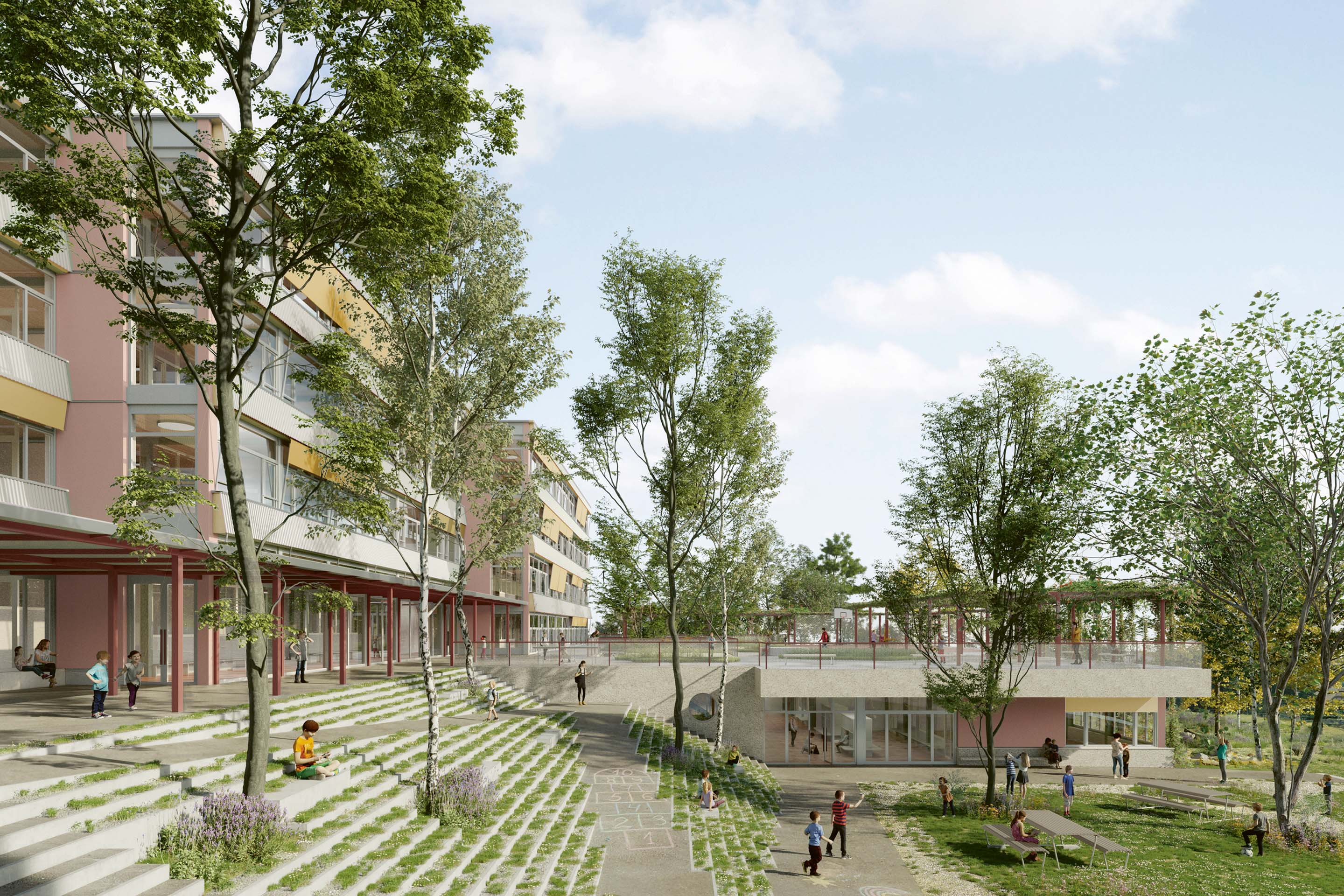
In German-speaking Switzerland, public involvement was more common — notably in Basel and Zurich — especially for community facility projects. The Freilager neighbourhood school in Zurich, for example, benefited from a public jury in 2017, which helped raise awareness among stakeholders and the broader community of the educational model proposed through its architecture. Today, however, those same contracting authorities seem to prefer retaining the option of fine-tuning their choices by asking the teams to go a little further (!) during a final stage of refinement. For practical reasons — and to preserve the confidentiality of the projects — this requirement makes it impossible to open jury deliberations to a public audience.
In Lausanne, in 2010, the competition for the Plaines-du-Loup site (an SIA 142 urban planning procedure) inaugurated a participatory approach through its “1000 et une idées!” initiative. Jean-Bernard Racine, professor of geography at UNIL and expert advisor, was appointed to represent the participatory process. He carried out this role by conducting an in-depth analysis of the submissions, in particular through a close reading of the proposals, before presenting his assessment to the jury. In 2016, another SIA 142 competition — this time for the public spaces of the Sous-Gare neighbourhood in Lausanne — went a step further by involving target groups, notably station users, through surveys and interviews, as well as shopkeepers, residents, and children in workshops designed to inform the competition brief and prepare the two public representatives sitting on the jury.
Opening the black box
“Opening the black box of competitions to the public” was a key concern for the City of Lausanne, which in 2018 turned to the SIA to reflect together on appropriate procedures for the competition for Place de la Riponne — a major public space, yet often unloved, and deserving of broad consultation rather than a standard competition format. In the background, the inevitable question arose: what is the legitimacy of a professional and closed decision-making body tasked with ultimately recommending the implementation of a project? How can its choices be justified — to the legislative body responsible for approving the implementation credit, and above all to the public, the primary party concerned with the use of the redeveloped site?
In 2019, continuing this political objective of openness, the City of Lausanne allocated the necessary resources — in terms of both time and funding — to make full use of the SIA’s guideline. It launched an ambitious participatory process, in which the competition served merely as the framework for the professionals’ expression.
During the SIA 142 ideas competition for Place de la Riponne and Place du Tunnel, the possibilities for citizen involvement were fully explored — before, during, and after the competition. Indeed, the involvement of “laypeople” — in reality, experts in use — was significant: a broader citizen group followed the activities throughout the participatory process. In total, 16 people representing user perspectives were trained2 to analyse the 34 submissions and present their views to the jury. During the jury deliberations, three people represented this citizen group. On a Saturday in December, 500 people attended the final deliberations of the jury at the Palais de Beaulieu, where the winning project was selected and the awarded entries ranked.
This model was later adopted in 2022 for the project competition concerning the redevelopment of Place du Tunnel, as well as for the parallel study mandates (MEP) for Place de la Riponne, where the public was once again able to attend the final dialogue. Unlike the initial ideas competition, these two procedures aimed at awarding execution contracts.
This experience has been recognised abroad3, and many of the lessons learned were incorporated into the practical guide La participation citoyenne dans les concours, mandats d’étude parallèles et études-test, published in 2021 by the Canton of Geneva4. The guide provides methodological guidelines to support resident participation in competitions, test planning procedures, and parallel study mandates (MEPs). These guidelines are structured in clear tables aligned with the key stages of competitive procedures as practised in Switzerland. Each is illustrated with recent examples from French-speaking Switzerland.
Transparent boxes
With user expertise and public deliberation, the black box is finally being opened, offering tangible proof that citizen participation in competitions can be implemented in a serious and structured way. Feedback from participants has been largely positive, although some criticism persists, describing these approaches as political publicity stunts. The Riponne–Tunnel and Place du Tunnel competitions confirm a growing aspiration for more transparent and inclusive processes. These are approaches in which public participation and attention to diverse needs foster decisions grounded in people’s everyday reality. The professional community is also closely following the jury’s debates, which continue to inform — and even challenge — its practices. The jury itself emerged from the process with greater awareness.
In an era when advocacy for a high-quality built environment is gaining momentum, opening up competition procedures represents a powerful lever for strengthening collective ownership of ideas, projects, and even new spatialities, forms, and uses. By making jury deliberations transparent and sharing its detailed reasoning along with a rigorous evaluation of the proposals, the process highlights the competence and integrity of its members.
This transparency gives communities the opportunity to actively participate in shaping their environment, improving their (public) spaces, and strengthening identity and social ties. In return, such an approach may also have a positive impact on project acceptance — though this can only be assessed after the public inquiry phase.
Gabriela Marcovecchio is an architect (FADU), an urban planner (FSU), and holds a MAS from the University of Lausanne. Since 2010, she has regularly organised SIA-endorsed competition procedures, including the Riponne–Tunnel ideas competition and the project competition for Place du Tunnel, both for the City of Lausanne. She is co-author of the guide “La participation citoyenne dans les concours, mandats d’étude parallèles et études-test”, published by the Canton of Geneva, co-founder of the association LE CONCOURS SUISSE, and a member of both the femme et sia network and LARES.
Notes
1. SIA 142i‐402f Public involvement, Guidelines for SIA 142 and SIA 143 regulations. SIA 142/143 Commission Competitions and parallel study mandates. Available free of charge at shop.sia.ch
2. The City of Lausanne published the Guide de l'expertise d'usage (Guide to Expertise) for the Riponne\Tunnel ideas competition. It has been updated twice, for the SIA 142 Place du Tunnel competition and the MEP SIA 143 Place de la Riponne competition. It is available for download from the City of Lausanne website.
3. As a member of the jury for the SIA 142 Riponne/Tunnel ideas competition, French urban planner Ariella Masboungi wrote the article, “The Swiss originality of public competitions: dialogue, duration, expertise, and uses at the center!” Innovapresse, September 2021. She also invited a Swiss delegation, including the mayor of Lausanne, Grégoire Junod, and the jury president, Pierre Feddersen, to present this approach at the Urban Projects Forum in Lyon in 2021. In addition, a section of the exhibition Le Concours Suisse is dedicated to the Riponne\Tunnel ideas competition. This exhibition has been presented in several cities, including Rio de Janeiro (UIA 2021), Geneva, Lausanne, Biel, Fribourg, Sion, Singapore, and Copenhagen (UIA 2024).
4. Available for download from the website 3ddge.ch
Riponne\Tunnel ideas competition and Tunnel project competition. Judging process open to the public
SIA requirements:
- Preservation of participant anonymity throughout the process.
- Composition of the jury in accordance with the rules, ensuring competent and impartial judging.
- Prior identification of any conflicts of interest between jury members and participants.
- No direct communication between the jury and participants before the final decision.
Implementation by the City of Lausanne:
- After an initial closed-door session, the jury will present the shortlisted projects to the public.
- Separation of spaces: one room reserved for the audience and a separate room for the jury's deliberations. The project boards will be displayed in both rooms. The site model and the collection of texts produced by the participants are also made available to the public.
- Deliberations: the jury will retire to its dedicated room to deliberate.
- Broadcasting: cameras and microphones in the jury room, live broadcast via screens and loudspeakers in the public room.
- Transparency: live broadcast of the jury's discussions until the final ranking of the projects and the announcement of the winner.
- Lifting of anonymity: the jury returns to the public room to reveal the identities of the project authors, followed by a convivial aperitif to close the day.